







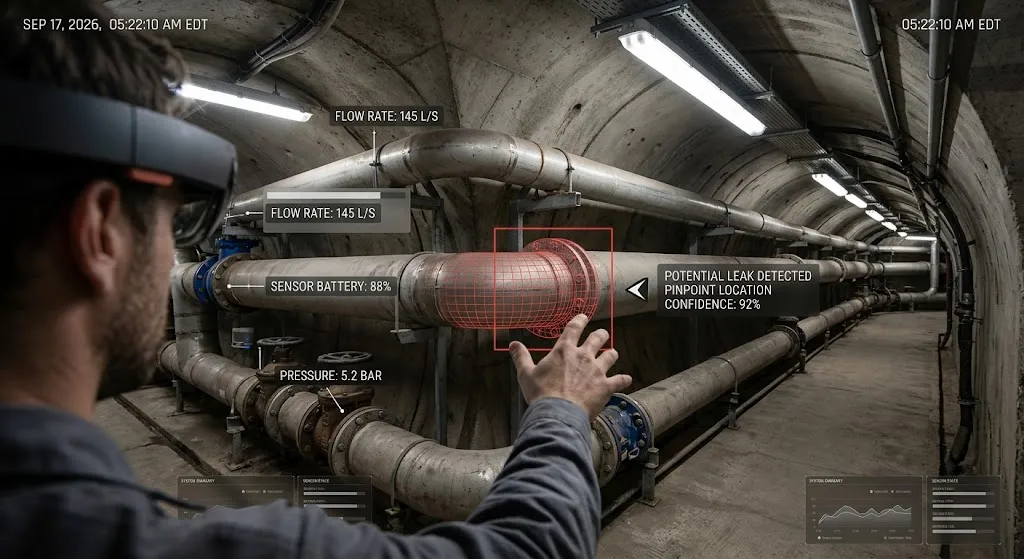
Why Pipe Leaks and Bursts Are Becoming a Digital Water Challenge
A water distribution network can look perfectly healthy from above ground while losing significant amounts of water underground.
That is one of the biggest challenges facing modern water utilities.
Pipe leaks and bursts are not always dramatic events. A major pipe failure is easy to notice because streets flood, pressure drops and customers lose service. Smaller leaks can be far more difficult to identify. They may continue for months or even years before becoming visible.
This is where Digital Water is changing the way utilities think about water loss.
Instead of relying exclusively on customer complaints, field inspections or emergency repairs, utilities can combine smart meters, pressure sensors, flow monitoring, SCADA systems, geographic information systems (GIS), analytics and artificial intelligence to understand what is happening inside the network.
The goal is not simply to find a leak faster.
The bigger opportunity is to understand where losses are occurring, why they are occurring and which intervention will create the greatest operational value.
The International Water Association (IWA) describes Digital Water as an important pathway toward the wider adoption and integration of digital technologies across water services. Its Digital Water Programme brings together utilities, technology providers, researchers and water professionals around practical digital transformation.
For utilities managing aging infrastructure, rising energy costs and growing expectations for service reliability, that shift is becoming increasingly important.
From Reactive Repairs to Digital Water Management
For decades, water loss management followed a relatively straightforward pattern:
A pipe fails → someone reports it → the utility investigates → the pipe is repaired.
The problem is that this approach is inherently reactive.
By the time a visible leak appears, substantial amounts of treated water may already have been lost. And when a buried pipe bursts, the cost is not limited to the lost water. Utilities may also face emergency excavation, traffic disruption, customer complaints, infrastructure damage and unplanned maintenance.
A Digital Water approach changes the question.
Instead of asking:
“Where did the pipe fail?”
utilities can increasingly ask:
“Where is the network behaving differently from what we would normally expect?”
That distinction matters.
Digital Water systems can bring together information from multiple sources, including:
- Flow meters
- Smart water meters
- Pressure sensors
- Pumping stations
- SCADA systems
- GIS platforms
- Customer consumption data
- Historical maintenance records
- Pipeline condition assessments
- Weather and demand information
When these datasets are connected, unusual patterns can become easier to identify.
A sudden overnight flow increase in one district, for example, may indicate a hidden leak. A gradual pressure decline may indicate deterioration somewhere in the network. Repeated failures in the same pipeline corridor may point toward a deeper asset-management problem rather than isolated incidents.
This is the real value of Digital Water: turning fragmented operational data into actionable network intelligence.
Understanding Water Loss and Non-Revenue Water
Water loss is broader than a single leaking pipe.
Utilities commonly distinguish between physical losses and apparent losses. Physical losses include water escaping from pipes, tanks and other infrastructure, while apparent losses can involve inaccurate metering, billing issues or unauthorized consumption.
Together, these factors contribute to non-revenue water (NRW).
The American Water Works Association (AWWA) provides industry resources for water loss control and water auditing, including its Free Water Audit Software. The latest version, v6.1, also incorporates carbon calculations related to leakage emissions.
That development highlights an important change in how water loss is being evaluated.
Water loss is no longer simply a question of:
“How much water are we losing?”
It is increasingly connected to:
“How much energy, money and carbon are associated with that loss?”
Every cubic metre of treated water requires resources to abstract, treat, pump and distribute. When water is lost before reaching the customer, much of that energy investment has effectively been wasted.
Why NRW deserves a Digital Water strategy
A structured water-loss programme can help utilities:
- Establish a reliable water balance
- Identify high-loss areas
- Prioritize leak detection
- Monitor pressure conditions
- Improve meter accuracy
- Reduce unnecessary pumping
- Prioritize pipeline rehabilitation
- Improve maintenance planning
- Measure the results of interventions
A water audit is therefore not simply an accounting exercise.
It can become the starting point for a broader Digital Water and asset-management strategy.
How Digital Water Detects Hidden Pipe Leaks
The most difficult leaks are often the ones nobody can see.
A buried distribution pipe can develop a small opening that releases water continuously without immediately causing surface flooding. Traditional inspection methods may struggle to identify such failures efficiently across large networks.
Digital Water technologies provide a different approach.
4.1 Flow monitoring
Flow data can reveal discrepancies between expected and actual network behaviour.
If consumption follows a relatively predictable pattern but minimum night flow suddenly increases, the utility may have a reason to investigate.
This does not automatically prove that a leak exists.
But it can identify where further investigation is justified.
4.2 Pressure monitoring
Pressure is another critical indicator.
A distribution network operating outside its expected pressure range may experience increased leakage risk or service problems. EPA guidance highlights pressure management as an important component of drinking water distribution system operation, including its relationship with water losses, main breaks and energy efficiency.
4.3 Acoustic leak detection
Acoustic technologies can identify characteristic sounds generated by water escaping through a pipe opening.
These technologies can be particularly valuable when the leak is underground and has not yet produced visible evidence.
4.4 Data analytics
The real advantage comes when these technologies work together.
A sensor alone generates data.
A connected Digital Water platform can help interpret that data.
For example:
Flow anomaly + pressure change + historical failure location = higher-priority investigation area.
That is a much more useful output for an operations team than thousands of isolated sensor readings.
Drinking Water Distribution System Tools and Resources | US EPA provides further technical resources covering water losses, main breaks, pressure management and distribution-system risks.
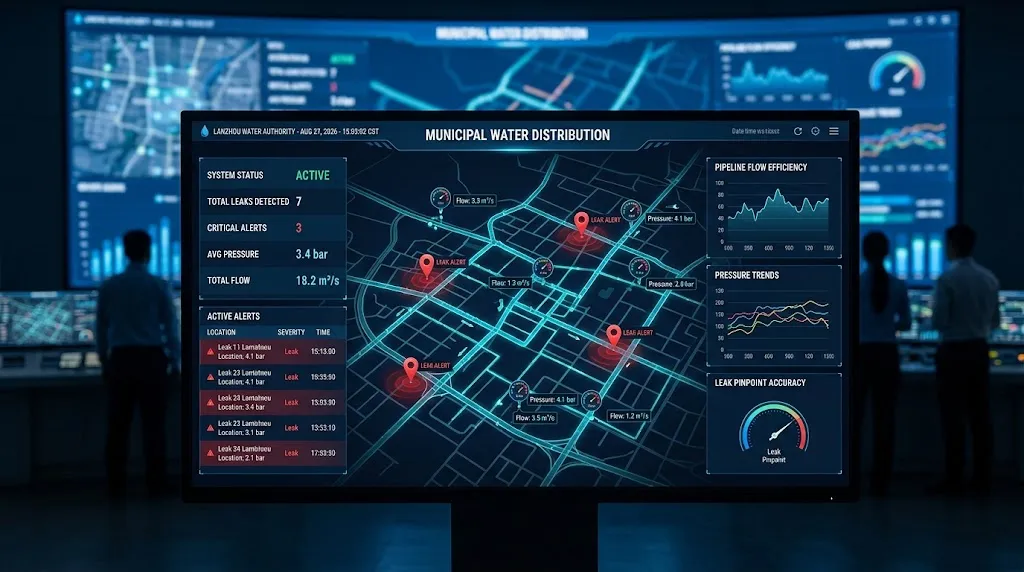
Smart Meters, DMAs and Network Monitoring
One of the most effective ways to make a large water network manageable is to divide it into smaller, measurable areas.
These are often known as District Metered Areas (DMAs).
A DMA can contain a defined group of customers and network assets where inflow, consumption and pressure can be monitored.
Why does this matter?
Imagine trying to locate a leak somewhere across a city-wide network.
That is a very different problem from investigating a potential leak inside one defined district.
DMA-based monitoring can narrow the search area and allow utilities to compare:
- Water entering the district
- Customer consumption
- Minimum night flow
- Pressure
- Historical leakage
- Previous repair records
This approach also works particularly well with smart meters.
Smart meters can provide more frequent consumption information than traditional manual meter-reading processes. When connected to a broader Digital Water platform, the resulting data can help utilities identify unusual consumption patterns and improve network visibility.
The value isn’t simply “more data.”
The value is better localization of problems.
A 2024 Xylem case article describes European utility applications involving smart metering, DMAs, network monitoring and analytics to address water loss. Its examples include the use of DMAs to help identify loss areas and pipeline inspection technologies to locate hidden leaks.
For FLOWTECH CHINA readers, the broader lesson is more important than any individual technology:
Digital Water works best when measurement, network segmentation and decision-making are designed as one system.
Pressure Management: The Missing Link in Leak Reduction
Leak detection receives a lot of attention.
Pressure management often receives less.
Yet the two are closely connected.
A water network needs sufficient pressure to provide reliable service. Excessive or poorly controlled pressure, however, can increase stress on aging infrastructure and contribute to leakage and failures.
This creates an important Digital Water opportunity.
Instead of treating pressure as a static engineering parameter, utilities can monitor it dynamically.
Consider a network where demand changes throughout the day.
At 3 a.m., consumption may be low.
At 8 a.m., demand may rise sharply.
During a fire event or major industrial demand period, conditions can change again.
Digital Water systems can help operators understand these changing conditions and identify areas where pressure control may need to be improved.
Pressure management can support:
- Leakage reduction
- Lower burst risk
- Better service reliability
- Pump optimization
- Energy efficiency
- Longer asset life
The most sophisticated approach therefore connects pressure management, leak detection and asset management rather than treating them as separate projects.
AI and Predictive Maintenance for Water Networks
Once utilities have sensors and operational data, another question appears:
What should they do with all that information?
This is where artificial intelligence and machine learning are becoming increasingly relevant.
The objective isn’t to replace engineers.
It is to help engineers identify patterns that are difficult to detect manually.
The IWA has specifically examined AI applications in the water sector, including practical solutions addressing challenges in real-world water systems.
AI can potentially support Digital Water applications such as:
- Anomaly detection
- Demand forecasting
- Leak-risk prediction
- Asset failure prediction
- Pressure optimization
- Pump optimization
- Maintenance prioritization
- Network performance analysis
From predictive analytics to predictive maintenance
Traditional maintenance often follows a fixed schedule.
For example:
Inspect every five years.
Predictive maintenance asks a different question:
Does the available operational evidence suggest that this asset is becoming more likely to fail?
That distinction can change how utilities allocate maintenance budgets.
A pipeline with no abnormal behaviour may not require immediate intervention simply because it has reached a predetermined age.
Another pipeline may deserve attention sooner because it shows:
- Repeated pressure anomalies
- Increasing leak frequency
- Abnormal flow behaviour
- Previous repair history
- Deteriorating condition indicators
This is where Digital Water becomes an asset-management tool, not merely a monitoring system.
Digital Twins and Data-Driven Asset Management
Digital twins are often presented as the next major step in Digital Water.
But a digital twin should not be confused with a sophisticated 3D model.
The real value lies in connecting a digital representation of infrastructure with operational information.
A water utility could potentially combine:
- GIS data
- Hydraulic models
- Sensor data
- SCADA information
- Asset condition
- Maintenance records
- Customer demand
- Historical failures
The result can provide a more complete view of how infrastructure behaves.
Why this matters for pipe leaks and bursts
Suppose a utility is deciding which pipeline sections should be replaced first.
Age alone may not provide the answer.
A more sophisticated assessment could consider:
Age + material + failure history + pressure + leakage + criticality + customer impact.
This creates a more rational basis for capital investment.
ISO 24516-1 provides guidance on asset management for drinking water distribution networks, with strategic, tactical and operational approaches intended to maintain the value of existing assets over long periods. ISO also published an amendment in 2025 covering performance indicators and monitoring/review requirements.
For utilities, this reinforces an important principle:
The goal of Digital Water isn’t to digitize every asset. It’s to improve decisions about those assets.
From Water Loss to Energy and Carbon Management
There is another reason water loss deserves greater attention.
It consumes energy.
Water must be abstracted, treated, pumped and distributed before it reaches the customer. If part of that water escapes through a leaking pipeline, the energy embedded in that water is also effectively wasted.
This creates a direct connection between:
Water loss → Energy use → Operating cost → Carbon emissions
The IWA Water Loss Specialist Group’s Leakage Emissions Initiative specifically examines the carbon implications of real water losses and aims to encourage utilities to reduce leakage as part of broader carbon-neutrality efforts.
AWWA’s Free Water Audit Software v6.1 has also incorporated carbon calculations associated with leakage emissions.
That is a meaningful development.
It suggests that future water-loss programmes may increasingly be evaluated not only through cubic metres saved, but also through:
- Energy saved
- Operating costs avoided
- Carbon emissions reduced
- Infrastructure life extended
This changes the business case for Digital Water.
A leak-detection project is no longer simply a maintenance investment.
It can become part of a utility’s energy-efficiency and sustainability strategy.

A Practical Digital Water Strategy for Utilities
Not every utility needs to build a sophisticated digital platform overnight.
In fact, trying to digitize everything at once can create another problem: too much data and too little operational value.
A more practical approach is to build Digital Water capabilities around clearly defined problems.
Step 1: Establish a reliable baseline
Start with a water balance.
Understand:
- How much water enters the network?
- How much is billed?
- Where are the largest discrepancies?
- Which districts have the highest apparent losses?
- Which areas show potential physical leakage?
AWWA’s Free Water Audit Software is one recognized tool for conducting a structured water balance and assessing related KPIs.
Step 2: Identify high-priority zones
Don’t attempt to monitor every pipe equally.
Prioritize areas based on:
- Leakage history
- Pipe age
- Criticality
- Failure frequency
- Pressure conditions
- Population served
- Industrial customers
- Environmental or regulatory sensitivity
Step 3: Connect measurement systems
Integrate relevant data from:
- Smart meters
- Flow meters
- Pressure sensors
- SCADA
- GIS
- Maintenance systems
The objective is to create a usable operational picture.
Step 4: Introduce analytics
Once reliable data is available, analytics can identify anomalies and trends.
Only at this stage does it make sense to ask whether AI or machine learning can provide additional value.
Step 5: Link data to action
A Digital Water system should ultimately answer practical questions:
Which asset needs attention?
Where should the field team investigate?
Which pipeline should be rehabilitated?
Which pressure zone should be optimized?
Where can the utility achieve the greatest reduction in water loss?
If the technology cannot support these decisions, the project may be producing data without producing value.
What Utilities Should Look for in Digital Water Solutions
For utilities, EPC contractors and system integrators evaluating Digital Water technologies, the technology itself is only one part of the decision.
Interoperability may be just as important.
A solution should ideally work with existing infrastructure rather than creating another isolated data environment.
Key evaluation criteria include:
Interoperability
Can the platform communicate with existing SCADA, GIS, meters and sensors?
Data quality
Can the system identify missing, inconsistent or unreliable data?
Scalability
Can the platform expand from one pilot district to a city-wide network?
Cybersecurity
How are devices, communications, user access and firmware updates protected?
Analytics
Does the system provide actionable information rather than simply displaying dashboards?
Asset management
Can operational information support maintenance and capital planning?
Lifecycle value
What are the total costs of hardware, software, integration, maintenance and training?
This is particularly important for utilities with legacy infrastructure.
Digital transformation should not mean replacing everything.
It should mean making existing infrastructure more visible, measurable and manageable.
The Future of Digital Water and Water Loss Management
The next phase of Digital Water will be less about individual technologies and more about how different technologies work together.
Smart meters will continue to improve visibility.
Sensors will provide more frequent network information.
SCADA systems will remain essential operational platforms.
AI will increasingly help interpret large datasets.
Digital twins may provide more sophisticated simulation and planning capabilities.
But the real transformation will happen when these technologies become part of everyday asset-management decisions.
AI will move closer to operational decision-making
The water industry is already exploring AI for anomaly detection, forecasting, asset management and decision support. Recent IWA activities on AI in Digital Water demonstrate growing interest in practical applications rather than technology for its own sake.
The next question will be:
Can AI help utilities decide what to do next?
That could mean recommending where to inspect, which assets require attention or how operating conditions should be adjusted.
Digital twins will become more practical
Digital twins are likely to become increasingly useful as utilities improve their data infrastructure.
But the value will depend on data quality.
A highly sophisticated model built on incomplete or unreliable data will not necessarily produce better decisions.
Water loss will increasingly be viewed through a lifecycle lens
The industry is moving away from the idea that the cheapest solution is automatically the best solution.
A better question is:
What is the lowest lifecycle cost while maintaining reliability, water quality and service performance?
That means considering:
- Capital expenditure
- Energy consumption
- Maintenance
- Failure risk
- Water losses
- Carbon emissions
- Asset lifespan
This is where Digital Water, predictive maintenance and asset management begin to converge.
Frequently Asked Questions
What is Digital Water?
Digital Water refers to the use of digital technologies, data, sensors, analytics, automation and connected systems to improve the planning, operation and management of water and wastewater services. Applications can include smart metering, leak detection, SCADA integration, predictive maintenance, AI analytics, digital twins and asset management.
How can Digital Water help detect pipe leaks?
Digital Water combines information from flow meters, pressure sensors, smart meters, acoustic technologies and network monitoring systems. By identifying abnormal patterns, utilities can narrow down potential leak locations and prioritize field investigations. This can help detect hidden leaks before they develop into major pipe failures or visible bursts.
What is the difference between water loss and non-revenue water?
Water loss refers broadly to water that does not reach its intended destination or is not properly accounted for. Non-revenue water generally includes physical losses, such as leakage, together with apparent losses such as inaccurate metering or unauthorized consumption. A structured water audit can help utilities identify the sources of these losses.
Can AI predict pipe bursts?
AI can support burst-risk assessment by analysing historical failures, pressure patterns, asset characteristics, sensor data and other operational variables. However, AI does not eliminate engineering judgment. The quality of the available data, the model design and the utility’s asset-management practices all influence how useful predictive analytics will be.
How do smart meters reduce water loss?
Smart meters can provide more frequent and detailed information about water consumption than traditional manual meter-reading approaches. When integrated into a Digital Water platform, this information can help utilities identify abnormal consumption, improve water balances, detect potential losses and better understand demand patterns across different parts of the network.
Why is pressure management important for water loss control?
Pressure management helps utilities maintain adequate service pressure while avoiding unnecessarily high or unstable pressures. Poorly controlled pressure can increase stress on aging infrastructure and contribute to leakage and main breaks. Digital monitoring can help utilities understand pressure behaviour across different network zones and improve operational control.
Authoritative Resources
For readers who want to explore Digital Water, water loss and water infrastructure management in greater depth, the following organizations provide useful technical resources:
International Water Association
Digital Water Programme – International Water Association
IWA’s Digital Water Programme focuses on the adoption and integration of digital technologies across water services.
American Water Works Association
Free Water Audit Software – American Water Works Association
AWWA’s Free Water Audit Software supports structured water balances and water-loss assessment. Version 6.1 also incorporates carbon calculations associated with leakage emissions.
U.S. Environmental Protection Agency
Drinking Water Distribution System Tools and Resources | US EPA
EPA provides resources covering distribution-system evaluation, pressure management, water losses, main breaks and related water-quality considerations.
International Organization for Standardization
ISO 24516-1 provides guidance for the management of assets in drinking water distribution networks, while the 2025 amendment added performance indicators and monitoring/review requirements.
IWA Leakage Emissions Initiative
The initiative examines the carbon implications of real water losses and their relevance to carbon-neutrality strategies.
Industry Case Reference
Xylem – European Utilities Tackling Water Loss Through Advanced Technologies
This case-based article provides examples of European utilities using smart metering, DMAs, network monitoring and pipeline inspection to address water loss.
Discover More at FLOWTECH CHINA
Water loss is no longer simply a problem of aging pipes.
It is increasingly a question of visibility, data, asset intelligence and decision-making.
For water utilities, the transition from reactive maintenance to Digital Water management can create new opportunities to detect hidden leaks, reduce pipe bursts, optimize pressure, improve energy efficiency and extend the useful life of critical infrastructure.
For EPC contractors, engineering companies and technology providers, this transformation is creating demand for increasingly integrated solutions across the water value chain.
And for equipment manufacturers, the direction of travel is becoming clearer: valves, pumps, meters, sensors and control systems are no longer isolated pieces of hardware. They are becoming connected components of intelligent water infrastructure.
The most successful Digital Water strategies will not necessarily be the ones with the most sensors or the most sophisticated software.
They will be the ones that help utilities turn better information into better decisions.
Discover the latest technologies, solutions and industry developments at FLOWTECH CHINA, where global water-industry professionals can connect with manufacturers, technology providers and solution partners across the water and wastewater value chain.

