







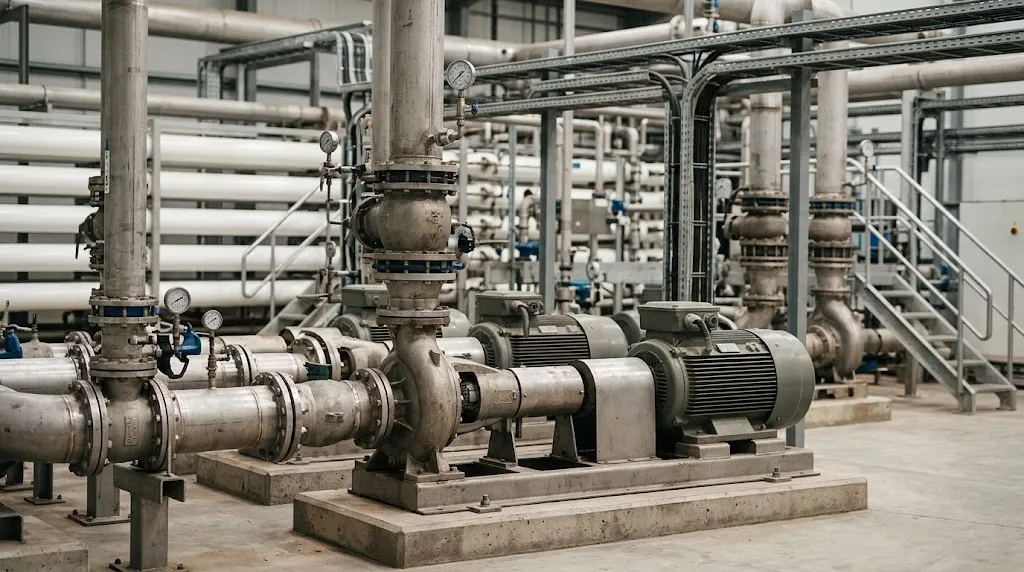
Desalination has become an increasingly important source of freshwater for water-stressed coastal regions, industrial facilities, and island communities. Among the different desalination technologies, seawater reverse osmosis (SWRO) has become a major focus of efficiency improvements because it relies on electrically driven high-pressure equipment rather than the thermal energy used by conventional distillation.
That makes one question particularly important:
How efficiently is the plant converting electricity into treated water?
The answer depends on much more than the membrane itself.
High-pressure pumps, pretreatment, energy recovery devices, membrane condition, pressure losses, recovery rate, and operating strategy all affect the specific energy consumption of an SWRO system.
Among these factors, the high-pressure pumping system deserves particular attention. It must continuously provide enough pressure to overcome the osmotic pressure of seawater and drive water through the RO membrane. Any avoidable hydraulic or mechanical loss ultimately appears as additional electricity consumption.
Recent research continues to identify pump efficiency and energy recovery as major opportunities for reducing the gap between today’s SWRO systems and their practical minimum energy requirements. A 2024 analysis of 39 SWRO facilities, for example, found substantial room for improvement through better pumps, energy recovery devices, membrane performance, and process configurations.
For operators, this changes the way pump efficiency should be viewed.
The goal is not simply to buy a pump with a high efficiency rating.
The goal is to keep the entire pumping system operating efficiently over its actual duty cycle.
Where Does the Energy Go in an SWRO Plant?
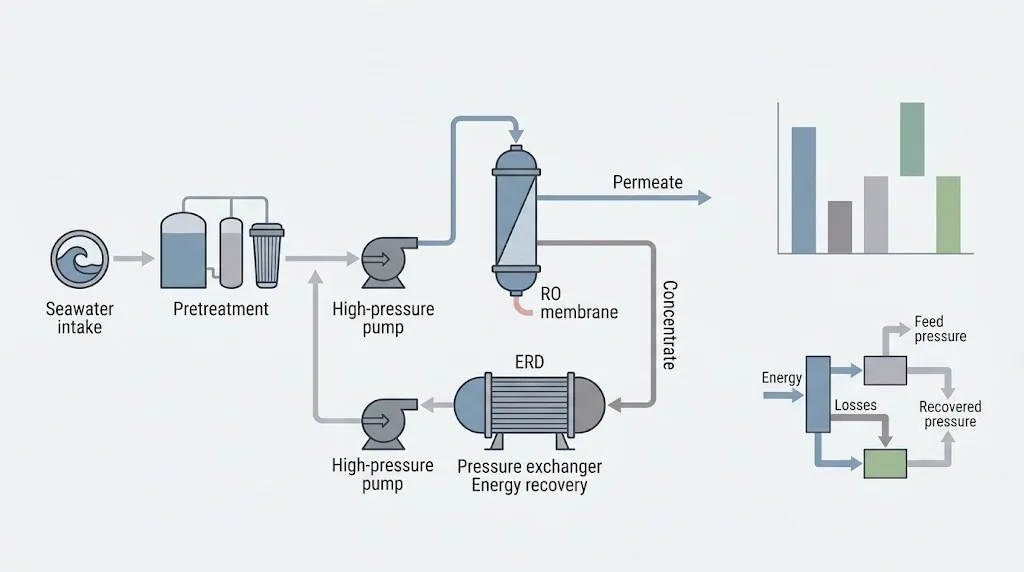
A typical seawater reverse osmosis system involves several energy-consuming stages:
- Seawater intake
- Pretreatment
- High-pressure pumping
- RO membrane separation
- Energy recovery
- Post-treatment
- Brine and concentrate management
The high-pressure pump is particularly important because it supplies the pressure required for membrane separation.
However, focusing on the pump alone can lead to an incomplete optimization strategy.
Consider two systems with identical pumps.
If one operates close to its best efficiency point while the other frequently operates far from its design condition, their real-world electricity consumption can be very different.
The same applies when:
- Flow demand changes throughout the day
- Seawater salinity varies seasonally
- Membrane fouling increases pressure requirements
- Pretreatment causes excessive pressure loss
- Valves introduce unnecessary throttling losses
- Energy recovery equipment is poorly matched to the operating condition
- Pumps are oversized for the actual duty
This is why system-level optimization is more useful than looking at pump nameplate efficiency alone.
What is specific energy consumption in desalination?
Specific energy consumption (SEC) refers to the amount of energy required to produce a given volume of desalinated water, commonly expressed in kWh/m³.
For operators, SEC is more meaningful than pump efficiency alone because it captures the relationship between electricity consumption and actual water production.
A pump can operate efficiently while the overall system still consumes excessive energy if pressure losses, membrane fouling, pretreatment requirements, or energy recovery performance are poorly managed.
Pump Optimization Starts with the Right Operating Point
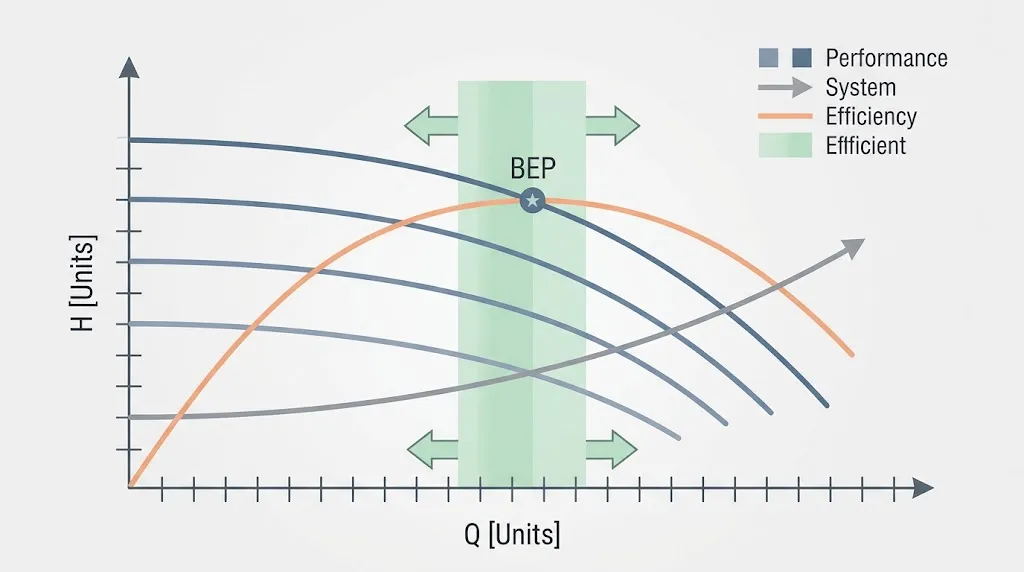
One of the most important concepts in centrifugal pump operation is the best efficiency point (BEP).
At or near the BEP, a centrifugal pump generally operates with favorable hydraulic efficiency, vibration, mechanical loading, and internal flow conditions.
But desalination plants rarely operate under one perfectly fixed condition.
Demand changes. Feedwater conditions change. Membrane performance changes.
Equipment is taken offline for maintenance. Production requirements can vary.
A pump selected only for the maximum design condition may therefore spend much of its operating life away from its optimal range.
This creates a practical engineering problem:
Is the pump actually operating where it was designed to operate?
The answer should be based on measured flow, pressure, power consumption, efficiency, and operating hours rather than assumptions from the original design specification.
Signs that a pump may be poorly matched
Operators should investigate when they see:
- Persistent operation far from the design flow
- Frequent throttling through control valves
- Excessive vibration
- Rising power consumption at similar production levels
- Repeated mechanical seal or bearing problems
- Unexpected pressure fluctuations
- Large differences between design and actual operating conditions
- Significant changes in performance after years of operation
These symptoms do not automatically mean the pump needs to be replaced.
In some cases, a hydraulic re-rate, impeller modification, control adjustment, or system redesign may deliver a better return than installing an entirely new pump.
Five Ways to Improve Pump Efficiency in Desalination
Pump optimization can involve equipment selection, hydraulic design, controls, maintenance, and process operation.
There is no single solution for every plant.
1. Match Pump Capacity to the Actual Duty
Oversizing is a common problem in pumping systems.
A pump selected with excessive flow or head capacity may require throttling to meet the actual process demand. The pump still consumes energy to generate the higher pressure, while the valve dissipates part of that pressure as a loss.
A better approach is to evaluate the actual duty point and expected operating range before selecting or modifying the pump.
For large installations, engineers may also consider whether several pumps operating in parallel provide better flexibility than a single oversized unit.
The right configuration depends on plant size, redundancy requirements, process control, and expected operating conditions.
2. Keep Hydraulic Performance in the Efficient Range
Pump efficiency is influenced by hydraulic design, impeller geometry, internal clearances, wear, and operating point.
Over time, wear can change hydraulic performance even when the pump continues to operate.
For example, internal clearances may increase, components may deteriorate, and hydraulic surfaces may become less effective. The pump can still deliver the required flow, but with increasing power consumption.
This is why periodic performance testing is valuable.
Rather than asking only:
“Is the pump still running?”
operators should ask:
“How much energy does it now require to deliver the same hydraulic duty?”
That difference can reveal an efficiency problem before it becomes a major operational issue.
3. Use Variable-Speed Control Where Operating Conditions Require It
Variable-frequency drives (VFDs) can adjust motor speed to better match changing system demand.
This can be useful where flow or pressure requirements vary significantly.
Instead of continuously operating at full speed and controlling flow through throttling, a variable-speed system can adjust pump output more directly.
However, VFDs are not automatically an energy-saving solution in every application.
Their value depends on the system curve, operating range, motor characteristics, control strategy, and actual load profile.
For a desalination plant, the correct question is therefore not:
“Should we install a VFD?”
but:
“Would variable-speed operation reduce the energy required across our actual operating profile?”
That distinction matters when evaluating capital investment.
4. Reduce Unnecessary Pressure Losses
Every pressure loss in the hydraulic system has an energy consequence.
Pipe friction, fittings, valves, filters, heat exchangers, pretreatment equipment, and other components can all contribute to pressure loss.
In an RO system, some pressure is unavoidable because the process itself requires sufficient pressure for membrane separation.
Unnecessary pressure loss is different.
A system with excessive hydraulic resistance may require the high-pressure pump to provide more pressure than the membrane process itself requires.
A pump optimization study should therefore look beyond the pump casing and examine the complete hydraulic path.
This is particularly important during retrofit projects.
Replacing a pump without examining downstream and upstream restrictions may leave a significant portion of the energy-saving opportunity untouched.
5. Optimize the Pump Together with the RO Process
Pump optimization cannot be separated completely from membrane operation.
Membrane fouling, feedwater temperature, salinity, recovery rate, flux, and pretreatment performance can all affect the pressure required by the RO process.
If membrane condition deteriorates, operators may increase pressure to maintain production.
That can maintain output in the short term but increase electricity consumption.
A more efficient strategy is to monitor the relationship between:
Feed conditions → membrane performance → required pressure → pump power → water production
This allows operators to distinguish between a pump problem and a process problem.
The distinction is important.
If the real cause of rising energy consumption is membrane fouling, replacing the pump alone will not solve the underlying issue.
Energy Recovery: Reducing the Pressure Burden on the Pump
Energy recovery is one of the most important technologies for reducing SWRO energy consumption.
In a conventional RO system, the concentrate leaving the membrane system still contains substantial hydraulic pressure.
An energy recovery device (ERD) can transfer part of this pressure energy back into the feed stream, reducing the amount of energy that must be supplied by the high-pressure pumping system.
Modern isobaric energy recovery devices can achieve high levels of pressure-energy transfer under suitable operating conditions.
This changes the role of the high-pressure pump.
Instead of supplying all of the process pressure from electrical energy, the system can recover part of the hydraulic energy already present in the high-pressure concentrate stream.
The result can be a significant reduction in specific energy consumption.
Recent research has continued to identify energy recovery devices, high-efficiency pumps, and alternative RO configurations as important pathways toward lower-energy desalination.
Pump and ERD selection should be considered together
A pump and energy recovery device should not be treated as completely independent pieces of equipment.
Their operating ranges, pressure requirements, flow rates, control strategies, and maintenance requirements interact.
For new projects, this means the pump and ERD should be evaluated as part of the overall RO train.
For existing plants, performance testing can reveal whether the energy recovery system is operating close to its expected efficiency.
VFDs and Smarter Pump Control
The next generation of pump optimization is increasingly data-driven.
Sensors can provide continuous information about:
- Flow
- Pressure
- Motor power
- Pump speed
- Vibration
- Temperature
- Valve position
- Operating hours
When these measurements are combined, operators can calculate changes in pump performance rather than relying only on periodic inspections.
This creates an opportunity for condition-based operation.
For example, if a pump gradually requires more electrical power to deliver the same flow and pressure, the change may indicate wear, fouling, hydraulic deterioration, or another developing problem.
Digital monitoring can help operators identify the change earlier.
Machine learning can also be applied to historical operating data to identify abnormal patterns. However, digital tools should support engineering decisions rather than replace them.
A predictive model is only as useful as:
- The quality of the sensor data
- The quality of historical operating records
- The stability of the process
- The accuracy of the underlying engineering model
- The ability of operators to act on the information
In other words, digitalization does not make an inefficient pump efficient by itself.
It makes performance problems easier to see and, potentially, easier to manage.
Why Maintenance Matters as Much as Pump Selection
A highly efficient pump can lose part of its performance advantage if it is poorly maintained.
Maintenance should therefore be viewed as an energy-management activity as well as a reliability activity.
Key areas include:
Hydraulic condition
Impeller wear, internal clearances, erosion, corrosion, and hydraulic surface condition can affect pump efficiency.
Bearings and mechanical components
Mechanical losses and deteriorating components can increase power demand and vibration.
Seals
Seal problems can lead to leakage, reliability issues, and unplanned downtime.
Alignment
Poor alignment between the pump and motor can contribute to vibration and mechanical stress.
Instrumentation
Incorrect flow, pressure, or power measurements can make it difficult to identify actual performance deterioration.
Operating records
Historical data is essential for identifying long-term performance trends.
A pump does not suddenly become inefficient on one particular day.
Performance often deteriorates gradually.
The earlier that deterioration is identified, the more options operators have to correct it.
How to Evaluate Pump Upgrades by Lifecycle Cost
The lowest purchase price is rarely the same as the lowest cost over the life of a desalination pump.
For energy-intensive equipment, electricity consumption can dominate lifecycle expenditure.
A procurement evaluation should therefore consider at least:
Factor | Key Question |
Initial cost | What is the equipment and installation cost? |
Energy consumption | How much electricity will the pump require under actual operating conditions? |
Efficiency range | How does efficiency change away from the design point? |
Maintenance | What components require regular service or replacement? |
Reliability | What is the expected operating availability? |
Downtime | What are the consequences of an unplanned shutdown? |
Retrofit requirements | Will existing piping, controls, or foundations need modification? |
Spare parts | How readily are critical components available? |
Monitoring | Can performance be measured continuously? |
Service life | How does the investment perform over the expected lifecycle? |
This approach can change the outcome of a pump replacement decision.
A more expensive pump may provide a better lifecycle result if it operates more efficiently, requires less maintenance, and avoids costly downtime.
Conversely, an expensive technology is not automatically the best option.
The correct comparison should be based on the actual operating profile of the plant.
From Energy Savings to Carbon Reduction
Reducing electricity consumption and reducing carbon emissions are closely connected, but they should not be treated as identical metrics.
The carbon impact of electricity savings depends on the electricity source and the emissions factor used.
A plant operating on a relatively carbon-intensive grid will generally achieve a different emissions reduction from the same energy saving as a plant supplied predominantly by low-carbon electricity.
That means operators should track both:
Energy performance
and
Carbon performance
For energy:
- kWh consumed
- kWh/m³ of product water
- Pump efficiency
- System efficiency
- Peak demand
For carbon:
- Electricity-related emissions
- Emissions factor
- Renewable electricity share
- Operational emissions associated with the plant
This distinction becomes increasingly important as desalination projects integrate renewable electricity, energy storage, and other low-carbon energy strategies.
The most effective approach is often not a single “green” technology, but a combination of:
efficient pumping + energy recovery + optimized RO operation + effective maintenance + lower-carbon electricity.
What Should Desalination Operators Look at First?
Not every desalination plant needs a major pump retrofit.
Before investing in new equipment, operators can begin with a performance audit.
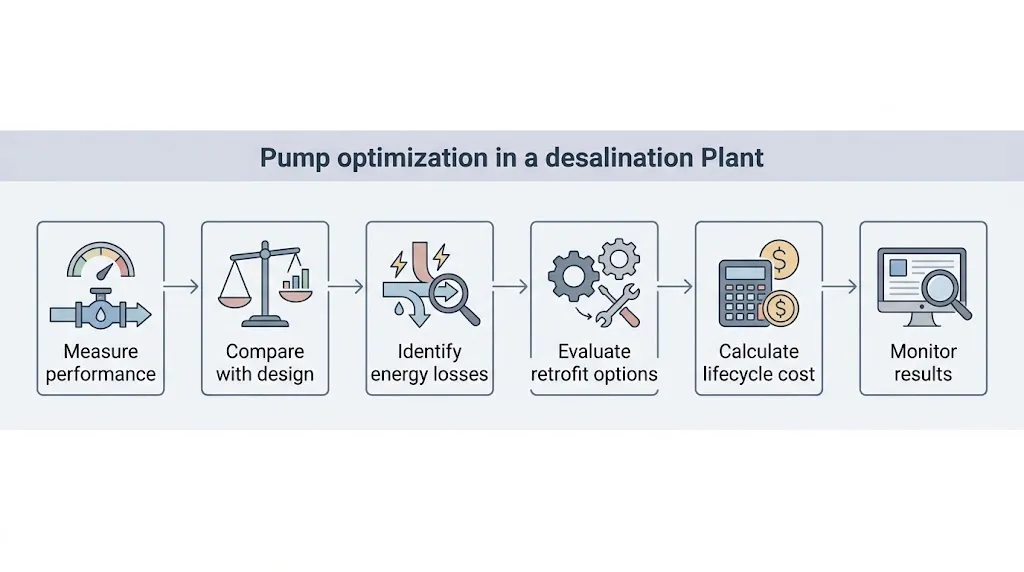
A practical assessment can follow five steps.
Step 1: Establish the baseline
Record:
- Flow
- Pressure
- Motor power
- Pump speed
- Water production
- Specific energy consumption
- Operating hours
Without a reliable baseline, it is difficult to quantify improvement.
Step 2: Compare actual and design conditions
Determine whether pumps are operating near their intended duty points.
Large deviations may indicate oversizing, changing process requirements, system modifications, or deteriorating equipment.
Step 3: Identify the largest energy losses
Look at:
- Pump inefficiency
- Pressure losses
- Throttling
- Pretreatment
- Membrane condition
- Energy recovery performance
- Control strategy
Prioritize the losses with the largest practical impact.
Step 4: Compare retrofit options
Potential measures may include:
- Hydraulic re-rating
- Impeller modification
- Pump replacement
- VFD installation
- Control optimization
- Pipe or valve modifications
- Energy recovery improvements
- Maintenance interventions
Step 5: Calculate lifecycle economics
Compare:
Investment → energy savings → maintenance savings → downtime reduction → payback → lifecycle value
This is more useful than comparing equipment purchase prices alone.
The Next Step: Designing for Efficiency Across the Pump Lifecycle
Desalination efficiency is moving beyond the question of how efficient an individual pump is.
The more important question is how the entire pumping system performs over time.
For a new plant, efficiency can be designed into the system from the beginning through appropriate pump sizing, hydraulic design, energy recovery, controls, instrumentation, and maintenance planning.
For an existing plant, optimization can begin with relatively simple steps: measuring actual performance, identifying deviations from the design point, reducing unnecessary pressure losses, and assessing whether pumps and energy recovery systems remain correctly matched to current operating conditions.
Recent research also suggests that there is still substantial technical headroom beyond today’s conventional SWRO configurations. Studies published in 2024 and 2025 have examined semi-batch and batch RO, improved spacers, advanced energy recovery, and hybrid configurations as potential pathways toward lower specific energy consumption. These approaches remain at different stages of development and should be assessed according to site conditions and commercial maturity rather than treated as universal solutions.
For plant operators, the practical lesson is simpler:
Energy efficiency starts with knowing where the energy is going.
A pump that runs reliably is not necessarily a pump that runs efficiently.
And a pump that is efficient at one operating point may not remain efficient across an entire production cycle.
By combining hydraulic performance testing, appropriate pump selection, energy recovery, intelligent control, preventive maintenance, and lifecycle analysis, desalination operators can turn pumping from a major energy burden into one of the most measurable opportunities for improving plant performance.
As desalination expands to support water security, industrial production, and climate resilience, pump optimization will remain an important part of the industry’s effort to produce more water with less energy and lower environmental impact.
FAQ
What is pump optimization in desalination?
Pump optimization is the process of improving pump and system performance so that the required flow and pressure are delivered with the least practical energy consumption while maintaining reliability and process requirements. It can involve pump selection, hydraulic modifications, controls, maintenance, energy recovery, and operating-condition adjustments.
How does pump efficiency affect desalination energy consumption?
High-pressure pumping is a major energy-consuming part of seawater reverse osmosis. Improving pump efficiency can reduce the electricity required to deliver the pressure needed for membrane separation. The actual benefit depends on the pump’s operating point, system design, membrane condition, and other process variables.
Can a VFD reduce desalination pump energy consumption?
A variable-frequency drive can reduce energy consumption when pump demand varies and speed control can better match output to the actual system requirement. However, the benefit depends on the system curve and operating profile. A VFD should therefore be evaluated using measured operating data rather than assumed savings.
What is the role of energy recovery in SWRO?
Energy recovery devices capture hydraulic energy from the high-pressure concentrate stream and transfer part of it back to the feed side. This reduces the amount of external electrical energy required by the high-pressure pumping system and is an important component of energy-efficient SWRO design.
How can operators tell if a desalination pump is losing efficiency?
Operators can compare current flow, pressure, power consumption, and pump speed against historical or baseline performance. Increasing power consumption at similar hydraulic output, combined with vibration or maintenance issues, may indicate declining pump performance and should trigger further investigation.
Sources
- Qiao, M., “Reducing desalination energy consumption,” Nature Chemical Engineering, 2024. The analysis reviews energy use across 39 SWRO facilities and highlights pump efficiency, energy recovery, membrane performance, and process configuration as important optimization factors.
- Alnajdi et al., “Practical minimum energy use of seawater reverse osmosis,” Joule, 2024. The study evaluates energy-performance ranges for SWRO and identifies high-efficiency pumps, energy recovery, and advanced RO configurations as important opportunities.
- Kim et al., “Optimizing energy efficiency in desalination: Performance evaluation of seawater reverse osmosis and pressure retarded osmosis hybrid systems,” Desalination, 2025. The research examines hybrid SWRO-PRO configurations and their potential energy benefits under specific operating conditions.
- Touati & Mulligan, “Energy consumption and energy efficiency of high-pressure reverse osmosis,” Applied Energy, 2025. The research examines how recovery, staging, and energy recovery influence HPRO energy consumption.

