







Activated carbon filtration is widely used in drinking water treatment, wastewater polishing and industrial water treatment to remove dissolved organic contaminants that conventional particulate filtration cannot reliably capture.
The technology is often described simply as a “carbon filter.” In an engineered treatment system, however, the process is more accurately understood as adsorption using a porous carbon medium. Treatment performance depends on the contaminant, carbon characteristics, water chemistry, contact time, hydraulic conditions and the point at which the carbon bed reaches breakthrough.
That distinction matters when specifying or operating a system.
For municipal utilities, industrial facilities, EPC contractors and water-treatment engineers, the central question is not simply whether activated carbon can remove a contaminant. It is how much carbon is required, how long it will remain effective, and what happens when its adsorption capacity is exhausted.
What Is Activated Carbon Filtration?
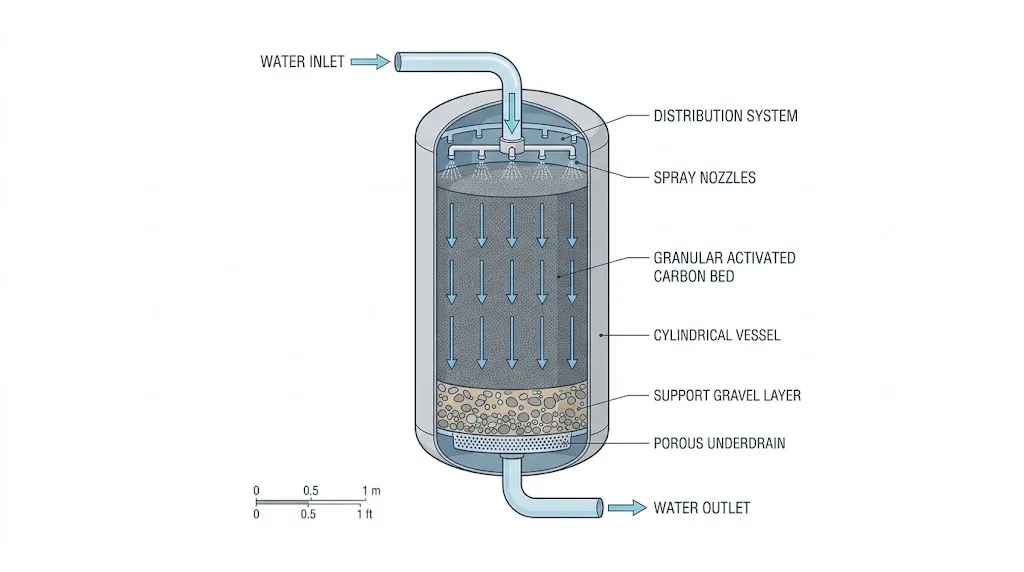
Activated carbon filtration is a water-treatment process in which water passes through a bed of highly porous carbon. Dissolved contaminants are attracted to and retained on the internal surfaces and pore structure of the carbon through adsorption.
Granular activated carbon (GAC) is the most common configuration for continuous flow-through treatment. Activated carbon can be manufactured from carbon-rich feedstocks such as coal, lignite, wood and coconut shell, with activation processes creating a network of pores and a large internal surface area.
The term filtration can be misleading.
A conventional sand or multimedia filter primarily removes suspended particles through physical filtration. GAC can also capture some particulates, particularly when used in a filter-adsorber configuration, but its principal value is the removal of dissolved contaminants through adsorption.
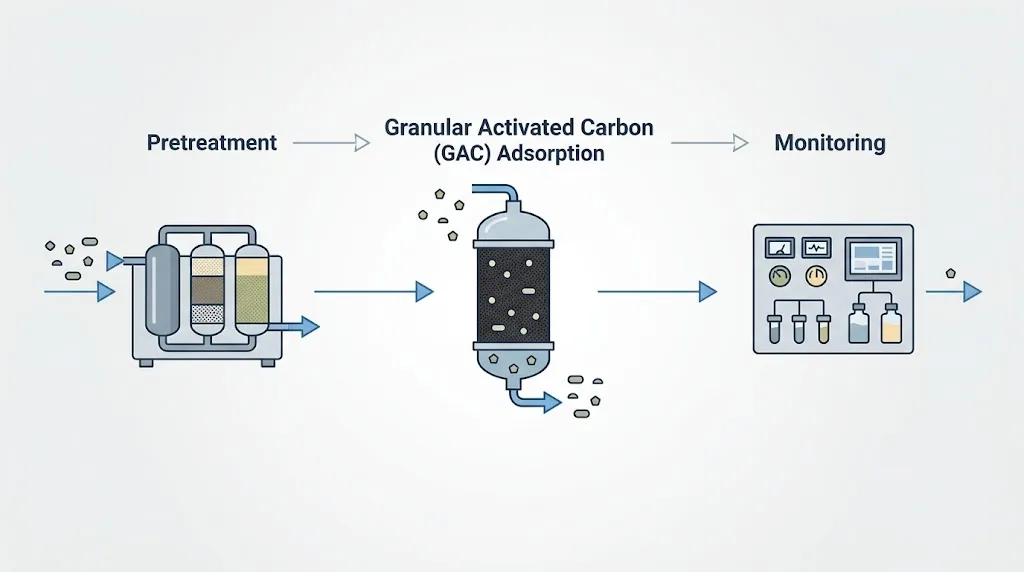
This makes GAC particularly useful as a polishing step after clarification, biological treatment, membrane treatment or other upstream processes.
Adsorption vs absorption
The two terms are sometimes confused.
- Adsorption:contaminants accumulate on the surface or within the pore structure of a solid.
- Absorption:a substance penetrates into the bulk of another material.
Activated carbon treatment is primarily an adsorption process.
The effectiveness of that process depends on both the properties of the carbon and the chemistry of the water being treated.
How Does Granular Activated Carbon Remove Contaminants?
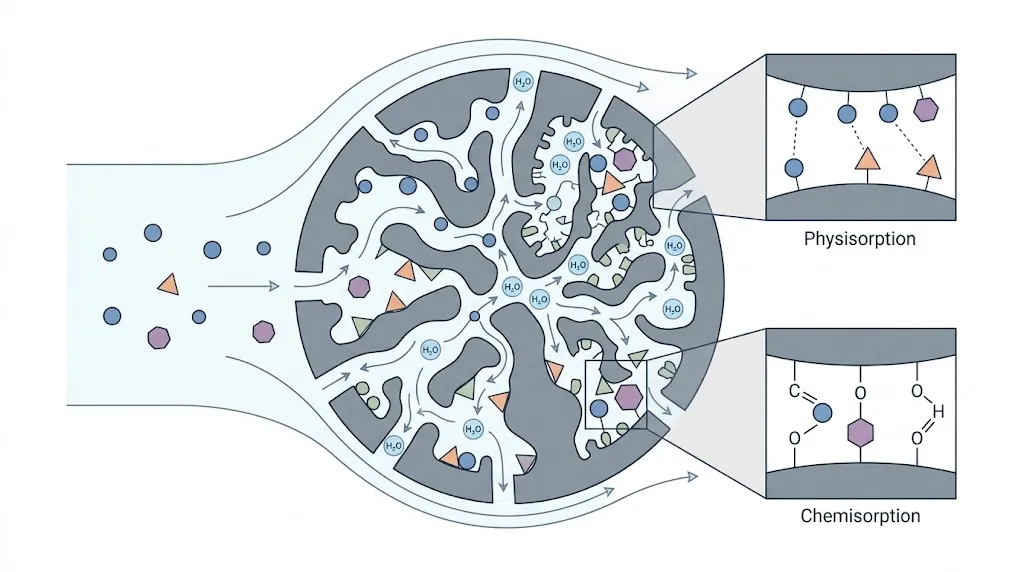
A GAC bed contains an interconnected network of pores ranging from larger pores to very small micropores. As water passes through the bed, dissolved molecules move from the bulk water toward the carbon surface and into accessible pores.
The overall process is affected by:
- Carbon pore structure
- Contaminant characteristics
- Contaminant concentration
- Water temperature
- pH and other water chemistry
- Competing organic matter
- Hydraulic loading
- Contact time
EPA notes that different GAC products can have substantially different treatment capacities because their raw materials and manufacturing processes influence their pore structures and adsorption characteristics.
This is why selecting carbon solely by a specification such as iodine number is insufficient for many engineering applications. The carbon needs to be matched to the actual contaminant and water matrix.
Why pretreatment matters
GAC works best when upstream treatment has already removed excessive suspended solids and other constituents that could unnecessarily occupy the bed or increase headloss.
Depending on the application, upstream processes may include:
- Coagulation and sedimentation
- Multimedia filtration
- Microfiltration or ultrafiltration
- Biological treatment
- Ozonation
- Other polishing processes
For wastewater applications, GAC is commonly positioned after biological or physical-chemical treatment, where the remaining dissolved organic contaminants are present at comparatively low concentrations. EPA identifies GAC adsorption as an established tertiary treatment technology for municipal and industrial wastewater.
What Can GAC Remove?
GAC is particularly useful for many organic contaminants and compounds responsible for taste, odor and color.
Potential targets include:
Contaminant / Water-Quality Issue | GAC Suitability | Key C onsideration |
Taste and odor compounds | High | Common drinking-water application |
VOCs | High for many compounds | Compound-specific adsorption capacity |
Pesticides | Often effective | Carbon type and water matrix matter |
Natural organic matter | Useful | Competing adsorption can consume capacity |
Disinfection by-product precursors | Useful | Often integrated into broader treatment trains |
Pharmaceuticals | Potentially effective | Requires contaminant-specific evaluation |
PFAS | Effective for some PFAS | Performance varies significantly by compound and matrix |
Dissolved organic compounds | Often effective | Requires characterization of feed water |
Inorganic salts | Generally poor fit | Other processes may be more appropriate |
Hardness | Not the primary application | Consider ion exchange or membranes |
Most dissolved minerals | Not the primary application | RO/NF or other processes may be appropriate |
The key point is that GAC is not a universal contaminant-removal technology.
EPA’s drinking-water technology guidance identifies GAC as useful for taste and odor compounds, natural organic matter, VOCs, synthetic organic compounds and disinfection-by-product precursors, while also emphasizing that adsorption capacity varies between carbon products.
For a new project, laboratory or pilot testing can therefore be more meaningful than relying on a generic “removal percentage.”
GAC vs PAC: What Is the Difference?
Activated carbon is commonly used in two physical forms: granular activated carbon (GAC) and powdered activated carbon (PAC).
Parameter | GAC | PAC |
Physical form | Granular particles | Fine powder |
Typical application | Fixed-bed contactors / filter beds | Dosed directly into water |
Continuous operation | Yes | Typically dosed continuously or intermittently |
Separation after treatment | Bed retains media | Requires downstream solids separation |
Media replacement | Periodic | Continuous or batch dosing |
Typical strength | Longer-term adsorption | Flexible response to changing water quality |
Common applications | Drinking water, wastewater polishing, industrial treatment | Taste/odor events, short-term contaminant control, process-specific applications |
EPA describes PAC as the same basic activated-carbon material as GAC but in a much smaller particle size. Because PAC cannot simply be operated as a conventional flow-through bed, it is normally added to the water and subsequently removed with solids during downstream treatment.
The choice therefore depends not only on adsorption performance, but also on process configuration, contaminant variability, media management and operating cost.
Where Is Activated Carbon Used in Water Treatment?
1. Municipal drinking water
GAC is used in drinking-water treatment for applications such as:
- Taste and odor control
- Natural organic matter reduction
- VOC removal
- Pesticide control
- Disinfection by-product precursor reduction
- Selected emerging contaminants
It may be installed as a dedicated GAC contactor or incorporated into a filtration stage.
2. Wastewater polishing
In advanced wastewater treatment, GAC can provide a polishing barrier for residual dissolved organic compounds and micropollutants following biological treatment.
Research has shown that GAC performance in wastewater depends strongly on the water matrix and operating conditions. A 2021 study of full-scale GAC filters found that EBCT and carbon pore characteristics were important factors in micropollutant removal.
3. Industrial water and wastewater
Industrial applications can include:
- Chemical manufacturing
- Pharmaceutical production
- Food and beverage processing
- Electronics and semiconductor facilities
- Industrial reuse systems
- Contaminated groundwater treatment
- Process-water polishing
For industrial facilities, feed-water variability can be particularly important. Production changes, cleaning cycles and intermittent chemical discharges can alter the contaminant loading on the carbon bed.
4. Water reuse
GAC can form part of a multi-barrier treatment train for water reuse.
Depending on the required final water quality, a reuse system may combine biological treatment, clarification, membrane processes, oxidation, activated carbon and disinfection.
GAC is particularly relevant where the treatment objective includes residual organic micropollutants rather than primarily dissolved salts.
Designing a GAC System: The Parameters That Matter
A successful GAC installation is not simply a vessel filled with “high-quality carbon.”
Several engineering parameters determine whether the system achieves its treatment objective.
1. Empty Bed Contact Time
Empty bed contact time (EBCT) is one of the most important parameters in GAC system design.
The basic relationship is:
EBCT = Empty Bed Volume ÷ Flow Rate
It represents the theoretical time water would occupy the empty carbon bed at a specified flow.
Longer contact time can improve adsorption kinetics and contaminant removal, but increasing EBCT also means a larger vessel and greater carbon inventory.
There is therefore no universal EBCT that applies to every contaminant.
A 2021 study of GAC treatment for wastewater micropollutants found that an EBCT of approximately 20–30 minutes was necessary under the conditions investigated, while longer contact time beyond that range did not necessarily provide proportional improvement.
That result should not be interpreted as a universal design requirement. Actual EBCT should be established according to the target contaminant, water matrix, carbon type and required effluent quality.
2. Hydraulic loading and pressure drop
Higher flow rates reduce contact time and can increase hydraulic stress on the bed.
Particle size also creates a trade-off:
- Smaller particles can provide faster mass transfer but increase pressure loss.
- Larger particles generally reduce pressure loss but may affect adsorption kinetics.
The design therefore has to balance adsorption performance, hydraulic capacity and operating energy.
3. Carbon characteristics
Important carbon characteristics can include:
- Raw material
- Pore-size distribution
- Particle size
- Apparent density
- Hardness
- Surface chemistry
- Moisture content
- Adsorption capacity for the target contaminant
A carbon selected for taste-and-odor control may not be the optimum carbon for PFAS or a particular industrial solvent.
How Do You Know When Activated Carbon Is Exhausted?
One of the most important concepts in GAC operation is breakthrough.
As the bed operates, adsorption capacity is progressively consumed. Eventually, the target contaminant begins appearing at the outlet.
This is called breakthrough.
A simplified sequence is:
Fresh carbon → adsorption zone develops → adsorption front moves through bed → breakthrough → exhaustion
The timing depends on the contaminant concentration, carbon characteristics, EBCT, competing constituents and operating conditions.
For this reason, replacing carbon according to an arbitrary calendar interval can be inefficient or risky.
Lead-lag configuration
For applications with stringent effluent requirements, two or more GAC vessels can be arranged in series.
The lead vessel performs most of the adsorption while the lag vessel provides additional treatment capacity and acts as a polishing barrier.
When the lead bed approaches exhaustion, it can be taken offline for carbon replacement or regeneration, while the lag bed becomes the lead bed.
This configuration can provide better operational control than relying on a single vessel, particularly when breakthrough consequences are significant.
GAC for PFAS and Emerging Contaminants
PFAS has increased interest in activated carbon treatment, but it is important not to treat “PFAS removal” as a single performance category.
PFAS compounds have different chemical properties, and GAC does not perform identically for all of them.
EPA research indicates that GAC has been studied extensively for PFAS treatment and can be effective, but longer-chain PFAS such as PFOA and PFOS are generally more amenable to GAC adsorption than some shorter-chain compounds. Performance is also affected by carbon type, bed depth, flow rate, temperature and competing organic matter.
The regulatory context also matters.
In its 2024 PFAS National Primary Drinking Water Regulation materials, EPA identified GAC, anion exchange, reverse osmosis and nanofiltration among the Best Available Technologies for meeting the specified PFAS maximum contaminant levels. EPA also emphasized that utilities are not restricted to those technologies and that treatment selection depends on system circumstances.
For a PFAS project, a supplier should therefore be asked for more than a general statement that its carbon “removes PFAS.”
Activated Carbon vs Other Treatment Technologies
GAC should be evaluated as part of the overall treatment train rather than as a standalone solution.
Technology | Main Strength | Typical Limitation |
GAC | Dissolved organic contaminants, taste/odor, selected micropollutants | Media eventually exhausts |
PAC | Flexible response to variable contaminant loading | Requires downstream solids separation |
RO | Broad dissolved contaminant and salt removal | Energy demand and concentrate management |
NF | Selective removal of many dissolved constituents | Membrane fouling and concentrate |
Ion exchange | Strong performance for selected ionic contaminants | Resin regeneration/disposal |
Ozone/AOP | Oxidation of selected difficult organics | Chemical/energy demand and possible by-products |
Biological treatment | Biodegradable organic load | Less suitable for persistent compounds |
There is no universally superior process.
For example, GAC may be attractive where the treatment objective is a specific group of organic micropollutants and the water has already undergone substantial solids removal. RO may be more appropriate where dissolved salts and a much broader range of contaminants must be reduced.
Hybrid systems can also be effective.
The engineering question is therefore:
Which combination of processes delivers the required water quality at acceptable capital, energy, chemical, media and residual-management costs?
Practical GAC Selection Checklist
Before issuing a GAC equipment or media specification, define the following.
Feed-water characterization
- Flow range and peak flow
- Temperature
- pH
- Turbidity and suspended solids
- DOC/TOC
- Target contaminants
- Contaminant concentration range
- Competing organic constituents
Treatment objective
- Required effluent concentration
- Required removal percentage
- Regulatory limit or internal specification
- Normal and upset operating conditions
- Required redundancy
GAC design
- Carbon type and source
- Bed depth
- EBCT
- Hydraulic loading
- Particle-size distribution
- Vessel configuration
- Backwash requirements
- Headloss limits
Operation
- Breakthrough monitoring
- Sampling frequency
- Differential-pressure monitoring
- Backwash frequency
- Carbon changeout strategy
- Regeneration options
- Spent-carbon handling
Supplier evaluation
Ask suppliers to provide application-specific performance data, rather than relying only on generic carbon specifications.
Pilot testing becomes particularly valuable when the contaminant concentration is low, the water matrix is complex, or the consequences of breakthrough are significant.
Maintenance, Regeneration and Spent Carbon Management
GAC is a consumable treatment medium even when the physical equipment has a long service life.
The carbon eventually becomes saturated with adsorbed compounds and must either be replaced or regenerated/reactivated.
EPA notes that spent GAC may require replacement or regeneration and that disposal requirements can depend on the contaminants captured by the carbon.
A complete lifecycle assessment should therefore include:
- Initial carbon inventory
- Carbon replacement frequency
- Transportation
- Regeneration cost
- Energy consumption
- Disposal requirements
- Backwash and rinse-water management
- Vessel maintenance
- Monitoring and laboratory testing
For large installations, regeneration can potentially reduce the need for virgin carbon, but its practicality depends on the carbon loading, contaminant type, logistics and availability of appropriate regeneration facilities.
This is one reason media lifecycle cost can be more useful than comparing the initial price per kilogram of activated carbon.
The Role of GAC in Advanced Water Treatment
Activated carbon is an established technology, but its role is changing as water-quality requirements become more specific.
Municipal utilities are increasingly dealing with trace organic contaminants, PFAS and more variable source-water conditions. Industrial facilities are also facing tighter requirements for water reuse and wastewater discharge.
These challenges are making process monitoring and data-driven operation more important.
Digital monitoring can help operators track:
- Flow
- Differential pressure
- Influent and effluent water quality
- Carbon usage
- Bed volumes treated
- Breakthrough trends
- Operating anomalies
EPA’s ETDOT program, for example, provides models for evaluating GAC and ion-exchange treatment for contaminant removal, illustrating the growing role of modelling and data in treatment-system evaluation.
For larger plants, these data can also feed into broader asset-management and process-control systems. The objective is not to make GAC “smart” for its own sake, but to provide earlier warning of performance deterioration and support better media-management decisions.
The key takeaway
Activated carbon filtration remains a mature treatment technology, but good performance depends on application-specific engineering.
The right carbon, bed configuration and operating conditions can provide effective treatment for a wide range of dissolved organic contaminants. The wrong combination can result in premature breakthrough, excessive carbon consumption, unnecessary capital expenditure or disappointing removal performance.
For engineers and procurement teams, the most useful approach is therefore to start with the water-quality target and operating conditions, then work backward to the carbon, contactor and monitoring strategy.
As water reuse, micropollutant control and PFAS treatment continue to influence treatment-plant design, GAC is likely to remain an important component of multi-barrier water treatment systems.
Explore the latest water-treatment, filtration and process technologies and connect with technology providers at WATERTECH CHINA.
FAQ
Is activated carbon the same as a water filter?
Not exactly. Activated carbon can be incorporated into a filtration system, but its primary treatment mechanism is adsorption rather than conventional particulate filtration. GAC is particularly useful for dissolved organic compounds, taste and odor compounds and selected micropollutants.
How long does activated carbon last in a water treatment system?
There is no universal service life. Carbon exhaustion depends on the target contaminant, influent concentration, water chemistry, carbon type, flow rate and EBCT. Actual replacement should be based on performance monitoring and breakthrough rather than a fixed calendar interval.
Can GAC remove PFAS?
GAC can remove many PFAS compounds, but performance varies by PFAS chemistry and operating conditions. EPA identifies GAC as one of the Best Available Technologies for the PFAS drinking-water limits established in its 2024 regulation.
What is EBCT in activated carbon treatment?
EBCT, or empty bed contact time, is the theoretical time water spends passing through the volume occupied by the carbon bed. It is calculated by dividing bed volume by flow rate and is a key parameter for GAC system design.
Is GAC better than reverse osmosis?
Neither technology is universally better. GAC is particularly suited to adsorption of many organic contaminants, while RO provides much broader removal of dissolved salts and other constituents. The appropriate technology depends on the required water quality and overall treatment objectives.
Sources
- S. Environmental Protection Agency — Overview of Drinking Water Treatment Technologies. Provides technical background on GAC, its applications, carbon feedstocks, adsorption and limitations.
- S. Environmental Protection Agency — Reducing PFAS in Drinking Water with Treatment Technologies. Provides technical discussion of GAC for PFAS and factors affecting performance.
- S. Environmental Protection Agency — 2024 PFAS NPDWR Treatment Fact Sheet. Identifies GAC, ion exchange, RO and NF among the Best Available Technologies for the specified PFAS drinking-water requirements.
- S. Environmental Protection Agency — ETDOT. Provides modelling resources for GAC and ion-exchange treatment evaluation.
- Fundneider et al., Water Research, 2021 — Empty bed contact time: The key for micropollutant removal in activated carbon filters. Examines EBCT, carbon characteristics and micropollutant removal in GAC filters.
- S. EPA — Granular Activated Carbon Adsorption and Regeneration Technology Fact Sheet. Background on GAC use in municipal and industrial wastewater treatment.

