







Introduction: The Dawn of Intelligent Water Management
The global water industry is no longer just a sector of pipes, valves, and manual checks; it is rapidly becoming a data-driven frontier. As the industry evolves, the focus of the conversation has shifted from basic filtration to AI-driven Reverse Osmosis (RO) Optimization. Recently, pioneering AI-enabled digital advisors have marked a significant leap in how we manage one of the most energy-intensive processes in water treatment. These new digital tools are designed to address a critical pain point for plant operators—the complexity of maintaining peak performance in fluctuating conditions. By leveraging machine learning and real-time data, this technology promises to reduce downtime, extend membrane life, and slash energy consumption. In this comprehensive guide, we will explore the mechanics of AI-driven RO management and the substantial economic benefits of integrated digital water management systems.
The Global Imperative for RO Efficiency
Reverse Osmosis is the gold standard for desalination and high-purity water production. However, its Achilles’ heel has always been high operational costs (OPEX) and the risk of unexpected membrane fouling. According to the International Water Association (IWA), energy accounts for up to 50% of the cost of desalinated water.
In an era of rising energy prices and strict wastewater compliance, the need for AI for Reverse Osmosis Optimization has never been more urgent. Traditional systems rely on periodic manual monitoring, which often leads to “too little, too late” interventions. AI changes the game by offering a 24/7 “digital twin” of the facility, providing predictive maintenance for RO that prevents problems before they occur.
Understanding DuPont’s AI-Enabled Digital Advisor
DuPont’s latest launch is not just a software update; it is a sophisticated AI water treatment advisor. This system integrates directly with existing sensors and PLC (Programmable Logic Controller) architectures to ingest massive datasets.
Real-Time Performance Normalization
Raw data from an RO plant can be misleading. Temperature shifts, feed water salinity changes, and pressure fluctuations mask the true health of the membranes. The AI advisor uses complex algorithms to “normalize” this data in real-time, allowing operators to see a true performance baseline.
Prescriptive Analytics vs. Descriptive Analytics
While traditional systems tell you what happened, DuPont’s AI tells you what to do next. This shift to smart desalination technology means the system can suggest the exact cleaning-in-place (CIP) timing or pressure adjustments needed to maintain the target permeate quality without wasting chemicals or power.
How AI Solves Modern Desalination Challenges
Desalination is a lifeline for water-scarce regions, but its environmental footprint is under constant scrutiny. Integrating AI for Reverse Osmosis Optimization allows facilities to hit their ESG (Environmental, Social, and Governance) targets by minimizing chemical discharge and maximizing water recovery.
Mitigating Membrane Fouling
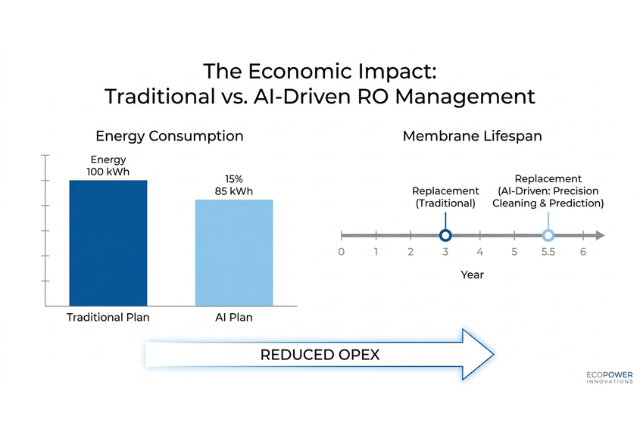
Bio-fouling and scaling are the primary causes of RO performance decay. AI models can detect the earliest molecular signs of scaling—well before a pressure drop is visible to the human eye. This allows for milder, more effective cleaning cycles, drastically extending the life of FilmTec™ membranes and other high-performance materials.
Maximizing Operational Efficiency with Predictive Analytics
The primary ROI of AI for Reverse Osmosis Optimization lies in the elimination of human error and the optimization of power consumption. Modern industrial plants are currently under intense pressure to lower their carbon footprint and increase sustainability, making the adoption of smart systems a necessity rather than an option.
Energy Savings: By running at the precise osmotic pressure required, AI avoids the “over-pumping” inefficiencies common in manually tuned systems.
Operational Resilience: In the event of a sudden change in feed water quality (e.g., an algal bloom), the AI advisor provides instant re-calibration steps to protect the equipment and maintain output stability.
The Synergy Between Hardware Excellence and Digital Layers
The industry trend is clear: Hardware + Software = The New Industry Standard. It is no longer sufficient to simply procure high-quality pumps, valves, or membranes; these components must be “digitally ready.”
We are seeing a shift toward “Born Digital” hardware—pumps with integrated vibration sensors and membrane vessels with built-in conductivity probes that feed data directly into AI water treatment advisors. This holistic approach ensures that the entire pipeline system is optimized as a unified network, rather than as a collection of individual components.
Embracing the Digital Tide
The launch of DuPont’s AI-enabled digital advisor is a clear signal that the “Intelligence Era” of water has arrived. AI for Reverse Osmosis Optimization is no longer a niche research topic—it is a critical tool for survival in a high-cost, water-scarce world. By embracing these digital water solutions, engineers and managers can ensure their facilities are not only compliant but also highly profitable.
From Optimization to Intelligent Water Management
The launch of AI-enabled digital advisors signals a broader shift in how reverse osmosis systems are designed, operated, and maintained. AI for Reverse Osmosis Optimization is moving beyond simple monitoring toward predictive and prescriptive management, helping operators identify performance issues earlier, fine-tune operating conditions, and make more informed decisions in real time.
However, the value of AI does not come from software alone. Its greatest potential lies in connecting data, equipment, and human expertise into a more responsive operating system. By combining real-time monitoring with predictive analytics and intelligent control, water treatment facilities can reduce energy and chemical consumption, extend asset life, and respond more effectively to changing feed-water conditions.
As water scarcity, energy costs, and operational demands continue to increase, intelligent optimization will become an increasingly important part of efficient and resilient water treatment. The future of RO is therefore not simply about building better membranes or more powerful equipment—it is about making the entire system smarter, more adaptive, and more efficient.

