







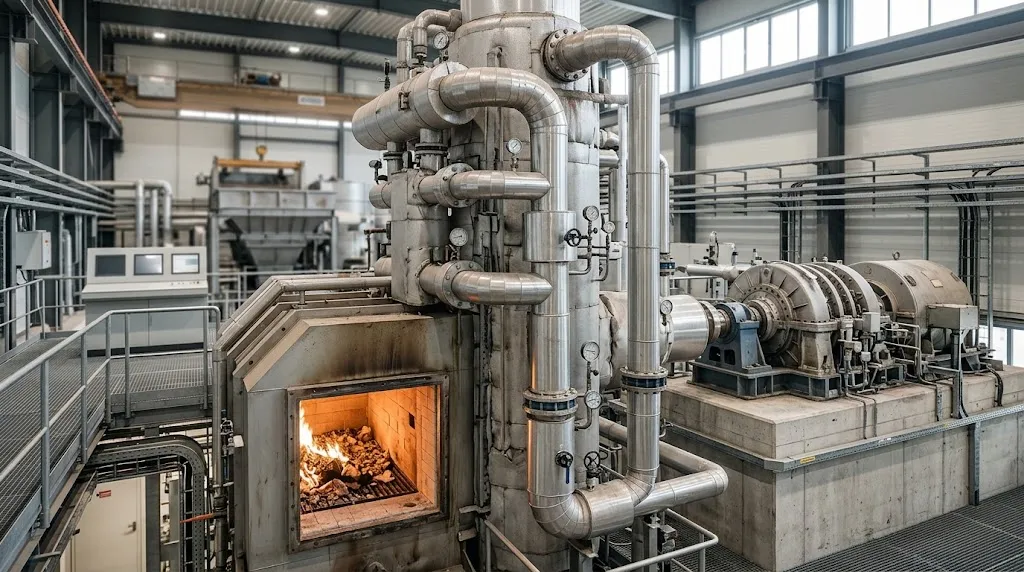
Waste-to-energy (WTE), also known as energy-from-waste (EfW), has traditionally been viewed as a thermal treatment technology: non-recyclable waste enters a plant, combustion releases heat, and that heat is recovered to produce electricity, steam or district heat.
But the performance of a modern WTE facility depends on much more than the furnace.
A typical plant brings together waste reception and preparation, combustion, boilers, turbines, pumps, water treatment, flue-gas treatment, ash handling, emissions monitoring and auxiliary systems. These processes interact continuously. A change in waste composition can affect combustion. Combustion conditions influence steam production. Steam conditions affect turbine performance. Flue-gas treatment affects reagent consumption, while equipment condition influences availability and maintenance requirements.
This makes WTE a particularly suitable environment for industrial digitalization.
Digital platforms can bring data from multiple plant systems into a common operational view. Advanced analytics can then help operators identify abnormal conditions, understand performance changes and plan maintenance before failures disrupt production.
The result is not simply a “smart” plant. The real objective is a plant that can make better operating decisions with the information it already generates.
1. Why Waste-to-Energy Is Becoming a Data-Driven Industry
Energy recovery is part of an integrated waste-management system, not a replacement for waste prevention or recycling. The waste hierarchy used in EU policy, for example, places prevention, reuse and recycling above other forms of recovery, including energy recovery.
For the waste that does require thermal treatment, however, operators face several competing objectives:
- Maintain stable combustion despite variable waste composition
- Maximize useful energy recovery
- Control air emissions
- Minimize reagent and auxiliary-energy consumption
- Maintain equipment availability
- Reduce unplanned shutdowns
- Manage water and wastewater streams
- Control operating and maintenance costs
- Demonstrate regulatory compliance
These objectives are connected.
For example, a change in furnace conditions may affect steam generation and flue-gas characteristics at the same time. An abnormal turbine condition can reduce power generation while increasing the risk of an unscheduled outage. A boiler or heat-exchanger problem can reduce thermal efficiency and increase maintenance requirements.
This is where plant-wide operational data becomes valuable.
SUEZ’s WasteAdvanced platform, for example, is designed to bring together performance indicators and predictive analysis for waste-to-energy operations, including combustion, energy production, flue-gas treatment and equipment condition. Its stated applications include detection of abnormal operating conditions, monitoring of reagent and energy consumption, and predictive maintenance.
The broader lesson is important: digitalization is most useful when it connects individual equipment signals to plant-level decisions.
2. How a Modern Waste-to-Energy Plant Works
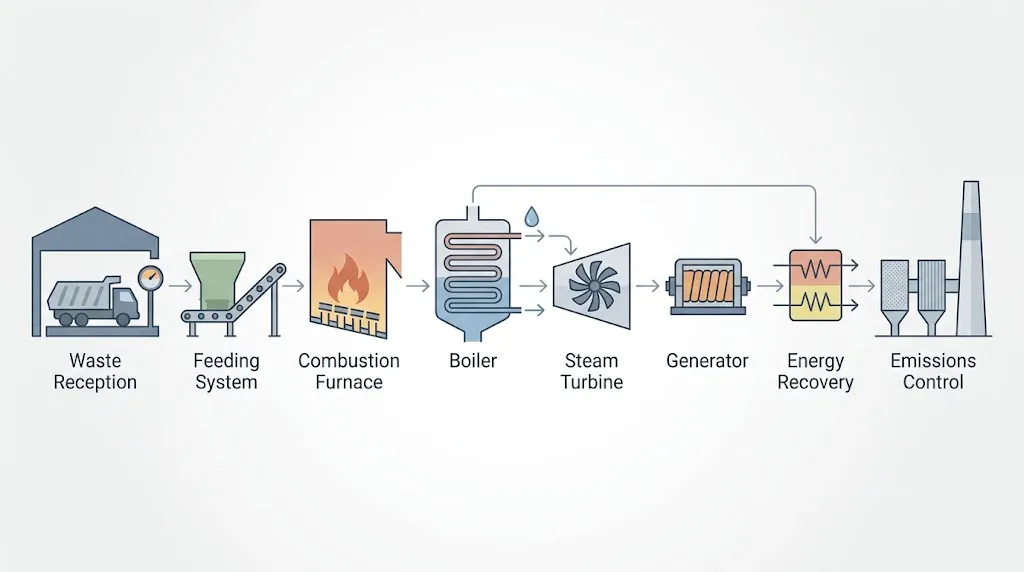
A conventional WTE plant can be simplified into several interconnected process stages.
Waste reception and preparation
Municipal or commercial waste is delivered to the facility and transferred into a waste bunker. Depending on the waste stream and plant configuration, pre-treatment or sorting may be used before the material enters the combustion system.
The composition of incoming waste can vary significantly. Moisture content, calorific value and the proportion of different materials all influence combustion behavior.
This variability is one reason WTE operation is more complex than operating a conventional fuel-fired boiler.
Combustion and heat recovery
Non-recyclable waste is combusted in a furnace. The resulting heat is transferred through a boiler system to produce steam.
The steam can then be used to:
- Generate electricity through a steam turbine
- Supply industrial process heat
- Feed a district heating network
- Support combined heat and power configurations
This basic process is well established. EPA describes energy recovery from waste as including combustion as well as other routes such as gasification, pyrolysis, anaerobic digestion and landfill-gas recovery.
Flue-gas treatment
Combustion produces flue gas containing pollutants that must be controlled before discharge.
Depending on the plant and regulatory requirements, treatment systems may address particulate matter, acid gases, nitrogen oxides, mercury and other contaminants.
This stage can involve several pieces of equipment and chemical processes, making it an important area for monitoring.
Residue and ash management
Combustion produces bottom ash and other residues. Bottom ash can undergo treatment and material recovery, including the extraction of ferrous and non-ferrous metals in some facilities.
The plant therefore operates as more than an electricity generator. It is a combination of waste-treatment, energy-recovery and environmental-control systems.
That complexity creates a large amount of operational data.
3. Where Digitalization Creates the Most Value
A digital WTE strategy should not start with the question, “Where can we use AI?”
A better starting point is:
Which operational decisions are currently difficult, slow or dependent on manual interpretation?
Several areas are particularly suitable.
3.1 Combustion optimization
Waste is not a standardized fuel. Operators need to respond to changing feedstock conditions while maintaining stable combustion.
Digital systems can combine information such as:
- Furnace temperature
- Oxygen concentration
- Waste-feed rate
- Combustion-air flow
- Steam production
- Pressure and temperature
- Historical operating patterns
The objective is to help operators identify changes in process behavior earlier and maintain stable operation.
The value is not necessarily an autonomous furnace. In many cases, the more practical application is decision support for operators.
3.2 Energy-production optimization
Energy output depends on the relationship between waste characteristics, combustion conditions, boiler performance and downstream equipment.
A digital platform can track:
- Steam production
- Turbine performance
- Electricity generation
- Heat export
- Auxiliary power consumption
- Condenser conditions
- Boiler and heat-exchanger performance
This allows operators to distinguish between a change caused by the waste feed and a deterioration caused by equipment.
3.3 Flue-gas treatment
Flue-gas treatment is another area where optimization can have operational and environmental value.
Excessive reagent consumption may indicate inefficient control. Insufficient dosing can create compliance risks.
Monitoring reagent consumption together with gas-treatment performance can therefore provide a better picture than looking at either parameter independently.
3.4 Equipment condition
Large WTE facilities contain rotating equipment, pumps, fans, turbines, conveyors, valves, heat exchangers and other critical assets.
Condition monitoring can use variables such as:
- Vibration
- Temperature
- Pressure
- Flow
- Motor current
- Valve position
- Lubrication condition
- Operating hours
The objective is to detect abnormal behavior before it becomes an equipment failure.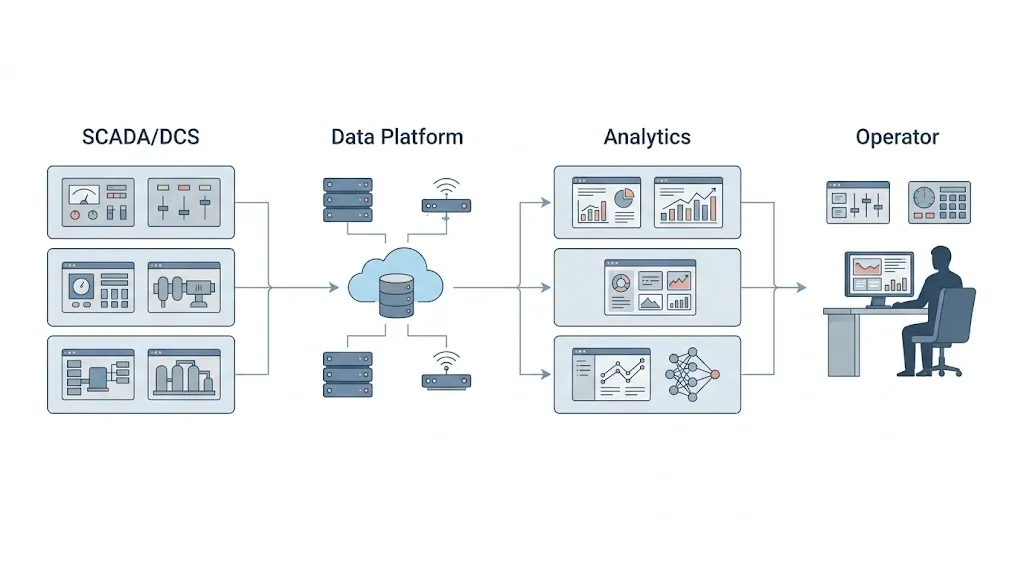
4. From Monitoring to Predictive Maintenance
There is an important difference between condition monitoring, predictive maintenance and prescriptive maintenance.
Approach | Main question | Typical action |
Condition monitoring | What is happening? | Monitor equipment condition |
Diagnostic analytics | What is wrong? | Identify abnormal behavior or probable fault |
Predictive maintenance | What may happen next? | Estimate failure risk or deterioration |
Prescriptive analytics | What should we do? | Recommend an operating or maintenance action |
Traditional maintenance often follows fixed schedules.
For example, a pump may be inspected every six months regardless of its actual condition.
A data-driven strategy can instead combine operating history and equipment-condition information to determine whether an asset is behaving normally.
This does not mean scheduled maintenance becomes unnecessary. Safety-critical equipment and regulatory requirements still require defined inspection and maintenance procedures.
The role of predictive analytics is to provide additional information for maintenance planning.
Research into digital-twin-enabled predictive maintenance has identified applications across asset monitoring, diagnosis and prognostics, while also highlighting practical challenges such as data quality, model complexity and limited failure data.
For WTE operators, this distinction matters.
A digital system that generates thousands of alarms is not necessarily a useful predictive-maintenance system. The real value comes when the system helps answer:
- Which asset requires attention?
- How abnormal is its behavior?
- What operating conditions contributed to the deviation?
- What is the likely consequence if no action is taken?
- Can maintenance be scheduled during a planned outage?
5. AI and Digital Twins in WTE Operations
AI is increasingly discussed alongside industrial digitalization, but not every WTE application requires machine learning.
A useful digital architecture can combine several levels of technology.
Level 1: Data acquisition
Sensors, PLCs, DCS, SCADA and laboratory systems provide the underlying data.
Level 2: Data integration
Data from separate process areas is consolidated into a common platform.
Level 3: Analytics
Historical and real-time data can be used to identify deviations, correlations and performance trends.
Level 4: Predictive models
Machine-learning or physics-based models can estimate equipment condition, process behavior or the likelihood of abnormal events.
Level 5: Decision support
The system converts analysis into an operational recommendation that engineers or operators can review.
This final step is often underestimated.
A prediction without an operational response has limited value.
Where digital twins fit
A digital twin is more than a dashboard. It is generally understood as a continuously updated digital representation of a physical asset or system, connected to operational data and models.
In an industrial environment, it can combine:
Physical equipment → sensors → data platform → models → simulation/analytics → operational decision
Digital-twin research has expanded rapidly across industrial predictive-maintenance applications, but standardization, data quality, model fidelity and integration remain important challenges.
For a WTE facility, a digital twin could eventually represent relationships between:
- Waste-feed characteristics
- Furnace operation
- Boiler performance
- Steam generation
- Turbine operation
- Flue-gas treatment
- Water systems
- Equipment condition
This is more useful than creating isolated digital models for individual machines.
6. The Water-Energy Connection Inside a WTE Plant
This is an area that deserves more attention in discussions about waste-to-energy.
A WTE facility is also a water-intensive industrial process environment.
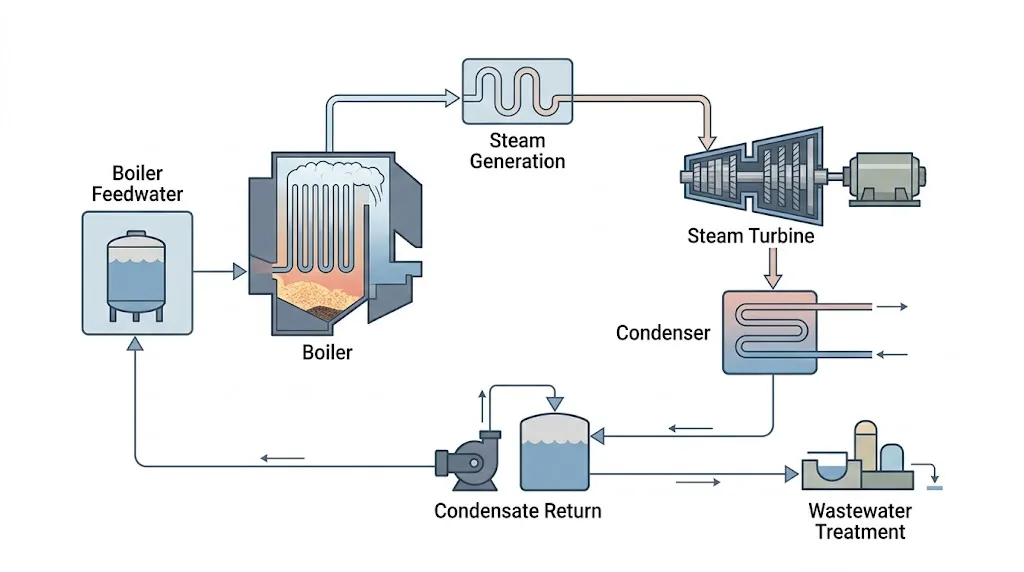
Water can be involved in:
- Boiler feedwater preparation
- Condensate recovery
- Cooling systems
- Steam-cycle operation
- Water treatment
- Flue-gas treatment
- Ash handling
- Wastewater collection and treatment
For water-treatment and flow-control professionals, this creates several relevant technology interfaces.
Boiler feedwater quality
Steam-cycle equipment requires appropriate water chemistry to control corrosion, scaling and deposition.
Monitoring water quality and chemical dosing therefore contributes directly to equipment reliability.
Pumps and valves
Water and steam systems depend on reliable flow control.
Failures involving pumps, valves or actuators can affect production even when the combustion system itself is operating normally.
Digital monitoring can help identify abnormal pressure, flow, valve-position or pump-performance behavior.
Wastewater treatment
WTE facilities can generate wastewater from several process streams. Treatment requirements depend on the plant configuration and local regulatory conditions.
Digital monitoring can help integrate wastewater parameters with other plant data rather than treating water treatment as an isolated utility function.
Cooling and heat recovery
Cooling systems influence overall plant efficiency.
Where useful heat can be exported to district heating or industrial users, the plant’s water and thermal systems become closely linked to its energy-recovery strategy.
This is one reason WTE should be viewed as a multi-utility industrial system, rather than simply an incineration facility.
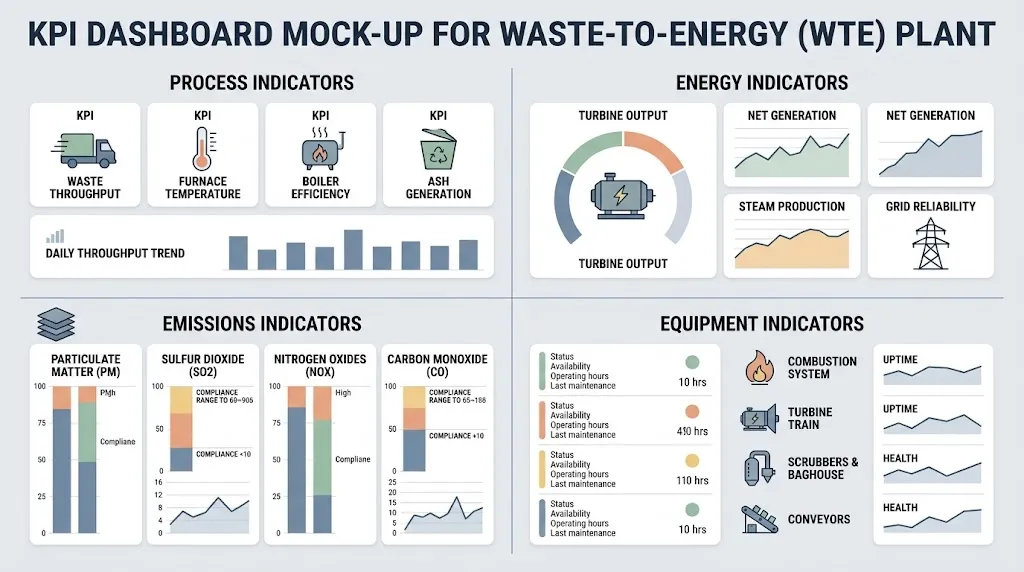
7. Key Data and KPIs to Monitor
A useful digital platform should focus on operationally meaningful indicators rather than simply collecting more data.
Area | Example indicators | Why they matter |
Waste feed | Feed rate, estimated calorific value, bunker levels | Supports combustion stability |
Furnace | Temperature, oxygen, air flow | Indicates combustion conditions |
Boiler | Steam pressure, temperature, heat-transfer performance | Supports energy recovery |
Turbine | Output, vibration, temperature | Tracks power-generation performance |
Flue gas | Pollutant concentrations, reagent consumption | Supports emissions control |
Water systems | Flow, pressure, conductivity, chemistry | Protects steam and water systems |
Pumps/fans | Vibration, current, flow, pressure | Supports condition monitoring |
Maintenance | Alarms, work orders, failure history | Builds asset-performance history |
Energy | Electricity output, heat export, auxiliary consumption | Tracks net energy performance |
The most useful KPI is rarely an isolated measurement.
For example, electricity output should be considered alongside waste throughput, steam production and auxiliary energy consumption.
Similarly, reagent consumption should be interpreted alongside flue-gas treatment performance.
The key is context.
8. What to Consider When Selecting a Digital WTE Solution
For plant owners, EPC contractors and operators, choosing a digital platform should begin with the existing control architecture rather than the marketing terminology.
1. Can it integrate existing systems?
A solution should be able to work with the plant’s existing DCS, PLC, SCADA, historians and other data sources where appropriate.
Replacing the entire control architecture is not necessarily required to introduce advanced analytics.
2. Does it provide plant-wide visibility?
A useful platform should connect process areas rather than creating another isolated monitoring screen.
3. Can operators understand the recommendations?
An algorithm that produces a prediction without explaining the relevant variables or operational context can be difficult to trust.
Human operators remain important, particularly for abnormal and safety-critical situations.
4. Can the system distinguish real problems from bad data?
Sensor drift, communication failures and calibration issues can produce misleading analytics.
Data-quality management is therefore a basic requirement for reliable AI and predictive maintenance.
5. Is the solution scalable?
A plant may initially deploy analytics for turbines or pumps and later expand into combustion, water systems or flue-gas treatment.
The architecture should support this development.
6. How is cybersecurity handled?
Connecting industrial control environments to analytics platforms increases the importance of network segmentation, access control, authentication, patching and other cybersecurity practices.
Digitalization should therefore be considered as part of the plant’s overall operational-technology architecture, not simply as a software purchase.
9. Where the Technology Is Heading
The next stage of digital WTE is unlikely to be defined by a single AI model.
Instead, the direction is toward integrated decision-support systems that connect process control, asset management, environmental monitoring and energy optimization.
Three developments are particularly relevant.
From equipment monitoring to system optimization
Instead of monitoring a pump, turbine or boiler separately, future platforms will increasingly analyze how these assets interact.
From prediction to recommended action
The more useful question will move from:
“What is going wrong?”
to:
“What is the best available response, given the current operating conditions?”
That requires process knowledge, reliable data and engineering validation.
From energy recovery to resource optimization
The modern WTE plant is not only recovering energy.
It can also recover materials, generate useful heat, manage water resources and potentially integrate with other infrastructure.
SUEZ, for example, describes current EfW projects that combine electricity and heat recovery with other resource-recovery applications, including hydrogen production and CO₂-related initiatives.
At the same time, regulatory frameworks are placing increasing emphasis on resource efficiency alongside emissions control. The EU’s revised Industrial and Livestock Rearing Emissions Directive, for example, strengthens the role of BAT-based permitting and includes resource-efficiency requirements covering materials, water and energy where appropriate.
For plant operators, this points toward a broader definition of efficiency.
The goal is no longer simply to maximize electricity generation. It is to optimize the whole system while maintaining environmental compliance, reliability and economic performance.
The Practical Takeaway for WTE Operators
Digitalization does not make a waste-to-energy plant efficient by itself.
The value comes from connecting reliable operational data with engineering knowledge and timely decisions.
For plant owners and operators, a practical digitalization roadmap can start with five questions:
- Which assets or processes cause the greatest operational losses?
- Which data is already available but underused?
- Which failures or deviations could be detected earlier?
- Which operating parameters have the strongest relationship with energy and reagent consumption?
- Can operators turn analytical results into clear maintenance or process actions?
Starting with these questions is often more useful than starting with the latest AI technology.
Waste-to-energy facilities are complex systems involving combustion, energy recovery, water treatment, flow control, emissions control and asset management. As these systems become more connected, digital tools can help operators move from reactive troubleshooting toward more informed, predictive and plant-wide decision-making.
For the water, wastewater, pumping, valve and environmental-technology industries, this creates a growing intersection between waste management, energy recovery, water treatment and industrial digitalization.
Explore the latest technologies for water treatment, pumping, flow control and environmental infrastructure at WATERTECH CHINA 2027.

