







Many homeowners assume that municipal water is already treated to an ideal condition. After all, city water goes through treatment and disinfection before reaching household taps. But does that mean it is free from hard water minerals?
Not necessarily. Municipal treatment is designed primarily to meet drinking water quality requirements, and it does not always include water softening. Depending on the local water source and treatment process, tap water may still contain significant amounts of calcium and magnesium.
These minerals are not generally a health concern, but they can contribute to scale buildup, soap residue and appliance maintenance problems.
So, do you need a water softener if you have city water? The answer depends on your actual water hardness, household needs and local conditions. This guide explains how to assess your water and choose an appropriate treatment solution.
Quick Takeaways
- City water can still be hard because municipal treatment does not always remove calcium and magnesium.
- Water hardness varies depending on local geology and water treatment practices.
- A water test is the best way to determine whether a softener is necessary.
- Ion-exchange softeners reduce hardness but do not replace general water filtration.
- Salt-based systems require regular regeneration and may have local installation restrictions.
- The right system should match household water use, hardness levels and treatment goals.
1. City Water Is Not Always Soft Water
Municipal water treatment focuses on making water suitable for distribution and consumption by controlling contaminants and harmful microorganisms. However, hardness is a separate water quality parameter.
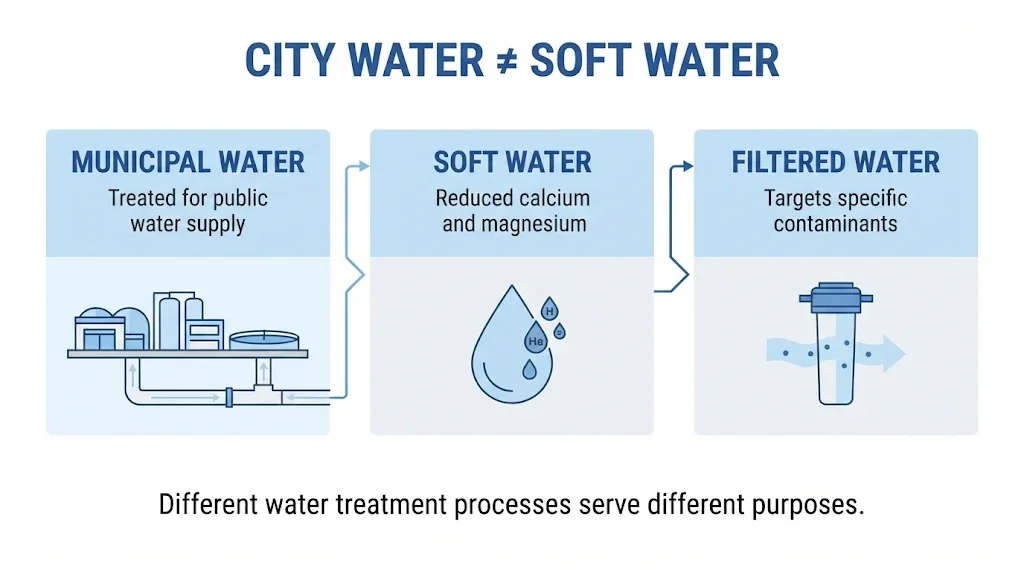
What municipal treatment actually does
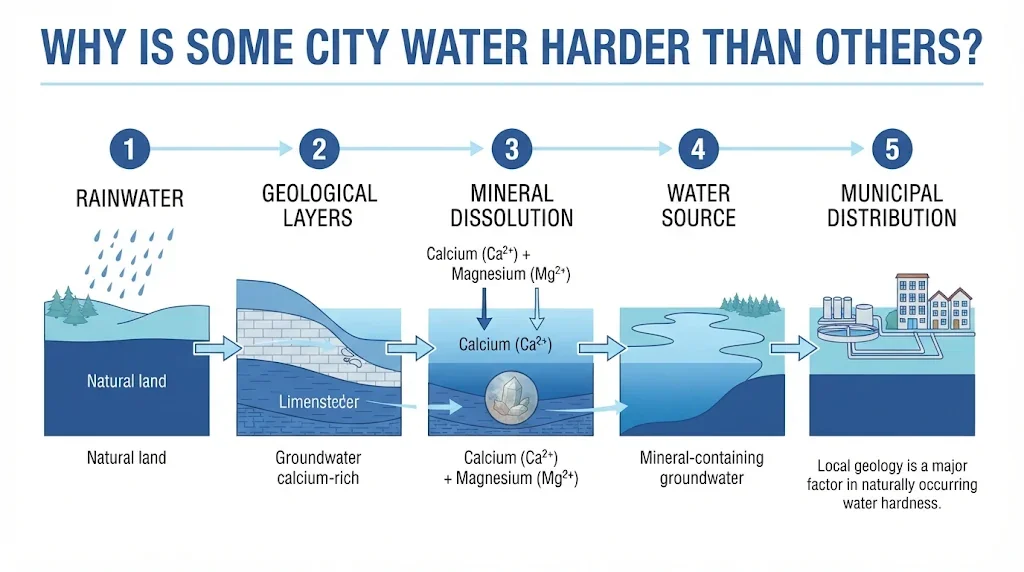
Water collected from rivers, lakes and groundwater sources may contain dissolved minerals. As water moves through soil and rock, it naturally picks up calcium and magnesium.
Conventional treatment processes, including filtration and disinfection, do not necessarily remove these dissolved minerals.
Some municipalities voluntarily soften their water, while others supply water with its natural hardness largely unchanged. Therefore, being connected to a public water supply does not automatically mean your home has soft water.
Why hardness varies by location
Local geology is one of the main factors influencing water hardness. Areas with limestone and other calcium-rich geological formations often have harder water.
According to the U.S. Geological Survey, water hardness is generally classified as follows:
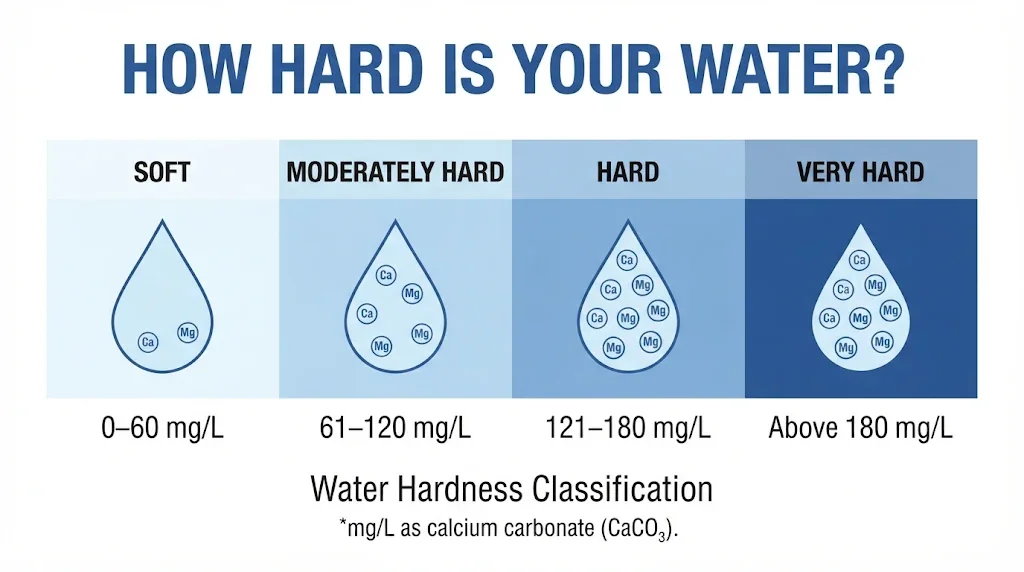
These classifications help homeowners understand their water quality and determine whether additional treatment may be worthwhile.
2. Test Your Water Before Buying a Softener
Before purchasing a residential water softener, it is important to establish the actual hardness level of your tap water.
How to check your water hardness
Start with your local water utility’s water quality report or contact its customer service department to ask whether hardness data is available.
You can also use a home water hardness test kit or arrange laboratory testing for a more detailed result.
The most useful measurement is total hardness expressed as mg/L of calcium carbonate (CaCO₃) or grains per gallon (gpg).
A professional test may also help identify other water quality issues that require a different treatment method.
Testing is particularly important because visible symptoms alone cannot accurately determine the hardness level or identify every possible water quality concern.
3. Signs That Your Home May Have Hard Water
Although testing provides more reliable results, several household problems may indicate excessive mineral content.
Mineral scale and soap performance
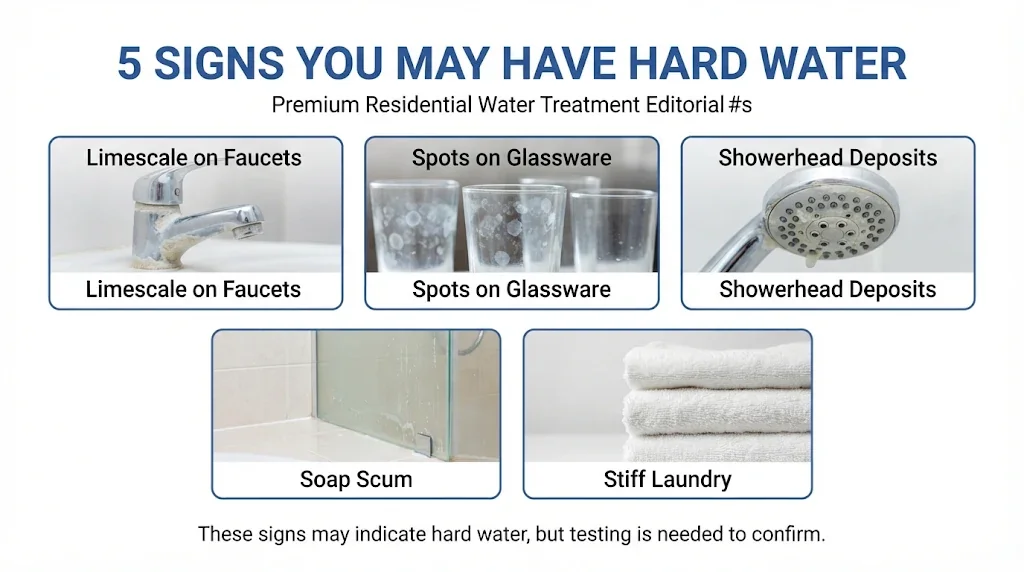
Hard water can leave white or cloudy deposits on glassware, shower doors, faucets and showerheads.
These deposits form as dissolved minerals accumulate on surfaces. Hardness minerals can also react with traditional soaps, producing residue that makes cleaning more difficult.
You may notice:
- White spots on dishes and glassware.
- Mineral buildup around faucets and showerheads.
- Soap residue on bathroom surfaces.
- Reduced soap lather during bathing and cleaning.
Household maintenance and appliance performance
Mineral deposits may accumulate inside water heaters, pipes and other water-using appliances.
Over time, scale can reduce heat transfer efficiency and contribute to maintenance requirements. Laundry may also feel stiff or require more detergent in hard water.
However, these symptoms are indicators rather than proof. Testing is still necessary before selecting a treatment system.
4. What Does a Water Softener Actually Do?
Most conventional residential water softeners use ion exchange to reduce hardness minerals.
Understanding ion exchange
Inside the system, water flows through a tank containing specialized resin beads. These beads exchange calcium and magnesium ions for sodium or potassium ions.
As a result, the treated water contains fewer hardness minerals, helping reduce scale formation and soap-related problems.
Regeneration and salt consumption
Over time, the resin becomes saturated with hardness minerals and needs regeneration.
A brine solution, usually made from sodium chloride or potassium chloride, flushes the accumulated minerals from the resin and restores its softening capacity.
This process consumes both salt and water. Therefore, equipment efficiency and regeneration settings influence the system’s long-term operating cost.
Some systems use demand-initiated regeneration, which triggers the process according to actual water usage rather than a fixed schedule. This can help reduce unnecessary salt and water consumption.
The U.S. Environmental Protection Agency recommends considering water-efficient equipment and checking local restrictions before installation.
5. When Do You Actually Need a Water Softener?
Not every household using municipal water needs additional softening.
A system may be worthwhile when water hardness is substantial and causes recurring problems with fixtures, appliances or household cleaning.
Softening may help reduce mineral scale, improve soap performance and lower the maintenance burden on certain water-using appliances.
On the other hand, homes with naturally soft or moderately hard water may not need a dedicated system.
There are also trade-offs to consider. Salt-based softeners increase sodium in treated water and discharge chloride during regeneration. Some local jurisdictions restrict their use to protect wastewater systems and freshwater environments.
For households concerned about sodium intake, an unsoftened drinking-water connection or alternative regeneration medium may be worth discussing with a qualified water professional.
The best decision is based on measured water quality and actual household needs, not simply the fact that a home uses city water.
6. Water Softener vs. Water Filter: What Is the Difference?
A common mistake is assuming that a water softener can solve every municipal water quality issue.
In fact, different treatment technologies serve different purposes.
| System | Main purpose |
|---|---|
| Water softener | Reduces calcium and magnesium hardness |
| Activated carbon filter | Targets certain chlorine-related taste and odor issues and other specified contaminants |
| Reverse osmosis | Reduces selected dissolved substances, depending on system design and certification |
| Sediment filter | Removes suspended particles |
For example, if your main concern is mineral scale, a water softener may be appropriate. If chlorine taste or odor is the issue, an activated carbon filtration system may be more relevant.
Some households may require a combination of technologies, but treatment should always be based on water testing and clearly defined performance needs.
A softener should not be considered a substitute for a water purifier or a system designed to remove specific contaminants.
7. How to Choose the Right Residential Water Treatment System
Once the water quality issue has been identified, selecting suitable equipment becomes much easier.
Consider these factors:
- Treatment capacity: Match the system’s grain capacity to water hardness and household consumption.
- Regeneration efficiency: Look for demand-initiated systems that avoid unnecessary regeneration.
- Certification: NSF/ANSI 44 provides performance and material-safety requirements for residential cation-exchange softeners using sodium or potassium chloride.
- Maintenance: Consider salt requirements, water consumption, resin maintenance and replacement costs.
- Local requirements: Check whether salt-based softeners are permitted and whether plumbing or installation rules apply.
Avoid oversizing equipment or treating water that does not require softening. A properly selected system can deliver the intended performance with less unnecessary resource consumption.
8. Discover Residential Water Treatment Solutions at WATERTECH CHINA
The growing interest in residential water quality is driving innovation across the water purification and conditioning industry.
For international buyers, distributors and industry professionals, WATERTECH CHINA provides an opportunity to explore technologies for household and commercial water treatment.
Explore the latest industry solutions at WATERTECH CHINA 2027 | Water Technology Expo Shanghai.
Conclusion
Having city water does not necessarily mean your home has soft water. Municipal treatment and water softening serve different purposes, and the concentration of calcium and magnesium depends largely on the local water source and treatment process.
Before investing in a residential softener, check your water hardness, review the local water quality report and identify the specific problems you want to solve.
If additional treatment is necessary, consider how ion exchange, filtration and other technologies address different water quality requirements. Equipment capacity, certification, regeneration efficiency and environmental impact should all be part of the decision.
The goal is not to install the most advanced system available, but to choose the treatment solution that matches your water quality and household needs.
Frequently Asked Questions
1. Do I need a water softener if I have city water?
Not necessarily. Some municipal supplies are naturally soft, while others contain higher levels of calcium and magnesium. Test your water before deciding.
2. How do I know if my city water is hard?
Check your local water quality report or use a water hardness test kit. Mineral deposits on faucets, glassware and showerheads may also indicate hard water.
3. Does a water softener remove chlorine?
A conventional ion-exchange softener is designed to remove hardness minerals, not chlorine. An appropriate filtration system, such as activated carbon, may be needed for chlorine reduction.
4. Is softened water safe to drink?
Ion-exchange softeners add sodium or potassium as they remove calcium and magnesium. The sodium increase depends on the initial hardness. People who need to limit sodium should consider an unsoftened drinking-water connection or consult a qualified health professional.
5. How often does a water softener need maintenance?
Maintenance depends on the equipment and water conditions. Typical tasks include checking salt levels, inspecting the brine tank, monitoring regeneration performance and following the manufacturer’s cleaning schedule.
Share Your Experience
Does your home use municipal water, and have you experienced mineral scale or other hard water problems?
Share your experience with other readers and pass this guide along to anyone exploring residential water treatment solutions.
References
- U.S. Geological Survey. Hardness of Water.
- U.S. Environmental Protection Agency. Cation Exchange Water Softeners | US EPA.
- University of Minnesota Water Resources Center. Residential Softening.
- Centers for Disease Control and Prevention. About Home Water Treatment Systems.
- NSF. NSF/ANSI 44 Technical Requirements | NSF.

