







A New MABR Deployment Highlights the Shift Toward Wastewater Process Intensification
Wastewater treatment plants are facing a combination of challenges: increasing influent volumes, tighter nutrient discharge requirements, limited expansion space and rising energy costs. For many municipal utilities, expanding treatment capacity is no longer simply a matter of constructing larger tanks or adding conventional aeration equipment. Improving the performance of existing infrastructure has become an equally important priority.
A recent project in California illustrates this shift. On November 17, 2026, DuPont announced that its OxyMem™ membrane aerated biofilm reactor (MABR) modules had been selected for an upgrade at the Windsor Water Reclamation Facility in Windsor, California. The project represents the first municipal deployment of OxyMem MABR modules in the United States.
Developed in collaboration with Black & Veatch, MISCOwater and United Flow Technologies, the planned upgrade is intended to increase biological nutrient removal capacity while accommodating future demand within a space-constrained facility. The project also aims to support compliance with nitrogen and phosphorus discharge requirements and reduce the energy demand associated with biological treatment.
The project reflects a broader development in wastewater engineering: the growing interest in process intensification technologies that improve treatment performance without requiring equivalent increases in plant footprint.
Among these technologies, MABR is attracting attention for its approach to oxygen delivery and biofilm-based biological treatment.
What Is Membrane Aerated Biofilm Reactor Technology?
A membrane aerated biofilm reactor (MABR) is a biological wastewater treatment technology that uses gas-permeable membranes to deliver oxygen directly to microorganisms growing on the membrane surface.
Unlike conventional aeration systems, which introduce air bubbles into wastewater, MABR supplies oxygen through the membrane wall. This creates a biofilm-based treatment environment in which microorganisms can break down organic pollutants and convert nitrogen compounds.
The technology combines two established wastewater treatment principles:
- Membrane-based gas transfer: Oxygen passes through a gas-permeable membrane without requiring conventional bubble aeration at the biofilm surface.
- Attached-growth biological treatment: Microorganisms form a biofilm on the membrane, where they carry out biological reactions.
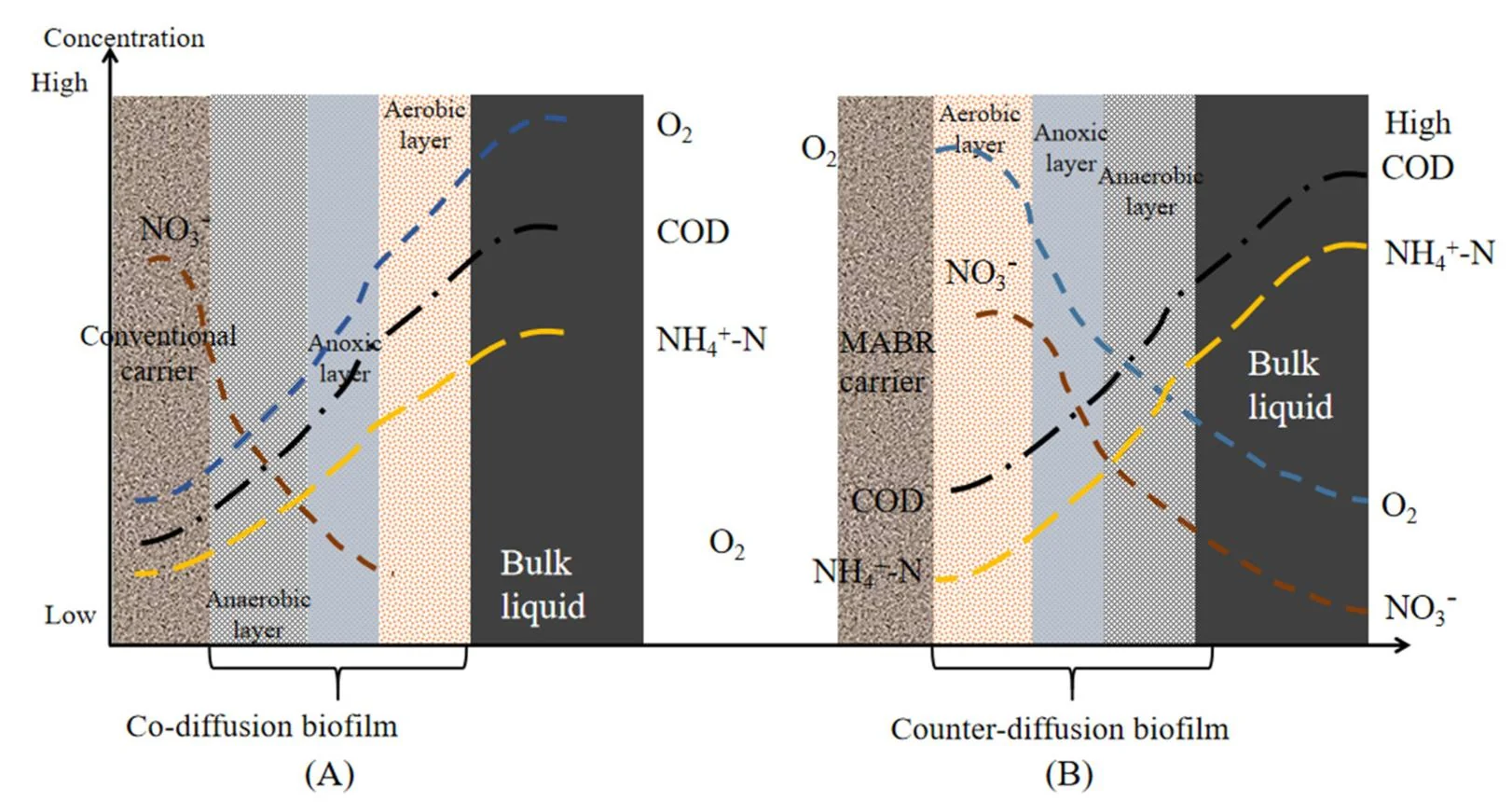
A particularly important feature is the counter-diffusional arrangement. Oxygen enters the biofilm from the membrane side, while wastewater pollutants diffuse from the surrounding liquid toward the biofilm.
This opposing diffusion pattern can create different oxygen conditions within the biofilm, supporting multiple biological reactions in relatively close proximity.
In hybrid MABR systems, membrane-supported biofilms operate alongside suspended-growth microorganisms, combining attached-growth and activated-sludge processes.
The technology has moved beyond laboratory research. Commercial MABR applications have been developed since the mid-2010s, with increasing attention to full-scale municipal wastewater treatment. A 2025 review in Water Environment Research examines recent developments in hybrid MABR design, nutrient removal and operational control. Source.
How Does MABR Technology Work?
Understanding the oxygen transfer mechanism is essential to understanding the potential advantages of MABR.
1. Oxygen is supplied through gas-permeable membranes
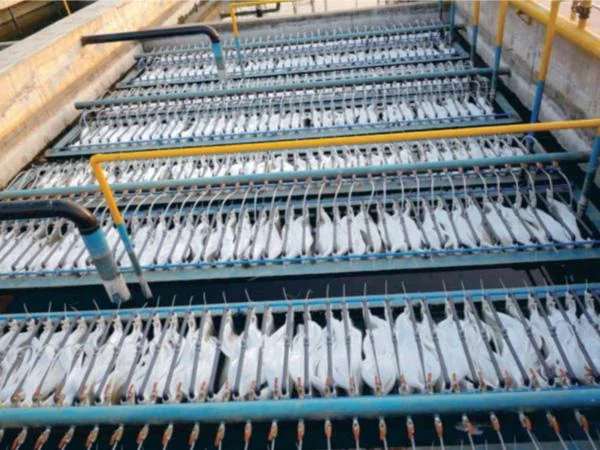
MABR modules generally contain membrane elements, often configured as hollow fibres or other high-surface-area structures.
Air or oxygen-containing gas is supplied to the membrane interior. Oxygen then diffuses through the membrane wall into the biofilm growing on its external surface.
Because oxygen is transferred directly to the biofilm, the process does not rely on conventional fine-bubble aeration to deliver oxygen throughout the treatment tank.
This can reduce the energy associated with oxygen transfer, although actual savings depend on system design, gas supply requirements, mixing and overall plant operation.
2. Microorganisms develop a biofilm on the membrane surface
The membrane surface provides an attachment area for microorganisms.
As wastewater flows around the membrane modules, dissolved organic matter and nitrogen compounds move from the liquid into the biofilm. Microorganisms use these substances in biological treatment reactions.
The biofilm retains a concentrated microbial population at the treatment surface, which can help maintain biological activity under operating conditions where suspended-growth systems may require longer solids retention times.
3. Different biological reactions occur within the biofilm
One of the most distinctive characteristics of MABR is the development of oxygen gradients within the biofilm.
The inner region, closer to the membrane, generally receives more oxygen and supports aerobic microorganisms, including ammonia-oxidizing bacteria.
Further away from the membrane, oxygen concentrations may decrease. Depending on biofilm thickness, wastewater composition and operating conditions, anoxic regions can develop where denitrification takes place.
This arrangement creates opportunities for nitrification and denitrification to occur within the same biofilm structure.
4. Treated wastewater moves through downstream treatment stages
MABR is not necessarily a complete standalone treatment solution.
In many applications, it is integrated into a hybrid process that includes suspended-growth biological treatment and additional treatment stages.
Depending on discharge requirements, the overall treatment train may include:
- Preliminary screening and grit removal
- Primary treatment, where applicable
- Biological treatment using MABR and suspended growth
- Secondary clarification or solids separation
- Tertiary filtration
- Disinfection
- Sludge treatment and handling
The final configuration depends on influent characteristics, treatment objectives, regulatory requirements and the existing plant layout.
MABR vs. MBR vs. Conventional Activated Sludge
Although MABR and MBR both use membranes in wastewater treatment, their functions are fundamentally different.
Confusing these technologies can lead to incorrect equipment selection and unrealistic expectations during project planning.
| Technology | Main Function | Membrane Role | Typical Application |
|---|---|---|---|
| MABR | Biological wastewater treatment | Supplies oxygen to attached biofilm | Nutrient removal and process intensification |
| MBR | Biological treatment and solids separation | Separates treated water from biomass | High-quality effluent and water reuse |
| Conventional Activated Sludge | Suspended-growth biological treatment | No biological membrane required | Municipal and industrial wastewater treatment |
MABR vs. Conventional Activated Sludge
Conventional activated sludge systems introduce oxygen through mechanical aerators or diffused-air systems.
Microorganisms remain suspended in mixed liquor, and oxygen transfer takes place through gas-liquid contact.
MABR changes this arrangement by supplying oxygen through membranes directly to attached biofilms.
The potential advantages include:
- More efficient oxygen transfer under suitable conditions.
- Higher concentrations of retained biofilm microorganisms.
- Opportunities for simultaneous nitrification and denitrification.
- Reduced dependence on conventional aeration in hybrid configurations.
- Potential for upgrading existing treatment infrastructure.
However, conventional activated sludge remains a well-established and flexible process. Its extensive operating history, established design practices and broad supplier base make it suitable for many wastewater treatment applications.
MABR vs. MBR
MBR systems use membrane filtration to separate treated water from biological solids.
MABR membranes, by contrast, function primarily as gas-transfer surfaces supporting biological growth.
This distinction is important:
- MBR membranes are selected for filtration performance, including permeability, solids rejection and fouling resistance.
- MABR membranes are selected for gas permeability, oxygen transfer, biofilm support and durability under operating conditions.
MABR should therefore not be considered a direct replacement for MBR. The two technologies address different treatment functions and may even be incorporated into different stages of a broader treatment system.
Key Benefits of MABR in Wastewater Treatment
The potential advantages of MABR are closely connected to its oxygen transfer mechanism and biofilm structure.
1. Improved Oxygen Transfer Efficiency
Conventional aeration systems must transfer oxygen from rising air bubbles into wastewater. Some of the supplied oxygen escapes without being absorbed.
MABR delivers oxygen through gas-permeable membranes directly to attached microorganisms, avoiding the need for conventional bubble-based oxygen delivery at the membrane surface.
This can improve oxygen utilization and reduce aeration energy requirements.
However, total energy consumption must be evaluated at the process level. Membrane gas supply, recirculation, mixing, pumping and downstream treatment all contribute to plant energy demand.
2. Enhanced Biological Nitrogen Removal
Nitrogen removal is a major challenge for municipal wastewater treatment facilities, particularly where discharge limits are becoming more stringent.
MABR biofilms can support nitrification in oxygen-rich regions and denitrification in oxygen-limited regions.
This arrangement creates opportunities for simultaneous nitrification and denitrification (SND).
Hybrid MABR systems can also combine biofilm activity with suspended-growth biological treatment, providing additional flexibility in process configuration.
A 2025 review identifies improved biological nutrient removal as one of the major development areas for hybrid MABR technology. Source.
3. Potential for Wastewater Plant Upgrades Without Major Expansion
Expanding a wastewater treatment facility can involve substantial construction costs, land requirements and operational disruption.
MABR modules offer a modular approach to process intensification. Depending on the existing reactor configuration and hydraulic conditions, modules may be incorporated into existing treatment tanks.
This can help utilities increase biological treatment capacity without necessarily constructing an entirely new treatment train.
Nevertheless, retrofit feasibility must be assessed against tank geometry, hydraulic retention time, available membrane surface area, mixing requirements and existing process performance.
4. Reduced Aeration-Related Energy Demand
Aeration is a significant energy-consuming operation in many wastewater treatment plants.
By supplying oxygen through membranes, MABR can reduce the amount of conventional aeration required for biological treatment.
The 2025 Water Environment Research review discusses hybrid configurations in which energy demand can be substantially reduced compared with conventional Modified Ludzack-Ettinger (MLE) processes under specific modeled and studied conditions.
These findings should not be treated as guaranteed savings for every facility. Actual performance depends on influent loading, process design, temperature, aeration strategy and the extent of MABR integration.
5. Modular and Scalable Process Design
Modular MABR systems can provide flexibility when treatment demand increases gradually.
Utilities may be able to add treatment modules as population growth or industrial wastewater flows increase, subject to available reactor capacity and engineering constraints.
This approach is particularly relevant to facilities where land availability is limited or phased investment is preferred.
Where Can MABR Technology Be Applied?
MABR is particularly relevant to biological wastewater treatment applications where nutrient removal, process intensification or energy efficiency are important considerations.
Municipal Wastewater Treatment Plants
Municipal facilities are among the most relevant applications.
Growing populations and changing discharge requirements can place pressure on existing wastewater treatment infrastructure.
MABR may be considered for:
- Increasing biological treatment capacity.
- Improving nitrogen removal.
- Upgrading existing activated sludge facilities.
- Reducing conventional aeration requirements.
- Accommodating future treatment demand.
The Windsor project announced by DuPont is an example of this application direction.
Industrial Wastewater Treatment
Industrial wastewater streams can vary significantly in organic loading, nitrogen concentration, temperature, pH and chemical composition.
MABR may be considered for selected industrial wastewater applications, particularly where biological nitrogen removal is required.
Potential sectors include:
- Food and beverage processing.
- Chemical manufacturing.
- Pharmaceutical production.
- Industrial parks and manufacturing facilities.
- Other industries generating biodegradable wastewater.
However, industrial applications require careful assessment of toxicity, salinity, inhibitory substances and variations in wastewater composition. A technology that performs well on municipal wastewater may not deliver the same results on a complex industrial stream.
Wastewater Treatment Plant Retrofitting
Retrofitting is an important potential market for MABR.
Instead of replacing an entire biological treatment system, utilities may evaluate whether membrane modules can be incorporated into existing tanks to increase treatment capacity or improve nutrient removal.
This can be particularly attractive where:
- Existing tanks have limited expansion potential.
- Nitrogen discharge limits are becoming more demanding.
- Additional treatment capacity is required.
- Conventional aeration energy is a major operational concern.
A detailed process evaluation is essential before selecting a retrofit solution.
Engineering Considerations Before Selecting MABR
Despite its potential advantages, MABR is not automatically the best option for every wastewater treatment facility.
Engineers and project owners should evaluate the following factors before selecting the technology.
1. Influent Wastewater Characteristics
The composition of influent wastewater directly affects biological treatment performance.
Important parameters include:
- Chemical oxygen demand (COD).
- Biochemical oxygen demand (BOD).
- Ammonia nitrogen.
- Total nitrogen.
- Total suspended solids (TSS).
- Temperature.
- pH and alkalinity.
- Potential inhibitory or toxic substances.
Carbon availability is particularly important for denitrification. If biodegradable carbon is insufficient, additional process adjustments or external carbon sources may be required.
2. Membrane Configuration and Oxygen Supply
Membrane material, surface area, packing density and gas supply configuration influence oxygen transfer performance.
Engineers should assess:
- Membrane permeability and durability.
- Available membrane surface area.
- Gas pressure and flow requirements.
- Oxygen transfer capacity.
- Module arrangement and hydraulic distribution.
- Potential for membrane damage or performance deterioration.
The design should ensure that oxygen delivery is sufficient for the intended biological loading without creating unnecessary operating costs.
3. Biofilm Thickness and Process Control
Biofilm growth is central to MABR performance, but excessive accumulation can affect mass transfer and biological activity.
A biofilm that becomes too thick may develop unwanted diffusion limitations, reducing the effectiveness of treatment.
Operational strategies may therefore include:
- Monitoring ammonia and nitrate concentrations.
- Controlling membrane gas supply.
- Managing hydraulic conditions.
- Periodic biofilm scouring where required.
- Monitoring dissolved oxygen and oxidation-reduction potential.
Recent research has also explored the use of off-gas oxygen measurements and ammonia monitoring as indirect indicators of biofilm condition, creating opportunities for more responsive process control. Source.
4. Energy Consumption and Lifecycle Cost
Energy efficiency should be evaluated across the entire treatment process rather than through oxygen transfer efficiency alone.
A useful lifecycle assessment should include:
| Cost Factor | Evaluation Consideration |
|---|---|
| Capital expenditure | Modules, tanks, installation and integration |
| Energy | Gas supply, pumping, mixing and auxiliary equipment |
| Maintenance | Membrane inspection, cleaning and replacement |
| Process performance | Nitrogen removal, effluent quality and capacity |
| Operational flexibility | Response to flow and loading variations |
| Lifecycle cost | Total cost over the expected operating period |
The most appropriate solution is the one that achieves the required treatment performance at an acceptable total lifecycle cost, not necessarily the one with the lowest initial equipment price.
5. Integration With Existing Treatment Systems
MABR retrofits require more than simply installing membrane modules in an existing tank.
Engineers should review:
- Existing tank dimensions and structural condition.
- Hydraulic retention time.
- Flow distribution and mixing.
- Sludge handling capacity.
- Downstream clarification requirements.
- Existing aeration and pumping infrastructure.
- Control-system compatibility.
Pilot testing or staged commissioning may be appropriate when influent conditions are variable or full-scale performance is difficult to predict.
The Future of MABR in Sustainable Wastewater Management
MABR development is increasingly focused on improving process integration, nutrient removal and operational control.
Several areas deserve attention.
Advanced biological nitrogen removal: Research is investigating how different biofilm environments can support partial nitrification, denitrification and other nitrogen transformation pathways. The integration of partial nitritation and anammox is also an area of ongoing development, rather than a universal capability of commercial MABR systems.
Hybrid treatment configurations: Combining membrane-supported biofilms with suspended-growth processes provides opportunities to improve biological nutrient removal while retaining the carbon-processing capabilities of activated sludge.
Smarter process monitoring: Online ammonia measurements, off-gas oxygen monitoring and other process indicators may help operators better understand biofilm activity and adjust aeration conditions.
Lower-carbon wastewater treatment: More efficient oxygen transfer and reduced conventional aeration demand can contribute to lower operational energy consumption. However, whole-plant greenhouse gas performance must also account for direct emissions, particularly nitrous oxide, as well as electricity sources and chemical use.
These developments suggest that MABR should be considered as part of a broader shift toward more efficient, flexible and resource-conscious wastewater treatment systems.
For utilities, engineers and technology suppliers, the key question is not simply whether MABR can replace an existing process. It is whether the technology can improve the performance of a particular treatment facility under its actual hydraulic, biological and regulatory conditions.
As wastewater infrastructure faces increasing pressure to deliver higher treatment performance with limited resources, technologies that combine biological process intensification, modular equipment design and efficient oxygen transfer will remain important areas of industry innovation.
Explore the latest wastewater treatment, membrane and environmental technologies at WATERTECH CHINA, where engineering professionals and technology suppliers connect to exchange solutions for the evolving water industry.
8. FAQ
Q1. Is MABR suitable for upgrading existing wastewater treatment plants?
Yes. MABR can be integrated into selected existing biological treatment tanks to increase treatment capacity or improve nitrogen removal. Suitability depends on tank configuration, influent characteristics, hydraulic conditions and available membrane installation space.
Q2. Does MABR remove nitrogen and phosphorus?
MABR can support biological nitrogen removal through nitrification and denitrification. Phosphorus removal may require additional biological or chemical treatment processes, depending on the required effluent quality and system configuration.
Q3. What is the difference between MABR and MBR membranes?
MABR membranes transfer oxygen to biofilms for biological treatment, while MBR membranes separate treated water from suspended solids and microorganisms. Their functions and engineering selection criteria are different.
Q4. What factors affect MABR treatment efficiency?
Key factors include membrane oxygen transfer capacity, biofilm thickness, wastewater temperature, influent loading, carbon availability, hydraulic conditions and aeration control.
Q5. Does MABR require less energy than conventional activated sludge?
MABR can reduce biological treatment energy requirements through more efficient oxygen transfer and reduced conventional aeration. Actual savings depend on the system configuration, influent conditions and whole-plant energy consumption.
Q6. Can MABR be used for industrial wastewater treatment?
Potentially, yes. However, industrial wastewater requires application-specific evaluation, particularly for toxicity, salinity, organic loading and chemical inhibitors. Pilot testing may be necessary before full-scale implementation.

