







Europe’s wastewater sector is entering a new phase of infrastructure investment. Stricter discharge standards, emerging contaminants and energy targets are changing what municipalities and wastewater operators need from their treatment facilities.
The Revised Urban Wastewater Treatment Directive (Directive (EU) 2024/3019) provides the regulatory framework for this transition. However, understanding the legislation is only the first step. For operators and project developers, the more practical question is how to translate its requirements into treatment upgrades, equipment specifications and long-term investment plans.
From nutrient removal and advanced filtration to energy management and digital monitoring, the directive will influence technology demand across the water industry.
This guide takes a project-oriented look at the new requirements, helping international water professionals identify where upgrades may be needed and what to consider when sourcing wastewater treatment solutions.
1. Start with the Plant: Who Needs to Upgrade?
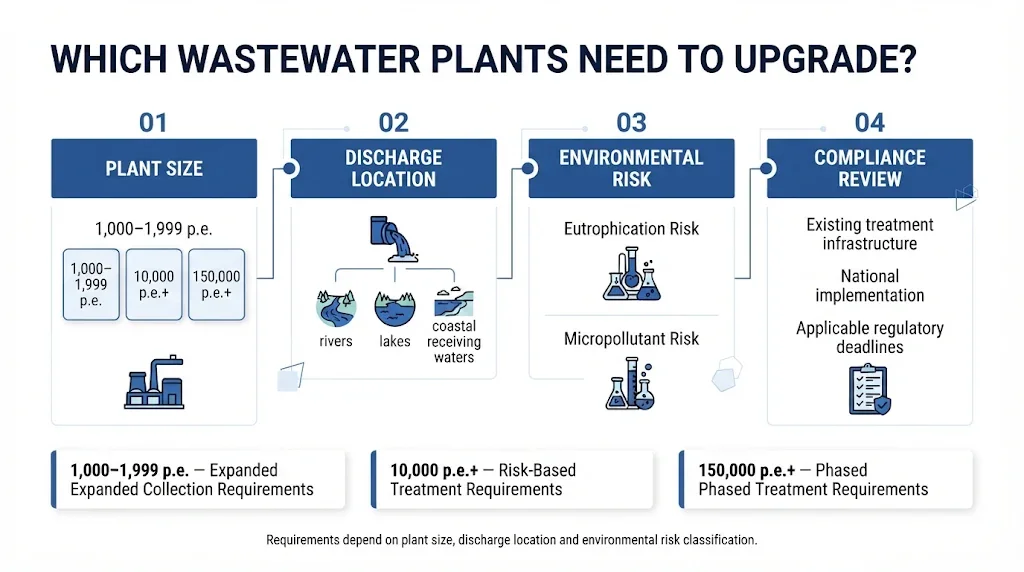
Not every wastewater treatment plant faces the same obligations. The revised directive uses treatment capacity, expressed in population equivalents (p.e.), and environmental risk classification to determine which requirements apply.
It is important to understand that p.e. measures biodegradable organic pollution load rather than simply counting local residents.
Three facility categories to understand
| Facility profile | Main regulatory considerations |
|---|---|
| 1,000–2,000 p.e. | Expanded collection and treatment requirements, generally with deadlines up to 2035 |
| 10,000–150,000 p.e. | Additional nutrient and micropollutant requirements depending on environmental risk classification |
| 150,000 p.e. and above | Phased tertiary and quaternary treatment requirements, alongside energy audits |
For collection systems, agglomerations of 2,000 p.e. and above are covered by the collection requirements, while those between 1,000 and 2,000 p.e. generally have until December 2035, subject to specified derogations.
This means the first step for any upgrade project should be a review of the plant’s actual treatment load, discharge location, existing processes and applicable national implementation measures.
2. Three Treatment Requirements That Will Influence Equipment Demand
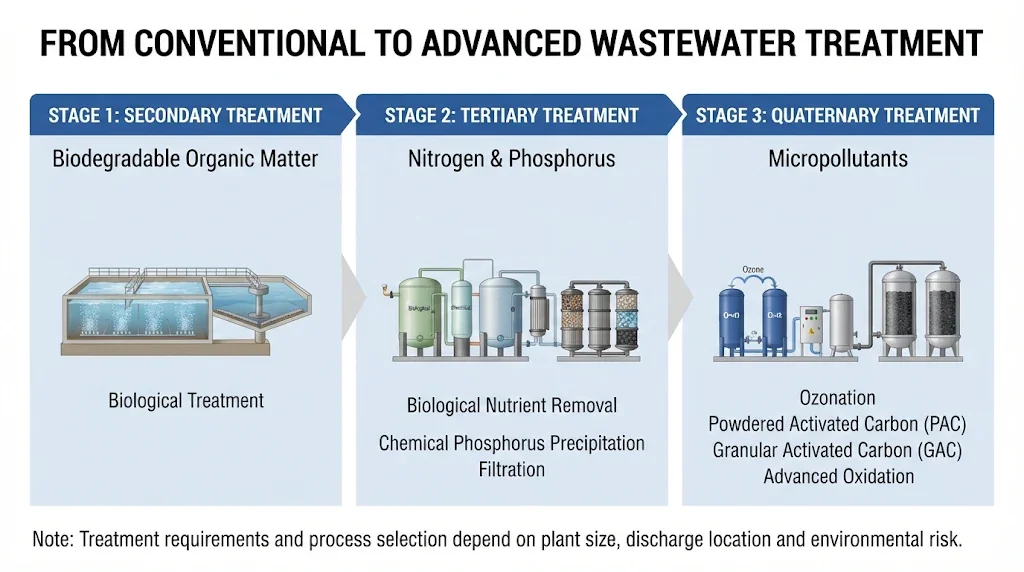
Rather than treating the directive as a single equipment upgrade, operators should separate the treatment requirements according to the pollutants they need to control.
Nutrient removal: Strengthening tertiary treatment
Nitrogen and phosphorus are major contributors to eutrophication, which can cause excessive algae growth and damage aquatic ecosystems.
The revised directive introduces tighter nutrient removal requirements for large treatment facilities and plants discharging into designated sensitive areas.
For relevant facilities of 150,000 p.e. and above, the implementation milestones are 30% by 2033, 70% by 2036 and 100% by 2039. Additional risk-based obligations apply to certain facilities of 10,000 p.e. and above.
Potential technologies include biological nutrient removal, chemical phosphorus precipitation and filtration.
Micropollutant removal: Adding advanced treatment barriers
Pharmaceutical residues, cosmetic ingredients and other trace organic substances may pass through conventional treatment processes.
The directive therefore introduces quaternary treatment requirements to improve micropollutant removal.
For plants treating 150,000 p.e. and above, the phased milestones are:
- 20% by December 2033.
- 60% by December 2039.
- 100% by December 2045.
Additional requirements apply to facilities of 10,000 p.e. and above in identified micropollutant-risk areas.
Which technologies should buyers evaluate?
The directive specifies treatment performance, not one universal equipment configuration. Technology selection should therefore be based on pollutant profiles, existing treatment capacity and operating conditions.
Common options include:
Ozonation: Uses ozone to transform certain organic micropollutants. Operators must also consider ozone demand, transformation products and downstream treatment requirements.
Activated carbon: Powdered activated carbon (PAC) and granular activated carbon (GAC) adsorb a broad range of organic contaminants. Their performance depends on water characteristics, carbon dosage, contact time and media management.
Advanced filtration: Filtration and membrane-based processes can support solids separation and treatment polishing, depending on the selected process configuration.
Research supported by the European Commission’s Joint Research Centre has examined ozonation and activated carbon as important broad-spectrum approaches to micropollutant reduction.
The important point for equipment buyers is that advanced treatment should be designed around measurable removal performance, rather than selecting equipment simply because it carries an advanced-treatment label.
3. How EPR Changes the Economics of Wastewater Projects
One significant change in the revised directive concerns Extended Producer Responsibility (EPR).
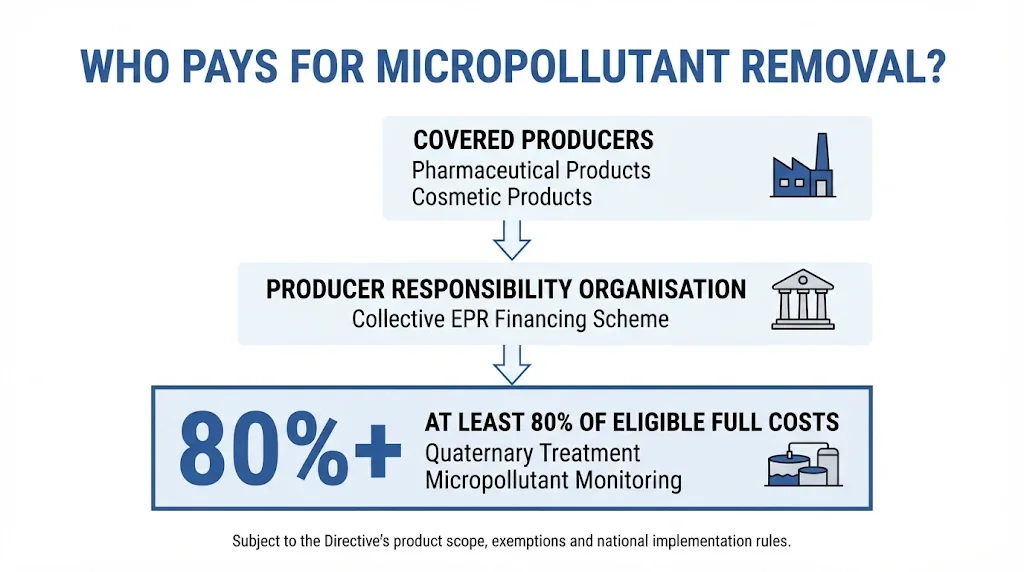
Under the new framework, covered producers placing specified pharmaceutical and cosmetic products on the EU market must contribute at least 80% of the eligible full costs of quaternary treatment and associated micropollutant monitoring.
Member States must establish the relevant EPR measures by 31 December 2028. The directive also provides specific exemption conditions.
For wastewater operators, this introduces a different approach to financing advanced treatment infrastructure. However, it does not remove the need for careful investment planning.
Before selecting equipment, project developers should compare:
- Initial investment and installation costs.
- Electricity, chemical and consumable requirements.
- Maintenance and replacement frequency.
- Treatment performance under actual operating conditions.
- Long-term compatibility with existing infrastructure.
For manufacturers and suppliers, this also means that performance verification, operating efficiency and whole-life costs are increasingly important when presenting advanced treatment solutions to European buyers.
4. Energy Efficiency and Digital Monitoring Become Design Priorities
Upgrading treatment performance can introduce additional energy requirements. Ozonation, pumping, filtration and other advanced processes must therefore be considered alongside the facility’s overall energy strategy.
The directive requires energy audits every four years for operating treatment plants and connected collection systems.
The first audits are due by:
- 31 December 2028: Facilities treating 100,000 p.e. and above.
- 31 December 2032: Facilities treating between 10,000 and 100,000 p.e.
Member States must also meet progressive renewable energy production targets for relevant facilities of 10,000 p.e. and above, reaching 100% of their annual energy consumption at national level by 2045.
For individual plants, the practical challenge is to improve process efficiency while identifying opportunities for biogas utilization, heat recovery and renewable energy generation.
Digital technologies can support this process. Online water quality monitoring, automated dosing, smart sensors and control systems provide operators with better information for maintaining treatment performance and managing energy consumption.
This makes instrumentation and automation important considerations in future wastewater infrastructure projects.
5. A Practical Checklist Before Sourcing New Equipment
For international buyers, the directive creates opportunities, but also makes technology selection more demanding.
Before issuing an equipment specification or requesting supplier quotations, project teams should consider five questions:
- What does the plant need to remove? Establish the relevant discharge requirements and identify whether nutrient or micropollutant removal is required.
- What infrastructure is already available? Assess existing biological treatment, filtration, dosing and monitoring systems.
- How will performance be verified? Define measurable treatment objectives and monitoring requirements.
- What is the total operating cost? Compare energy, chemicals, maintenance and replacement requirements rather than focusing only on purchase price.
- Can the equipment support future upgrades? Consider modular design, automation, system integration and long-term technical support.
For EPC contractors, distributors and municipal project developers, these considerations can help build more reliable specifications and identify suppliers suited to different applications.
Frequently Asked Questions
1. What is the Revised Urban Wastewater Treatment Directive?
Directive (EU) 2024/3019 updates the EU framework for urban wastewater collection and treatment, introducing stricter requirements for nutrient removal, micropollutants, energy performance and monitoring.
2. When must EU Member States implement the new wastewater directive?
The directive entered into force on 1 January 2025. Member States must transpose its provisions into national law by 31 July 2027, and the new framework generally applies from 1 August 2027.
3. Which technologies can remove wastewater micropollutants?
Ozonation, powdered activated carbon, granular activated carbon and suitable combinations of advanced treatment processes are commonly evaluated for micropollutant removal.
4. What is Extended Producer Responsibility in wastewater treatment?
EPR requires covered producers of specified products to contribute at least 80% of the eligible full costs of quaternary wastewater treatment and related micropollutant monitoring.
5. Does every wastewater treatment plant need to achieve energy neutrality?
The directive establishes renewable energy production targets at Member State level for relevant treatment plants of 10,000 p.e. and above. It does not simply require every individual plant to generate all its own energy.
Share Your Perspective
Which technology will see the greatest demand as wastewater standards evolve: advanced filtration, activated carbon, ozonation or smart monitoring?
Share your insights with colleagues and industry professionals, and join the conversation about the future of wastewater treatment.
References
- Urban wastewater – Environment – European Commission
- EUR-Lex — Directive (EU) 2024/3019
- JRC Publications
- EUR-Lex — Directive Summary and Key Requirements

