







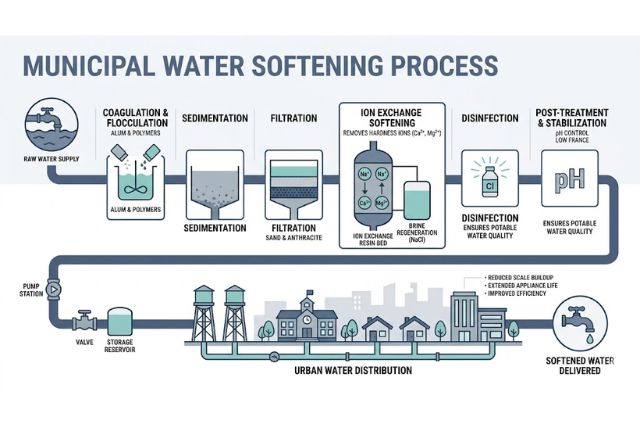
When you turn on a tap in a modern city, you expect safe, clean water. Yet beneath the surface of our streets lies a silent, creeping threat to urban infrastructure: hard water. For city planners and utility managers, mineral scale accumulating inside municipal pipes is far more than a maintenance headache—it can reduce hydraulic efficiency, increase energy consumption, shorten the lifespan of critical infrastructure, and create significant economic costs while making decarbonization goals harder to achieve.
As cities face growing pressure to improve efficiency, reduce emissions, and build more resilient water systems, the focus is shifting beyond simply removing minerals from water. Modern Municipal Water Softening Solutions are increasingly being evaluated as part of a broader strategy for infrastructure protection, energy efficiency, and sustainable water management. In this comprehensive guide, we explore the evolution of city-scale water softening, from traditional lime softening processes to advanced membrane technologies and AI-enabled systems that could reshape urban water management in the years ahead.
1. Understanding the Challenge of Hard Water in Urban Infrastructure
Hard water is characterized by high concentrations of calcium and magnesium ions. While not a direct health risk to humans, these minerals are the primary architects of scale buildup. In a municipal context, this scale acts as an insulator inside pipes and boilers, forcing pumps to work harder and significantly increasing energy consumption.
The Chemical Blueprint of Scale and Its Hidden Costs
When hard water is heated or undergoes pressure changes, these dissolved minerals crystallize. Research indicates that even a 1.5mm layer of scale in a boiler can lead to a 15% increase in energy usage. For a city managing thousands of kilometers of pipeline, this translates to a massive carbon footprint. By implementing robust municipal water softening solutions, cities can extend the life of their assets by up to 25%, drastically reducing the frequency of emergency repairs and pipe replacements.
2. Why Cities Are Prioritizing Water Softening in 2026
The global push for sustainable urban water management has made softening a top priority for utility leaders. It isn’t just about the pipes; it’s about the residents. In cities with hard water, households spend significantly more on detergents, energy for water heating, and the frequent replacement of appliances like dishwashers and laundry units.
Economic Benefits for Residents and Municipal Budgets
A study conducted on European municipalities showed that centralized softening can save a typical household approximately $200 per year in indirect costs. At the municipal level, the ROI (Return on Investment) of a centralized softening facility is often realized within 5-7 years through reduced energy bills and lower chemical costs in downstream wastewater treatment. This is why “Softening-as-a-Service” is becoming a key discussion point at the 9th International Industrial Water Leadership Forum (IWLF).
3. Innovative Technologies in Municipal Water Softening
The “one size fits all” approach to water treatment is dead. Today’s cost-effective hard water treatment for cities involves a diverse portfolio of technologies tailored to local water chemistry.
Pellet Softening: The Actiflo® Technique
One of the most recognized solutions in the industry (pioneered by leaders like Veolia) is pellet softening. This process uses a micro-sand ballasted clarifier to accelerate the precipitation of calcium carbonate. The result is a highly compact footprint—ideal for land-constrained urban environments—and the production of high-purity calcium pellets that can be repurposed in agriculture or the construction industry.
Membrane-Based Softening: The Nanofiltration Revolution
Membrane technology has advanced to the point where nanofiltration (NF) is now a viable option for large-scale municipal projects. Unlike reverse osmosis, which removes nearly everything, NF can be “tuned” to selectively remove hardness while leaving in essential trace minerals. This eliminates the need for massive chemical dosing, making it a “greener” alternative for the 2026 landscape.
4. Environmental Sustainability: Softening Without the Salt
Traditional domestic water softeners rely heavily on salt (sodium chloride) for ion exchange, which eventually ends up in our rivers and groundwater. Centralized municipal water softening solutions mitigate this environmental disaster by managing the brine and chemical byproduct at a single, controlled point.
Decarbonization and Reduced Chemical Usage
Modern systems are focusing on decarbonization in municipal water services. By moving toward pellet softening or low-pressure membranes, utilities can reduce their reliance on harsh chemicals like lime and soda ash. Furthermore, by providing “ready-to-use” soft water to the city, the municipality effectively “decentralizes” the environmental benefit—residents no longer need to run high-energy, salt-wasting home softeners.
5. Case Study Analysis: Successful City-Wide Implementations
Let’s look at real-world data. In the city of Hai Phong, Vietnam—a key partner for the upcoming Vietnam Water Supply & Wastewater Session—the integration of advanced filtration and softening has been a game-changer. By addressing water hardness at the source, the Hai Phong Water Joint Stock Company has seen a 12% reduction in non-revenue water (NRW) related to pipe scale and bursts.
Similarly, in several French municipalities, the implementation of the Actiflo® process has allowed utilities to maintain a constant hardness level despite seasonal fluctuations in raw water quality. This stability is crucial for local industries, such as pharmaceutical and food processing, which require consistent industrial water compliance.
6. Integrating Softening into Smart Water Management Systems
As we enter the era of Smart Water/IoT, softening facilities are becoming increasingly intelligent. Real-time sensors now monitor hardness levels, enabling AI-driven adjustments to chemical dosing and membrane pressure.
AI-Driven Optimization for Resilient Infrastructure
Beyond basic automation, the next frontier in water management lies in digital twin technology. By leveraging machine learning, softening plants can now predict scale formation hours in advance, allowing operators to optimize cleaning cycles, significantly reduce downtime, and cut energy waste. This seamless synergy between “hardware” (pumps and valves) and “software” (AI) is the true hallmark of the resilient cities of tomorrow.
7. Regulatory Compliance and International Standards
Navigating the landscape of global compliance and regulatory standards is a major hurdle for many cities. While the WHO (World Health Organization) provides general guidelines, local regulations—especially in the EU and North America—are becoming stricter regarding the discharge of salt-laden brine.
Municipalities must now design systems that not only produce soft water but also treat the “waste” as a resource. This “Circular Water Economy” is exactly what attendees will explore in our Sludge Disposal and Wastewater Reuse Zones.
8. Choosing the Right Solution for Your City’s Needs
The decision to implement a municipal water softening solution depends on three factors:
1. Raw Water Quality: Is the hardness primarily calcium-based or magnesium-based?
2. Land Availability: Does the city have space for large settling tanks, or does it require compact membrane modules?
3. End-User Profile: Is the water primarily for residential use, or must it meet the ultra-pure standards of a high-tech electronics park?
References & Authority Sources

