







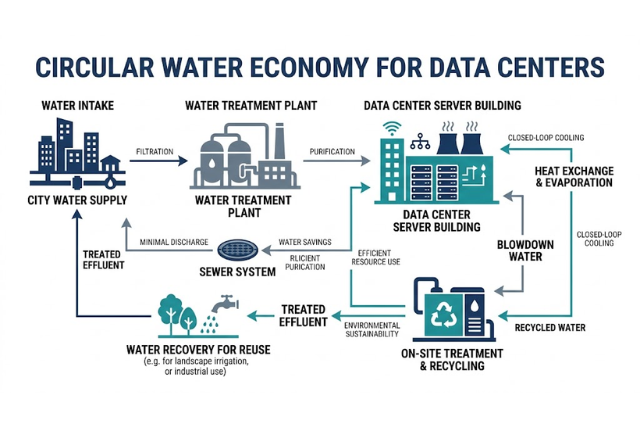
The global explosion of artificial intelligence (AI) and cloud computing has created an insatiable demand for data processing. However, this digital boom comes with a significant environmental price tag: heat. To keep servers running, data centers consume billions of gallons of water annually for cooling. As water scarcity and environmental pressures intensify, the industry is increasingly looking for more sustainable ways to meet this growing demand. The partnership between Veolia and Amazon Web Services (AWS) to develop a reclaimed water cooling system for data centers represents a landmark shift toward a circular water economy.
In this deep dive, we explore how treated municipal wastewater is being transformed into a high-tech cooling medium, the engineering challenges of implementation, and how reclaimed water can help data centers reduce their dependence on freshwater while building more resilient and sustainable cooling systems.
1. The Tech-Water Nexus: Why Data Center Cooling Matters
Every time you query a Chatbot or stream a high-definition video, a server somewhere generates heat. Data centers are essentially massive heat exchangers. Traditional cooling methods often rely on evaporative cooling towers that use vast quantities of potable (drinking) water. In water-stressed regions, this creates a conflict between industrial growth and community needs.
The introduction of a reclaimed water cooling system for data centers decouples digital growth from freshwater consumption. By using recycled water—water that has been used by a city, treated, and then further refined for industrial use—tech giants like AWS can meet their “Water Positive” goals without depleting local reservoirs. This isn’t just an ESG (Environmental, Social, and Governance) checkbox; it is a necessity for the “right to operate” in modern urban environments.
2. Veolia x AWS: A Blueprint for Industrial Symbiosis
The collaboration between Veolia, a global leader in optimized resource management, and AWS is more than a simple service agreement. It is a masterclass in industrial water reuse. Veolia’s expertise in membrane technology and chemical water treatment allows them to take municipal secondary effluent and “polish” it to a grade that is safe and effective for cooling towers.
Unique Insight: The “Water Positive” Strategy
Most tech companies measure efficiency using PUE (Power Usage Effectiveness), but the new gold standard is WUE (Water Usage Effectiveness). Veolia’s role is to ensure that the water entering the AWS system is free of silica, phosphorus, and organic matter that could cause scaling or biofouling in expensive cooling equipment. This partnership highlights how the wastewater reclamation sector is no longer just about “waste”—it is about creating a high-value commodity for the digital age.
3. How a Reclaimed Water Cooling System Works
To understand the complexity, we must look at the technical stages of a reclaimed water cooling system for data centers. It is not as simple as piping treated sewage into a cooling tower. It requires a multi-stage refinery process.
Step 1: Municipal Pre-treatment
Municipal plants treat sewage to a “secondary” level. While clean enough for discharge into rivers, it is far too “dirty” for industrial cooling.
Step 2: Advanced Membrane Filtration
This is where the magic happens. Using Membrane Bioreactors (MBR) and Ultrafiltration (UF), sub-micron particles and bacteria are removed.
Step 3: Reverse Osmosis (RO) and Polishing
To prevent scale (calcium and mineral buildup) that reduces cooling efficiency, the water often undergoes Reverse Osmosis. This ensures a low-conductivity fluid that protects the mechanical integrity of the data center’s HVAC infrastructure.
4. The Environmental Imperative: Beyond Fresh Water
Why are we seeing this massive shift toward reclaimed water cooling systems for data centers now? The answer lies in global water scarcity. According to the United Nations, global water demand is expected to exceed supply by 40% by 2030.
By utilizing recycled water for industrial cooling, data centers reduce their reliance on local municipal drinking water. In Northern Virginia or the Silicon Valley of China (Shanghai/Hangzhou), where data center density is high, this transition can save enough drinking water to support tens of thousands of households. This urban water resilience is a core theme of our upcoming 5th Decentralized Wastewater Treatment Technology Forum.
5. Overcoming the Challenges of Biofouling and Scaling
Using reclaimed water brings technical risks. The higher nutrient content (like nitrogen and phosphorus) in recycled water can lead to biofouling—the growth of algae and bacteria inside cooling loops.
Advanced Chemical Solutions
Veolia utilizes patented chemical inhibitors and automated dosing systems to manage these risks. In a reclaimed water cooling system, real-time water quality monitoring and automated controls can detect changes in water chemistry and respond before scaling or other operational issues occur. When sensors identify an increased risk of scaling, the system can automatically adjust pumps, valves, blowdown rates, or chemical dosing levels to maintain optimal water quality. This integrated “Smart Water” approach helps data centers operate reclaimed water cooling systems reliably while minimizing maintenance requirements and improving overall water efficiency.
6. Economic Benefits: The ROI of Water Circularity
While the initial CAPEX (Capital Expenditure) for a reclaimed water cooling system for data centers is higher than a standard potable system, the long-term ROI is compelling.
1. Lower Utility Costs: Reclaimed water is often priced significantly lower than potable water by municipal authorities eager to find a “customer” for their treated effluent.
2. Regulatory Credits: Many governments offer tax incentives or “green credits” for companies implementing circular water economy solutions.
3. Risk Mitigation: By not relying on the same water source as the local population, data centers are protected from “water shut-offs” during extreme droughts.
7. The Role of AI in Optimizing Water Cooling Efficiency
Ironically, the very AI that creates the heat is now being used to manage the water that cools it. Modern reclaimed water cooling systems for data centers are increasingly integrated with Digital Twin technology.
A digital twin of a cooling loop allows operators to simulate different “what-if” scenarios. What if the outdoor humidity rises by 10%? What if the reclaimed water turbidity increases? By using machine learning, the system optimizes WUE by adjusting evaporation rates and cycles of concentration. This intersection of tech and water is a primary focus of the 2026 Digital Water Innovation Summit.
8. Global Regulatory Landscape: Meet Compliance and Standards
Operating a reclaimed water cooling system for data centers requires navigating a complex web of environmental regulations. In the EU and North America, discharge standards are tightening. In China, the “Water Ten Plan” and subsequent mandates have made industrial water compliance a top priority.
Attendees at the 9th International Industrial Water Leadership Forum (IWLF) will have the opportunity to hear from global regulators on the future of water reuse standards, ensuring their facilities remain future-proof and compliant with international ESG frameworks.
9. Case Study: AWS and the Path to “Water Positive”
Amazon Web Services has pledged to be water positive by 2030. A cornerstone of this strategy is the use of reclaimed water. In regions like Northern Virginia and Umatilla, Oregon, AWS has partnered with local utilities to build the infrastructure needed to transport treated wastewater directly to their facilities.
This model is now being exported globally. In China, similar “industrial-municipal partnerships” are blooming. These case studies prove that a reclaimed water cooling system for data centers is not just a theoretical concept—it is a commercially viable, scalable solution that is being deployed at the gigawatt scale.
Frequently Asked Questions (FAQ)
Q1: Is reclaimed water safe for data center staff?
A: Yes. The reclaimed water cooling system for data centers utilizes advanced filtration (RO/UV) that meets industrial safety standards, ensuring no harmful pathogens or aerosols are released into the atmosphere.
Q2: Does recycled water cause more equipment corrosion?
A: Not if properly treated. Specialized Chemical Pumps & Valves and advanced polishing ensure the water chemistry is balanced to prevent scaling and corrosion.
Q3: What is WUE?
A: Water Usage Effectiveness (WUE) is a metric used to measure the sustainability of a data center’s water consumption. It is calculated by dividing annual water usage by IT equipment energy.
Q4: Can small data centers use these systems?
A: While large hyperscale centers see the fastest ROI, modular “package” reclamation plants are making this technology accessible for smaller facilities.
Authority References

