







Water utilities lose billions of gallons of clean water through aging pipes every year. Instead of waiting for visible breaks, operators now use artificial intelligence to locate hidden leaks and predict network failures early. Today, heavy industry is adopting these exact same tools to secure their private factories and meet strict environmental goals.
Water loss remains one of the most stubborn economic hurdles for drinking water systems today. Every day, utilities lose significant volumes of treated water before they reach end users, undermining revenues, increasing treatment and pumping costs, and placing additional strain on already stressed infrastructure.
Managing these networks is growing increasingly complex. In many markets, distribution networks are ageing at the same time as utilities face more variable weather, rising urban demand and tighter performance expectations. Historically, leak detection and pipe renewal have often been reactive, with action taken only after visible failures or significant drops in pressure.
Artificial intelligence (AI) is beginning to change that. By improving how utilities interpret acoustic, hydraulic and asset data, AI is helping operators detect hidden losses earlier, target interventions more effectively and make better decisions about maintenance and renewal. Importantly, the same capabilities are now attracting interest beyond municipal systems, particularly among industrial and commercial water users with large internal networks and growing exposure to water risk.
Market Drivers for Leak Reduction
Utilities are not adopting these advanced digital tools purely out of technological curiosity. Fierce regulatory pressure and the threat of massive financial penalties are the main engines behind this global market boom.
In Europe, the Drinking water is pushing this digital shift, requiring utilities serving over 50,000 people to actively monitor leakage and prepare for strict threshold-targets by 2028.
In the UK, the water regulator 2024 price review, driving massive municipal investment into AI software.
Meanwhile, in North America, digital investment is largely tied to stringent compliance and public health mandates. The
Lead and Copper Rule Improvements mandate utilities to rapidly map and replace hazardous pipes, pushing operators to rely on predictive AI to locate legacy infrastructure efficiently.
Furthermore, the industrial sector is facing its own regulatory reckoning. The Corporate sustainability reporting now mandates large companies to publicly disclose their water impacts and risks. This forces corporate CEOs to treat water loss within their own factory fences as a critical compliance issue, directly fueling private sector demand for water AI.
How Smart Water Networks Work
To understand this water revolution, you need to look at how technology fundamentally works. A smart network is not about installing one magic sensor. It is about connecting data that used to live in isolation.
For decades, finding leaks meant sending crews out to the street to literally listen to the pipes. Workers used physical listening sticks to catch the faint sound of escaping water. However, this slow, manual approach simply does not work in a modern city. Heavy traffic and loud pumps easily drown out the noise of a broken main.
Machine learning completely changes the physics of detection. Instead of a human ear, AI algorithms can listen to millions of audio files at the exact same time. They learn to recognize the unique sound of a leak and instantly filter out background street noise.
Beyond sound, AI also tracks water pressure. By combining standard network maps with live flow data, machine learning models can spot tiny, abnormal pressure drops. This allows operators to pinpoint a leak’s location mathematically, without needing a physical microphone on every single pipe.
Leak Detection: from Reactive Hunting to Proactive Prediction
The primary advantage of these digital systems is the speed of response. Utilities can now find hidden water losses long before they turn into visible and catastrophic pipe failures.
At Southern Water in the UK, artificial intelligence replaced traditional guesswork. The utility Smart leak detection builds drought resilience worldwide alongside its physical acoustic sensors. By feeding network data into this machine learning model, Southern Water achieved an 80 percent success rate in locating hidden leaks. This effort uncovered more than 1,170 broken pipes and saved roughly 204 million liters of water every single day.
Importantly, going digital does not always mean buying thousands of new physical sensors. In Australia, Unitywater took a pure software approach by Unity Water across its operations. By simply running intelligent algorithms over their existing data streams, the utility spotted abnormal water flows much faster. This strategy cut their leak repair time from 11 days down to just two, preventing an estimated 28 million Australian dollars in water losses over nine years.
This digital approach even works where humans cannot easily go. In the United States, Central Arkansas Water needed to assess a heavily forested service area. To solve this, they Central Arkansas Water: Satellite Imaging Technology Helps Reduce Nonrevenue Water. By reading soil moisture patterns from space, the utility successfully tracked down hidden leaks across rough terrain. In these remote areas, traditional walking inspections would have been nearly impossible and incredibly expensive.
Optimizing Capex: Pinpointing Aging Pipe Replacements
Finding existing leaks is only step one. The real power of artificial intelligence lies in predictive asset management telling utilities what will break tomorrow.
Utilities manage thousands of miles of pipes, but they have severely limited budgets for replacing them. Blindly digging up old pipes just because they were installed eighty years ago is a massive waste of capital. Often, an eighty year old iron pipe is perfectly fine, while a twenty year old plastic pipe is quietly failing because of highly corrosive soil.
Today, digital models digest pipe age, material, soil conditions, and historical break records to predict exactly which segments will fail next. This allows operators to step in and fix the infrastructure right before it collapses.
Sydney Water illustrates how predictive modelling is beginning to move from concept to operational use. In partnership with the University of Technology Sydney (UTS), the utility developed a solution using two decades of historical data, including soil conditions, pipe materials and pressure fluctuations. The model reportedly predicts critical water main failures with 80 percent accuracy, supporting more targeted maintenance planning.
The same direction of travel can be seen in Europe. In Portugal, Aguas do Porto has adopted machine learning software from Baseform that combines SCADA and GIS data to help operators identify higher risk assets and prioritize intervention before failures occur.
Similar approaches are also being used in North America to support long-term capital planning. The Washington Suburban Sanitary Commission (WSSC), for example, has applied an artificial condition assessment tool from Xylem to historical break and soil data, helping identify the pipe segments most at risk and improve prioritization within its wider replacement programme.
Crossing the Boundary: from Public Networks to Industrial Water Systems
Utilities are no longer the only buyers of this technology. Massive industrial parks, semiconductor plants, and data centers also rely on highly complex internal pipe networks to support their daily operations.
For these private facilities, a leak is much more than a simple efficiency problem. In industries that consume massive amounts of water, an undetected pipe failure can quickly shut down cooling systems, halt production lines, and cause severe financial damage. Recognizing this operational risk, industrial users are now actively adopting the exact same digital tools originally built for city water managers.
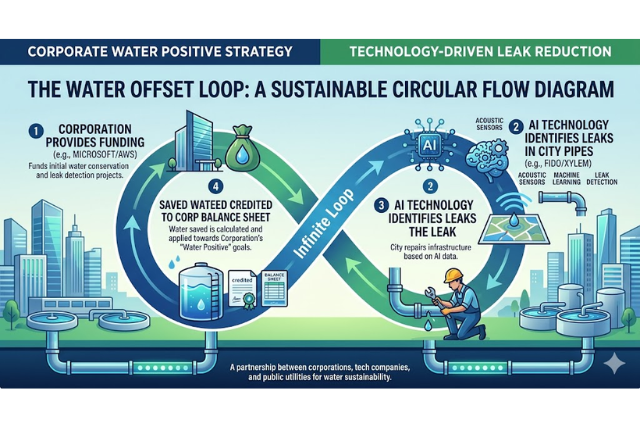
Another major market shift is the rise of corporate water offsetting. Under this model, large technology companies actually pay to find and fix leaks in public city networks. The water saved from these funded repairs is then counted toward the corporation environmental targets, helping them reach ambitious water positive goals.
The work funded by Microsoft provides a clear look at this strategy in action. The company funded artificial intelligence leak detection projects in London and the Mexican city of Queretaro, AI tool uses sound to pinpoint leaky pipes, saving precious drinking water. By paying to locate and fix hidden pipe failures in the public network, Microsoft helps return significant volumes of clean water to the local supply. This approach allows the tech giant to offset its own heavy water usage while directly benefiting the surrounding community.
A comparable model is being pursued by Amazon Web Services. The company Water stewardship in Mexico City and Monterrey. By funding digital inspections on critical water transmission pipes, Amazon helps local authorities reduce massive physical water losses. At the same time, the saved water is carefully tracked and used to support the company public commitment to become water positive by the year 2030.
This digital shift is also happening deep inside the industrial facilities themselves. Within private factory networks, intelligent monitoring platforms are now tracking water flow constantly to catch anomalies and identify hidden losses. PepsiCo, for instance, installed systems from WINT Water Intelligence across several global production facilities. This gives plant managers complete visibility over their internal water use, allowing them to instantly detect abnormal flows and cut out avoidable waste before it impacts their bottom line.
Beyond the Meter: a Unified Vision for Water Security
Digital water tools are expanding beyond municipal networks. Whether managing a public utility or a private data center, operators face the exact same fundamental questions. Where is the water going? Which pipes are failing? How can we intervene faster?
The traditional boundary between public utility management and private industrial water security is fading. As climate pressures rise and water becomes a strictly audited corporate asset, resilience depends on a proactive approach. Both public and private organizations must use artificial intelligence to stop reacting to failures and start predicting them.
As digital intelligence continues to reshape water management, the future will depend on breaking down the silos between infrastructure, operations, and data. The most resilient organizations will be those that can turn fragmented information into a unified view of their water systems—identifying risks earlier, optimizing resources more precisely, and taking action before disruptions become failures. Ultimately, water security will not be defined by how much infrastructure an organization controls, but by how intelligently it can understand, manage, and protect every drop.

