







Extreme rainfall is overwhelming legacy sewer networks. Instead of immediately building expensive new tunnels, water utilities are applying artificial intelligence to stop spills, predict floods, and maximize the capacity of their existing underground pipes.
Wastewater utilities face a compounding mathematical problem. Rainfall is becoming more intense, regularly overwhelming sewer networks built for a much milder climate. At the same time, operators face strict environmental scrutiny and severely limited capital budgets. They must somehow extract more performance from aging underground assets.
Artificial intelligence (AI) offers a practical solution to this capacity gap. Rather than being a vague technology concept, computer models now give operators the visibility to act early and use every drop of existing pipe capacity before they have to spend billions on major civil works.
Market Drivers for Sewer Management
The pace and shape of AI adoption vary by region, shaped by distinct local challenges ranging from strict compliance targets to extreme weather threats.
In the UK and Europe, tighter environmental rules and rising concern over river quality are pushing utilities towards more integrated drainage management. In the UK, 2024 price review.
At the European level, the Urban wastewater reinforces the same direction by requiring Member States to develop integrated urban drainage management plans.
In North America, where the utility landscape is more fragmented, digital investment is often linked to Water Enforcement and enforcement actions. In practical terms, that usually means building the case around reduced inflow and infiltration (I&I), deferred treatment plant expansion, and lower emergency maintenance costs.
Across Asia-Pacific, climate adaptation and flood resilience are often more central. Watercare’s wastewater network smartens up with rollout of 5000 sensors is rolling out 5,000 sensors across Auckland’s wastewater network as part of a NZ$12 million smart network programme.
Progress on delivering our flood modelling program expects 70 modelling projects to be completed before 2026, with climate forecasts extended to 2100. In Singapore,
Flood Forecasting and Monitoring combines real-time monitoring with radar-based rainfall forecasting to improve short-term operational decisions.
How Smart Sewers Work
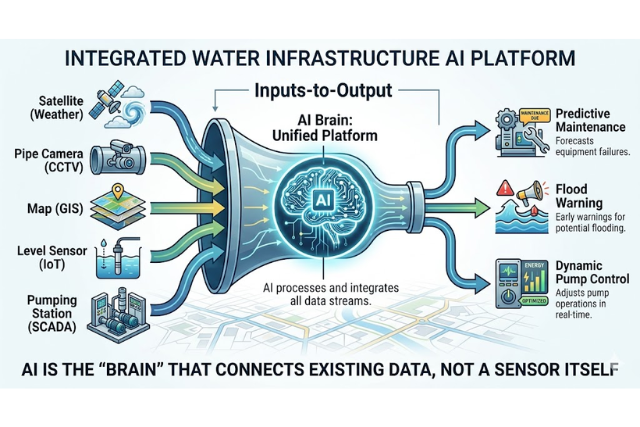
Intelligent sewer management requires more than a single software platform or sensor type. It relies on merging data streams that operators have historically kept entirely separate.
GIS provides network layout and asset location. CCTV data adds information on structural condition. Field sensors contribute near real-time measurements of depth, flow, level, and pump status. SCADA systems add operating data from pumping stations and other control points. Weather feeds and radar forecasts provide a view of what the network may soon have to absorb.
The true operational advantage emerges when these distinct inputs merge into one unified view.
Once field data, SCADA inputs, and weather forecasts sit within a common platform, utilities can use hydraulic models alongside machine learning tools. That helps them move beyond simple alarms triggered by fixed thresholds.
It becomes possible to identify anomalies earlier, prioritize events more effectively, and, in more advanced settings, support dynamic control of the network.
In that sense, AI is not simply an additional digital layer. It is becoming part of how utilities interpret asset condition, understand hydraulic behaviour, and determine when intervention is required.
Efficiency Gains: Automated Inspection and Coding
Pipe inspection represents one of the most mature applications for artificial intelligence in wastewater operations.
Traditionally, CCTV surveys have required trained operators to review long hours of footage manually. That process is slow and can be inconsistent, especially when fatigue affects how defects are identified or coded. Computer vision makes inspection outputs faster to process and easier to standardize.
This is already visible in utility deployments.
At Greater Western Water, Australian sewer inspection specialist VAPAR used Al-support to help refine capital planning, with published project material pointing to an approximately A$2 million refinement of the initial priority programme estimate. At United Utilities, a separate deployment reduced survey processing times from 10 days to two days – an 80% improvement.
A similar trend can be seen in North America.
SewerAI’s Pacific Northwest project summary covers 132 surveys and 29748 linear feet of CCTV inspections. Reported results show that the AI-based assessment identified 32.99% more conditions than manual surveys and missed 90.13% fewer conditions, while maintaining a margin of error below 10%.
These tools are also proving useful in emergency situations. Turning data into action to accelerate sewer system recovery after Hawaii wildfires.
At this stage, the value proposition is relatively clear. Utilities gain a faster and more consistent view of asset condition, providing a stronger basis for maintenance planning and capital prioritization.
Event Management: Filtering Alarms to Prevent Overflows
Beyond assessing structural health, operators must monitor how their networks actually behave under active flow.
That is where AI is being applied to flow, level, and event data to improve maintenance planning and reduce avoidable spills. One common problem in control rooms is alarm overload. Systems generate repeated alerts during wet weather, but many of those alerts reflect expected hydraulic behaviour rather than emerging failures.
Case Study: Wessex Water – StormHarvester Over a three-month trial, the system identified more than 60 emerging blockages in real time. Published results also indicate that 4,500 alarms were generated during the pilot period under the existing approach, whereas the AI-based approach would have reduced control-room alerts by 97%, leaving only 138 alerts.
The same analytical approach can also be used to identify hidden capacity loss. Anglian Water – Tackling Inflow & Infiltration in the Wastewater Network. The reported outcome was £2.4 million of targeted interventions, a 20% reduction in flow attributed to ingress, inflow, and infiltration, and almost 600 hours less pumping station runtime.
Similar methods are also being used to manage flood and capacity risk. Combining sewer and stormwater insights to better understand performance and risks to Northern Ireland Water’s wastewater network, with around 85% of highlighted sites yielding confirmed findings. More broadly, the platform is positioned as providing flood warnings up to 48 hours in advance.
South West Water offers another example of how this approach is being applied. The utility says it now has around 12,000 smart sensors acting as sewer level monitors across the region, and separately reports that pollution incidents halved in the eight months to August 2025 while storm overflow spills reduced by nearly 50% over the last year.
The practical significance lies not in prediction as an abstract capability, but in directing attention to the locations and events most likely to require action, so that field teams and operators can intervene earlier and more selectively.
Asset Optimization: Extracting Value from Current Infrastructure
The most advanced use of AI in sewer and overflow management moves beyond diagnosis and prediction into real-time control.
At this stage, the goal is to operate the existing network more dynamically. Utilities can anticipate rainfall, adjust pumps and gates in advance, and route flows more intelligently so that available storage and conveyance are used more fully before new infrastructure is built.
One of the best-known examples comes from South Bend, Indiana. Published project information from Xylem indicates that the city’s smart sewer programme eliminated dry-weather overflows, reduced combined sewer overflow (CSO) volumes by more than 80%, and helped secure an EPA-endorsed long-term control plan requiring 60% less infrastructure investment than originally estimated, saving approximately $400 million in capex.
A similar principle appears in Grand Rapids, Michigan, where digital monitoring and modelling helped demonstrate that the city’s inflow and infiltration problem could be addressed for $30-50 million rather than the original $1 billion estimate, according to Xylem.
SUEZ’s AQUADVANCED Urban Drainage points in the same direction. The platform is presented as combining real-time monitoring, weather forecasting, and hydraulic modelling to support automated control that maximizes storage use, limits overflows, and reduces flood risk.
Published project information also describes the system as operating in multiple European cities and, AQUADVANCED® Urban Drainage supports the operations of Singapore’s drainage system.
The operational value of AI is most evident at this point. Digital tools now do more than just analyze past events or forecast future risks. In the most advanced deployments, they directly influence how operators manage the network under active pressure.
Beyond the Overflow: a Connected Vision for Urban Drainage
For all the progress, scaling these systems across an entire utility service area remains difficult.
Predictive software relies heavily on accurate historical data and tough physical sensors that can survive harsh underground conditions for years. Furthermore, control room operators need time and proven results to build trust in automated recommendations before stepping back from traditional manual oversight. Despite these challenges, water managers are steadily moving away from monitoring isolated pipes to managing their sewers as one connected system.
AI cannot replace aging infrastructure by itself, but it provides the operational brain required to maximize the capacity of the pipes we already have. As extreme weather puts unprecedented pressure on urban drainage, the most resilient utilities will be those that combine physical engineering with predictive software. Ultimately, mastering this digital layer gives operators the precise foresight they need to route water safely and protect their communities before the rain even starts to fall.
As urban drainage networks face the twin pressures of aging infrastructure and extreme climate events, intelligent sewer management is becoming an essential part of building resilient cities. The future of urban drainage will depend not on replacing physical infrastructure with digital tools, but on bringing the two together—using data, predictive intelligence, and real-time control to make existing networks work smarter, respond earlier, and withstand increasingly unpredictable weather.

