


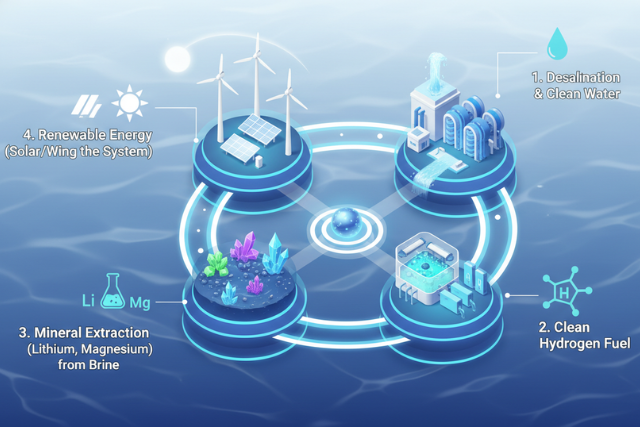
Let’s talk about water. Specifically, the stark fact that over 40% of China’s population lives in water-stressed coastal regions where industry is booming but freshwater is scarce. For years, the answer has been seawater desalination—an energy-hungry process often at odds with climate goals. But something new is happening. The conversation in China has dramatically shifted from simply “making water” to a much more ambitious question: What if a desalination plant could also produce clean fuel, extract valuable minerals, power itself sustainably, and become a cornerstone of a regional circular economy?
This isn’t a future concept; it’s an operational strategy. Driven by the need to reconcile water security with its 2060 carbon neutrality pledge, China is pioneering a new generation of desalination. This article cuts through the technical jargon to explore how engineers and policymakers are integrating solar desalination with green hydrogen production, turning problematic waste brine into a resource, and building plants that are no longer just water suppliers, but integrated clean resource hubs. We’ll look at the real-world tech making this possible and what it means for the global market.
1. The New Blueprint: Beyond the Water Pipe
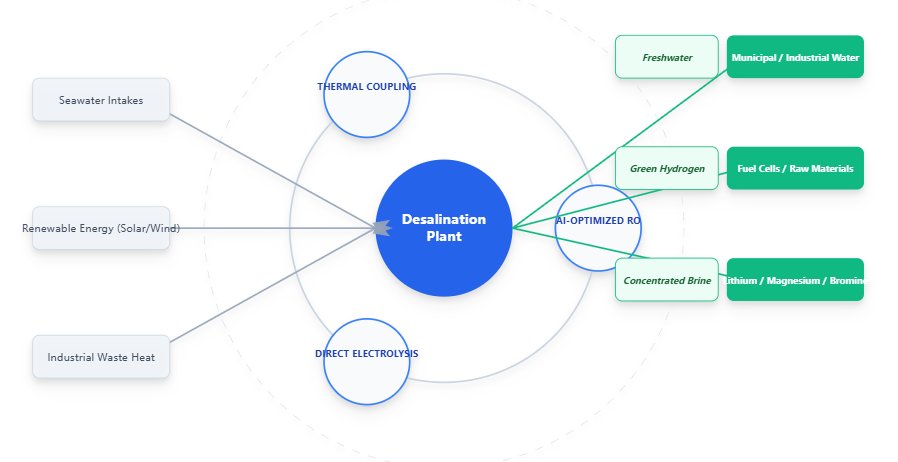
Forget the image of a lonely plant on a coast. China’s latest strategy treats desalination as a core node in a modern resource network. The goal isn’t just to pipe water to a factory, but to create “Water-Energy-Resource” hubs.
The “All-in-One” Industrial Model
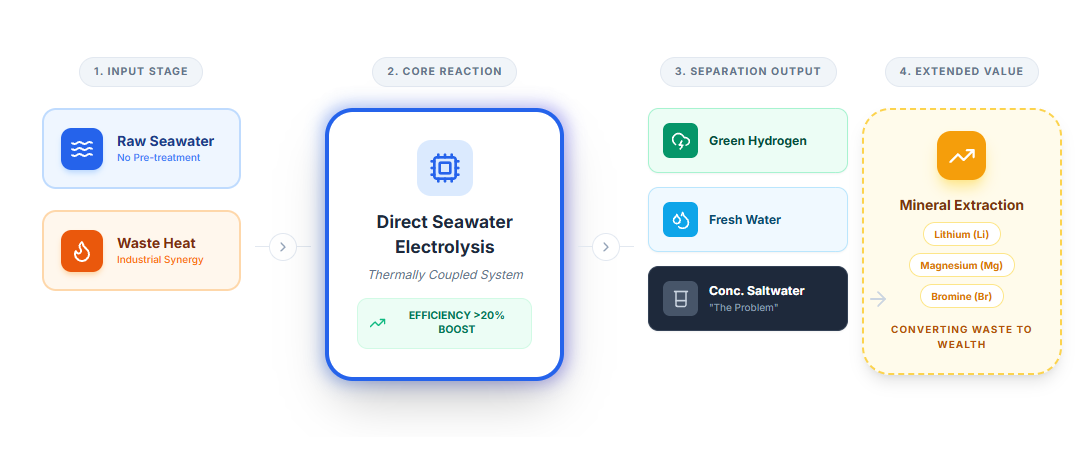
The most compelling shift is seen in places like the Rizhao Innovation Park in Shandong province. Here, they’ve moved past building standalone desalination facilities. Instead, they’ve launched the world’s first thermally coupled, direct seawater electrolysis system. In simple terms, this plant doesn’t just desalinate water; it “drinks” seawater directly to produce green hydrogen. This breakthrough is significant because it bypasses the need for complex and energy-intensive pre-purification typically required to protect sensitive electrolyzers. The Rizhao project represents a bold leap from laboratory-scale experiments to an integrated industrial pilot, tackling the real-world challenges of scale, corrosion, and system durability that have hindered the path of direct seawater splitting for decades.
Here’s the clever part: It uses low-grade waste heat from nearby industries to power parts of the process, boosting overall electrical efficiency by over 20%. This integration of thermal energy, often discarded as a loss in conventional power or industrial settings, is a masterstroke in energy cascade utilization. The output isn’t one product, but three: hydrogen for clean fuel, freshwater for use, and concentrated brine ready for mineral extraction. This turns a costly waste disposal problem (the brine) into a potential revenue stream, extracting lithium and magnesium for batteries and electronics. The economic calculus of the entire project changes fundamentally. The revenue from hydrogen and extracted minerals can subsidize the cost of water production, while the environmental cost of brine management is nearly eliminated, creating a compelling case for circular economy investment.
Policy: From Backup to Strategic Infrastructure
This integrated approach is now backed by national policy. China is actively planning for “dual-use” (peacetime-emergency) desalination projects. This means new large-scale plants are designed to be part of the regional water grid, providing baseline supply during normal times but capable of ramping up during droughts—a strategic hedge against climate volatility. This policy direction is crystallized in national and provincial-level “Water Security” plans, which explicitly designate seawater desalination as a crucial supplement to traditional water sources for coastal megacities and industrial clusters. The “dual-use” concept elevates these plants from being mere industrial utilities to becoming vital components of national infrastructure resilience, akin to strategic petroleum reserves.
This planning signals a move from seeing desalination as an industrial utility to treating it as critical, resilient national infrastructure. The government is fostering this transition through targeted subsidies for R&D in high-efficiency membranes and energy recovery devices, as well as through mandates for new industrial parks in water-scarce regions to incorporate desalination into their design. Furthermore, by linking large-scale desalination projects with renewable energy bases, such as offshore wind farms in the Bohai Sea or solar installations in the Gobi Desert transmitted via ultra-high-voltage lines, policymakers are ensuring that the growth in water supply is aligned with the nation’s decarbonization goals, preventing a lock-in of fossil-fuel dependent water infrastructure.
2. The Tech Making It Possible: Solar, Hydrogen & Smart Systems
The Rizhao model is possible because of breakthroughs in three key areas. These advancements are not occurring in isolation but are converging to create a new technological ecosystem for desalination. From harnessing the most abundant energy source—the sun—to embedding digital intelligence into century-old processes, and finally, to redefining waste, these innovations collectively enable the leap from single-purpose plants to multi-output resource hubs.
1. The Solar-Hydrogen Link
The direct link between sunlight and hydrogen from seawater is the holy grail. At Hainan University, researchers built a 3D-printed, flower-shaped evaporator. This biomimetic design is not merely aesthetic; its intricate geometry maximizes light absorption and creates efficient pathways for water transport and vapor release, mimicking natural transpiration. When placed on seawater under sunlight, it does two jobs at once: it evaporates water to produce clean steam for condensation into freshwater, and the same photothermal process triggers a reaction on special catalysts to split the vapor, producing green hydrogen. The localized heat generated by the sunlight-absorbing material creates intense thermal gradients at the microscopic level, driving both evaporation and, on strategically placed catalytic sites, the breakdown of water molecules.
It’s an elegant, off-grid solution that solves the chronic issue of salt fouling that plagues other devices. The secret lies in its self-regenerating design; as seawater evaporates, salt begins to crystallize. However, the flower’s structure and surface properties are engineered to confine salt crystallization to specific, expendable zones. Once these zones are saturated, the salt can be easily shed or rinsed away, allowing the device to maintain high efficiency over long periods without manual cleaning. This makes it a promising prototype for decentralized, resilient water and energy systems for remote islands, coastal communities, or as part of disaster relief infrastructure, operating entirely independently of the grid.
2. Smarter, Leaner Desalination (RO 2.0)
While flashy new tech grabs headlines, the workhorse Reverse Osmosis (RO) process is getting a major brain upgrade. AI is now used to predict membrane fouling and optimize pump pressure in real-time, cutting energy use by up to 15% in plants like Qingdao Baifa. These AI systems are trained on vast historical datasets encompassing water quality, pressure, temperature, and flow rates. They can identify subtle patterns that precede fouling events, enabling preemptive, targeted cleaning that saves chemicals and reduces membrane wear. Simultaneously, machine learning algorithms continuously analyze energy pricing from the grid, adapting plant operation to draw more power during off-peak, cheaper hours, thus optimizing both technical performance and economic cost.
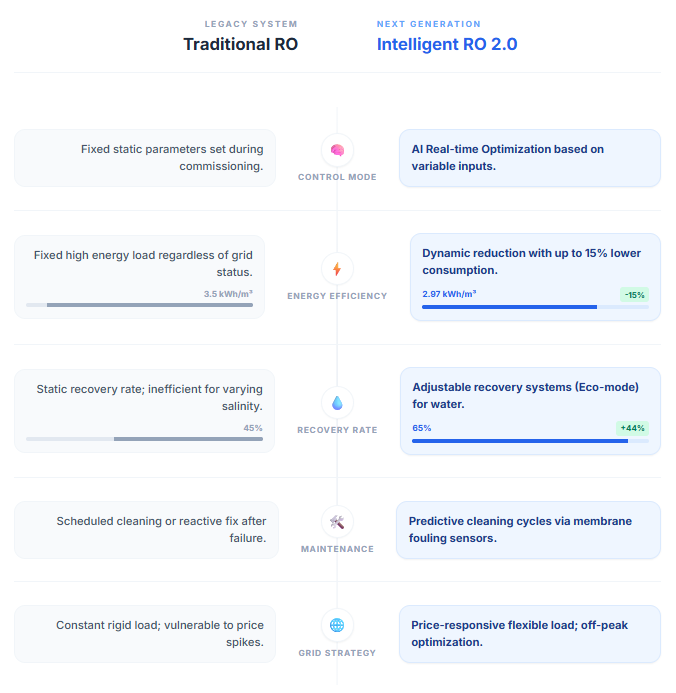
Furthermore, new “multi-stage RO with adjustable recovery” systems are like a car’s eco-mode for water. They can dynamically adjust how much freshwater they squeeze out of seawater based on the salt content and energy prices, optimizing every kilowatt-hour used. Traditional RO systems operate at a fixed recovery rate, but these advanced systems recirculate brine within multiple stages. Using real-time sensors and control software, they can vary the pressure and flow to maximize freshwater yield when energy is cheap and water is needed, or to produce a smaller volume of highly concentrated brine ideal for mineral extraction when the focus shifts to resource recovery. This flexibility is key to integrating RO plants with intermittent renewable energy sources and to functioning optimally within the variable conditions of an integrated resource hub.
3. The Brine Revolution: From Waste to “Liquid Mine”
The byproduct of desalination—hyper-salty brine—has always been an environmental headache. The new approach is “Zero Liquid Discharge Plus.” This goes beyond the traditional ZLD goal of producing a solid, disposable waste. Instead of just crystallizing it for disposal, companies are extracting valuable minerals. This process involves a sophisticated series of steps: chemical conditioning, multi-effect evaporation, crystallization, and often ion-exchange or solvent extraction. Each stage is designed to separate and purify different components of the complex brine mixture.
This isn’t just table salt; it’s lithium for EV batteries, magnesium for alloys, and bromine for flame retardants. The brine becomes a strategic domestic source of critical minerals, reducing reliance on geopolitically sensitive mining imports. For instance, the extraction of magnesium from seawater brine is already a commercial reality, and pilot projects are advancing for lithium, a metal crucial for the energy transition. By viewing brine as a “liquid mine,” the economics of desalination improve, and the environmental footprint shrinks. The revenue from selling these minerals can offset a significant portion of operational costs, while the final waste volume is minimized and rendered inert. This completes the circle of the integrated hub, transforming the plant’s largest liability into a core pillar of its business model and sustainability credential.
3. The Global Play: Exporting Systems, Not Just Pipes
China is now a dominant force in building the world’s desalination plants, with a contracted global capacity of 5.5 million tons per day. But the export model is evolving.
From Contractor to Solution Provider
The game is no longer just about winning the bid to build the plant. Chinese firms like PowerChina and CISDI are now pitching and delivering integrated resource solutions. For a country in the Middle East or North Africa, this package might include: the desalination plant itself, a connected solar or wind farm to power it, the technology to extract minerals from the brine, and the long-term operational know-how. This is attractive because it solves multiple problems (water, energy, waste) with one coordinated system.
The “Belt and Road” Test Bed
This model is being refined along the Belt and Road Initiative. Megaprojects like the 1-million-ton-per-day plant in Basrah, Iraq, are not just feats of engineering; they are large-scale labs for testing and proving these integrated systems in different climates and political economies. Success here builds a track record that is more valuable than any brochure: proven, at-scale delivery of complex water-security solutions.
The Bottom Line: A Replicable Model for a Thirsty World
China’s evolution in desalination offers a clear, replicable blueprint for any water-stressed nation: Stop thinking about water in isolation.
The most advanced projects show that the future lies in integrated hubs that synergistically produce freshwater, clean hydrogen fuel, and industrial minerals. This turns a high-cost, energy-intensive necessity into a multi-output industrial activity with better economics and alignment with climate goals.
The core insight for global observers is this: China is moving from mastering the engineering of desalination to mastering the economics and integration of it. The technology—from direct seawater electrolysis to AI-optimized RO—is the enabler. But the real innovation is the business and ecological model: building infrastructure that actively contributes to the circular economy. As climate change intensifies water scarcity worldwide, this integrated, resource-smart approach may become the new global standard.
Ready to Look at Water Differently?
The next time you see a headline about a new desalination plant, ask not just “How much water?” but “What else does it produce, and what problem does its waste solve?” The answers will tell you if it’s a relic of the 20th century or a hub for the 21st.
