







If your company exports plumbing fixtures, valves, water treatment components, or appliances to the European Union, a major regulatory shift is likely already on your radar.
The recast European Union Drinking Water Directive (Directive (EU) 2020/2184, or EU-DWD) represents the most significant overhaul of water hygiene regulations in a generation. By establishing unified European standards, the EU is phasing out national approvals and replacing them with a single, highly stringent framework.
For global purchasing managers, quality assurance engineers, and OEM suppliers, this transition brings both challenges and opportunities. Those who adapt early can secure their market share, while those who delay risk finding themselves locked out of key European markets.
Below, we break down the technical realities of the EU-DWD, examine critical regional deadlines, analyze material alternatives, and provide a practical playbook for auditing your supply chain.
What is the Recast EU-DWD? (And Why the Old Rules No Longer Apply)
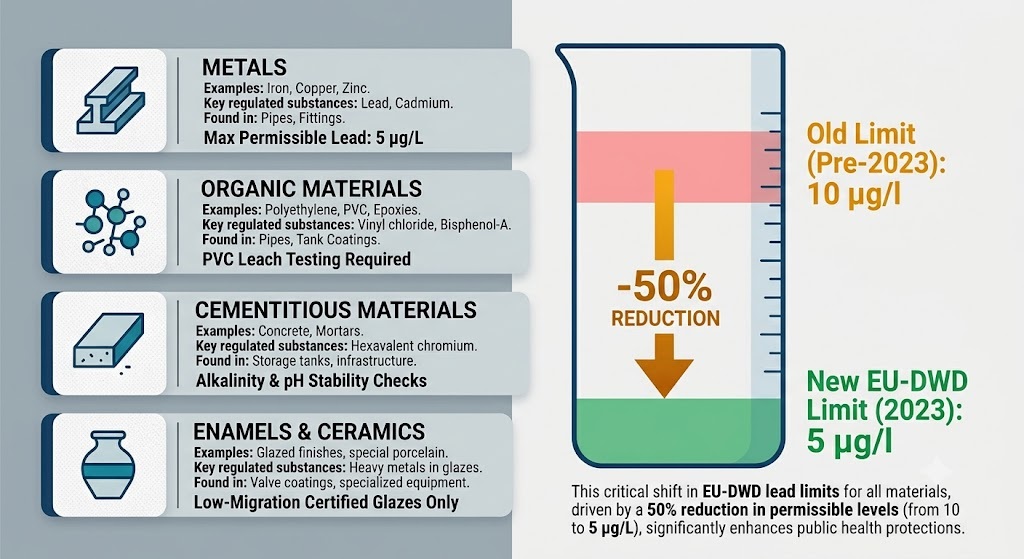
For decades, exporting potable water components to Europe meant navigating a fragmented patchwork of national testing regimes. A manufacturer selling a faucet body in Germany, France, and the Netherlands had to seek individual certifications from multiple national bodies:
- DVGW/UBA in Germany
- ACS in France
- KIWA in the Netherlands
- WRAS in the United Kingdom (historically aligned with European standards)
This fragmented approach was costly, slow, and administratively burdensome. The recast EU-DWD addresses this by establishing unified, legally binding hygiene requirements across all EU member states, governed by Article 11.
The European Positive Lists (EUPL)
Under the oversight of the European Chemicals Agency (ECHA) and codified in Commission Implementing Decision (EU) 2024/367, the EU is rolling out the European Positive Lists (EUPL). Moving forward, only starting substances, compositions, and constituents included in these official registries are permitted for use in products contacting drinking water.
The EUPL categorizes materials into four distinct groups:
- Metallic Materials: Specific brasses, bronzes, coppers, and stainless steels.
- Organic Materials: Polymers, rubbers, silicones, and the monomers or additives used to make them.
- Cementitious Materials: Mortars and concrete linings for large-scale storage and transport.
- Enamels, Ceramics, and Inorganic Materials: Protective glazes and cartridge discs.
The 5 µg/l Lead Limit
The most critical change for many manufacturers is the reduction of the maximum allowable lead concentration in drinking water at the tap—from 10 micrograms per liter (µg/l) down to 5 µg/l. Because lead can leach from standard copper alloys, this single change makes many traditional plumbing brasses unusable for European potable water systems.
The Timeline Trap: Why “Waiting Until 2032” is a Costly Mistake
A common misconception among global sourcing teams is that they have until the end of 2032 to fully transition their product catalogs. While the official EU-wide transitional period for existing national approvals runs until December 31, 2032, several member states are enforcing much tighter schedules—particularly regarding metallic materials.
January 1, 2027: The Baseline
From this date onward, any new product or component seeking certification for sale in the European Union must be manufactured using materials that comply with the EUPL. Existing certifications can remain valid for a limited time, but no new approvals will be granted for non-conforming materials.
January 12, 2028: Germany‘s Accelerated Metal Deadline
Germany‘s Federal Environment Agency (UBA) has historically maintained strict water safety standards and has shortened the transition period for metals.
- By January 12, 2028, products containing metallic materials that do not align with the EU/UBA positive list may no longer be sold or distributed in Germany.
- Because Germany is the largest economy in the EU, many European distributors and wholesalers are refusing to stock dual inventories (one line of compliant products for Germany and another for the rest of Europe). Practically speaking, the German 2028 deadline is acting as the de facto target for the entire European supply chain.
January 1, 2031: Italy‘s Transitional Milestone
Italy, a major hub for plumbing valve and brassware manufacturing, is also accelerating its timeline, designating the start of 2031 as its final transition date.
Deep Dive: Material Challenges Across Specific Applications
To achieve compliance, manufacturers must look closely at how these material requirements apply to specific components. A single non-compliant O-ring or leaded component can render an entire complex assembly, such as a thermostatic mixer, non-compliant.
Faucet Bodies, Fittings, and Valve Housings
Sanitary brassware has traditionally relied on leaded brasses like CW617N (containing up to 2.2% lead) or CW614N (containing up to 3.5% lead). Lead acts as a lubricant and chip-breaker during high-speed machining and forging. Under the new directive, these materials must be replaced with compliant alternatives:
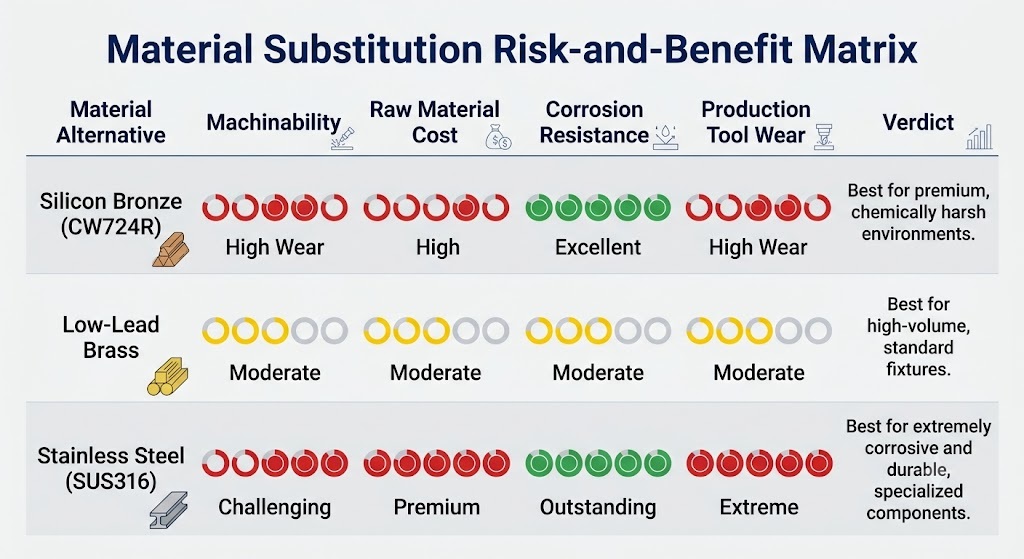
- Silicon Bronze / Silicon Brass (e.g., CW724R / CuZn21Si3P): These alloys replace lead with silicon to provide strength and dezincification resistance. However, silicon bronze is harder, which increases tool wear, requires slower machining speeds, and raises raw material costs.
- Bismuth Brasses: Bismuth is used as a direct metallurgical substitute for lead, offering comparable machinability. However, bismuth is relatively scarce, and its pricing can be volatile. It also requires careful scrap segregation in foundries to prevent contamination.
- Low-Lead Brasses (e.g., CW725R): These alloys keep lead levels well under 0.1%, but require adjustments to casting and machining parameters to achieve consistent quality.
Inline Components: Aerators, Flow Regulators, and Check Valves
Small inline components have a high surface-area-to-volume ratio, making them a common source of chemical leaching if not properly managed.
- Aerators & Flow Regulators: The outer metal housing must meet the metallic positive list, while internal polymer inserts—often made of Polyoxymethylene (POM) or ABS—must comply with the organic positive list. Sourcing teams must verify that the base resins, colorants, and processing aids are all registered under the ECHA guidelines.
- Check Valves & Diverters: These assemblies contain metallic springs, plastic guides, and elastomeric seals. Every single sub-component must meet its respective positive list.
Flexible Connection Hoses
Flexible hoses connect supply lines to faucets, filtration systems, and appliances. Historically, many hose liners were manufactured from Ethylene Propylene Diene Monomer (EPDM) rubber.
- Many traditional vulcanization agents, accelerators, and plasticizers used in standard EPDM compounding are not included in the organic positive lists because they can leach organic compounds or promote microbial growth.
- The Alternatives: Sourcing teams are increasingly turning to high-purity Silicones or PEX (Cross-linked Polyethylene) While PEX offers excellent chemical purity, it is stiffer than rubber, which can affect the hose’s bending radius and make installation in tight spaces more difficult.
The Procurement Audit Playbook: What to Ask Your Suppliers
For procurement officers and quality managers, identifying compliant partners requires a structured auditing process. Relying on basic self-declarations is no longer sufficient to manage regulatory risks.
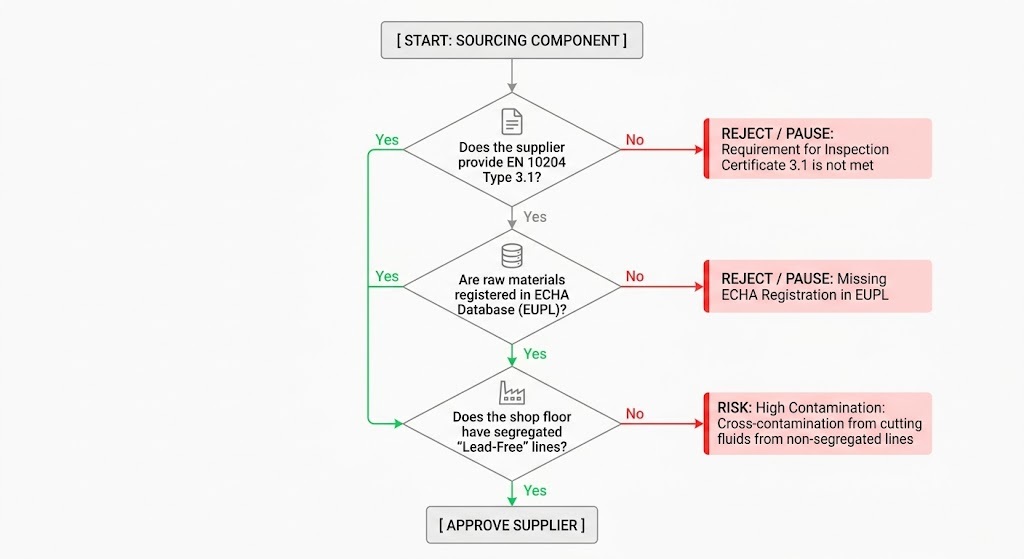
Here is a practical checklist of what to evaluate during your next supplier audit:
Demand Raw Material Certificates (EN 10204 Type 3.1)
When sourcing metallic components, do not rely on basic spec sheets. Request EN 10204 Type 3.1 Material Certificates for every production batch.
- What to look for: Verify that the chemical ladle analysis (specifically the lead, nickel, and arsenic content) aligns with the approved limits defined in Annex II of the European Positive List for metals.
Inspect for Cross-Contamination in the Factory
Many foundries and machining facilities process both leaded brass (for non-EU regions) and lead-free brass on the same shop floor.
- What to look for: Check if the supplier has dedicated machinery, separate cutting fluid filtration systems, and segregated scrap storage for lead-free production.
- If lead-free brass is machined on a line using cutting fluid contaminated with microscopic lead particles from a previous run, those particles can deposit onto the compliant component’s surface, leading to migration test failures.
Verify Testing Laboratory Credentials (ISO/IEC 17025)
Ensure that all material migration and composition testing is conducted by independent, third-party laboratories holding valid ISO/IEC 17025 accreditation specifically for drinking water contact testing.
- What to look for: Confirm that the laboratory uses standardized European testing methodologies, such as EN 12873 (for organic materials migration) and EN 15664 (for metal migration under dynamic test conditions).
Secure a Formal EU Declaration of Conformity
Your suppliers should be prepared to provide a formal EU Declaration of Conformity issued in accordance with Delegated Regulation (EU) 2024/370.
- What to look for: The document must list the unique product identifier, the specific material categories used, the relevant EUPL numbers of the starting substances, and a confirmation that migration testing results fall below the established threshold limits.
Common Sourcing Misconceptions
As sourcing teams work to update their supply chains, several common misunderstandings regularly surface:
- Misconception 1: “Surface plating solves the lead problem.” Some suppliers attempt to use standard leaded brass and apply a nickel or chrome plating to the internal water path. However, plating can degrade over time due to water friction, thermal expansion, and chemical exposure, which can cause lead leaching later in the product’s lifespan. The base metal itself must meet compliance standards.
- Misconception 2: “Our factory is ISO 9001 certified, so we are compliant.” ISO 9001 governs general quality management systems, not the specific chemical composition of materials in contact with drinking water. EU-DWD compliance requires specialized material testing and certification that goes well beyond general ISO standards.
- Misconception 3: “All lead-free brasses are identical.” Different lead-free alloys behave differently during manufacturing. For example, replacing a component made of CW617N with silicon bronze (CW724R) requires adjustments to casting temperatures and machining speeds. Sourcing teams must coordinate closely with engineering to ensure alternative materials perform reliably under production conditions.
Structuring Your Transition Plan
Transitioning a product catalog to meet the requirements of the EU-DWD is a multi-step process. Sourcing teams can structure their transition using the following roadmap:
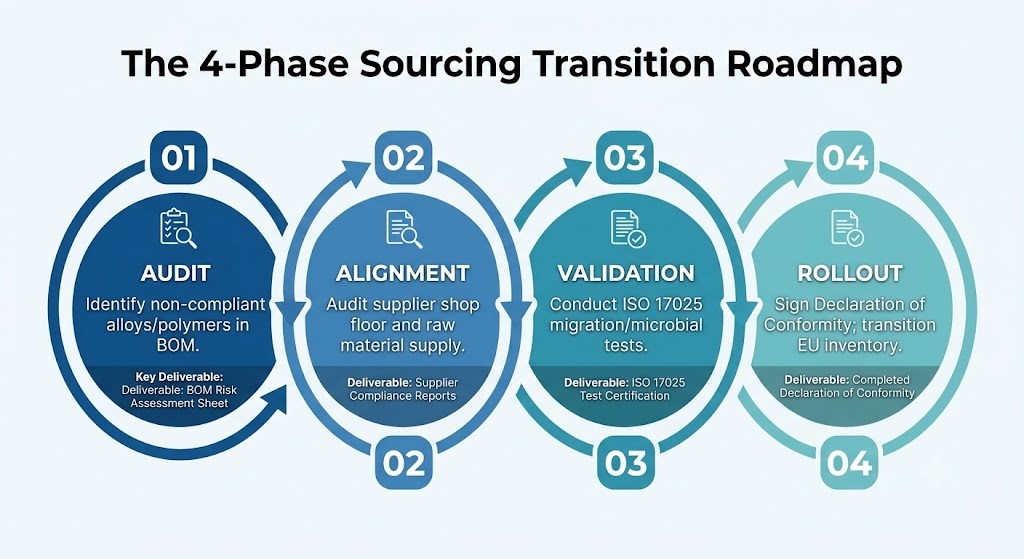
- Phase 1: Inventory & BOM Audit: Review the full Bill of Materials (BOM) for every product currently sold in the EU. Identify any components containing copper alloys, rubbers, or plastics that do not have documented EUPL compliance.
- Phase 2: Supplier Engagement: Share your compliance requirements with your existing supplier base. Assess their readiness, request material certificates, and determine if they can supply compliant materials within your required timelines.
- Phase 3: Validation & Testing: Work with engineering to run prototype batches using alternative materials. Conduct mechanical performance, pressure, and migration testing in accredited laboratories.
- Phase 4: Compliance Documentation & Rollout: Compile the necessary Declarations of Conformity, update your product markings, and coordinate with your European distribution partners to smoothly transition your inventory ahead of the regional deadlines.

