






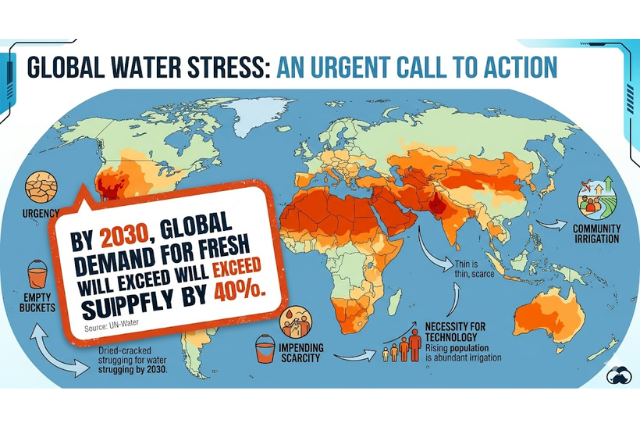
Every year, World Water Day serves as a poignant reminder that while water covers 70% of our planet, safe and accessible water remains a luxury for billions. For the international community, water is the common denominator of the UN Sustainable Development Goals (SDGs); without it, we cannot achieve health equity, food security, or industrial stability.
As the global landscape shifts due to climate volatility and rapid urbanization, the gap between the “water-haves” and the “water-have-nots” is widening. Addressing this crisis requires more than just advocacy—it demands the aggressive, large-scale deployment of cutting-edge technology. Innovation remains the great equalizer, capable of turning scarcity into abundance and transforming “waste” into a high-value resource. By prioritizing technical ingenuity and systemic efficiency, we can build the resilient water infrastructure necessary to secure a sustainable future for all.
Breaking Geographic Barriers: The Rise of Decentralized and Modular Infrastructure
Traditional water infrastructure relies on massive, centralized treatment plants and thousands of miles of expensive piping. For many regions—ranging from remote industrial outposts to rapidly growing suburban zones in emerging markets—this model is economically and physically unfeasible.
The advancement of Modular Water Treatment Systems and Containerized Desalination Units has changed the equation. By utilizing high-efficiency Reverse Osmosis (RO) and Ultrafiltration (UF) technologies in compact, plug-and-play formats, we can now bring potable water to the source of demand. This decentralization reduces the Capital Expenditure (CAPEX) required for massive pipeline networks and allows for localized water sovereignty. For overseas visitors looking to solve infrastructure challenges in diverse terrains, these scalable solutions represent the next frontier of equitable development.
Digital Intelligence: Reducing Non-Revenue Water and Enhancing Resilience
Inequality is often exacerbated by inefficiency. In many global cities, up to 40% of treated water is lost to leaks or theft—known as Non-Revenue Water (NRW)—before it ever reaches a faucet. This loss disproportionately affects low-income populations who pay the highest price for water scarcity.
The integration of the Industrial Internet of Things (IIoT) and Digital Twin technology offers a solution. Smart sensors and AI-driven acoustic monitoring can now detect microscopic leaks in real-time, allowing utilities to intervene before a pipe burst occurs. Furthermore, smart metering ensures transparent billing and equitable distribution. By digitizing the water cycle, we are not just optimizing a utility’s bottom line; we are ensuring that the existing water supply is distributed fairly and sustainably across all demographics.
The Circular Economy: Industrial Wastewater as a Catalyst for Growth
For too long, industrial growth was seen as being at odds with environmental equity. High-polluting industries often depleted local aquifers, leaving communities with diminished resources. Modern technology has rewritten this narrative through Zero Liquid Discharge (ZLD) and Advanced Oxidation Processes (AOP).
Today’s leading-edge water technologies allow factories to recycle nearly 100% of their process water. By extracting nutrients like phosphorus and nitrogen or recovering energy from sludge through anaerobic digestion, wastewater treatment plants are being reimagined as “Resource Recovery Centers.” This circular approach preserves freshwater for human consumption and agricultural use, allowing industrial expansion to coexist with community health. For the global professional, mastering these closed-loop systems is no longer optional—it is a prerequisite for a “Social License to Operate.”
Navigating Global Standards and Cross-Border Innovation
The primary challenge for overseas water specialists is the fragmentation of technology and regulation. A solution that works in Western Europe may need significant adaptation for the environmental conditions of Southeast Asia or the Middle East. True equality in water access requires a global exchange of intellectual property and engineering best practices.
This is where the role of an international platform becomes critical. To move from theoretical equality to practical reality, we need a centralized hub where the world’s most innovative membrane manufacturers, chemical engineers, and software developers can meet the municipal leaders and private investors who have the power to implement these technologies at scale.
The Future of Water Innovation: A Global Collaborative Effort
The path to achieving global water equity lies in the collective pursuit of advanced technological solutions. As the industry moves toward a data-driven and resource-efficient future, the integration of smart technologies, robust wastewater treatment, and high-performance desalination processes will be the key to overcoming modern water management complexities.
Solving these challenges is no longer a localized task—it is a global imperative that requires cross-border collaboration and the exchange of innovative ideas. Whether you are looking to optimize your current operations, source next-generation membranes, or explore the latest in digital water management, the focus must remain on building systems that are resilient, sustainable, and scalable.
By prioritizing technical ingenuity and fostering partnerships across the entire water value chain, we can bridge the gap between scarcity and abundance. Let us continue to invest in the technologies that will define the next decade of water resilience, ensuring a secure and equitable water future for all—one drop at a time.

