


The Scarcity Paradox: Why Are We Still Flushing Our Future?
Imagine standing in one of the most lush, tropical environments on Earth, only to be told that the water running through your pipes is a vanishing resource. This is the reality in Hawaii, and frankly, it is becoming the reality for industrial and residential hubs globally. For too long, our approach to water has been linear: extract, use, and discard. But as a professional in the B2B environmental sector, you know that this “take-make-waste” model is no longer financially or ecologically viable.
The recent milestone in Hawaii—the state’s first legally permitted multi-family Greywater Reuse project—is not just a local victory; it is a global signal. It challenges the centralized status quo and proves that Decentralized Water Systems are ready for mainstream adoption. In this deep dive, we will explore how this pioneer project broke regulatory barriers, the technical architecture of Resource Recovery, and why this model is the “missing link” in achieving true Circular Economy goals in urban development.
1. Decoding the Hawaii Pioneer Project: More Than Just Plumbing
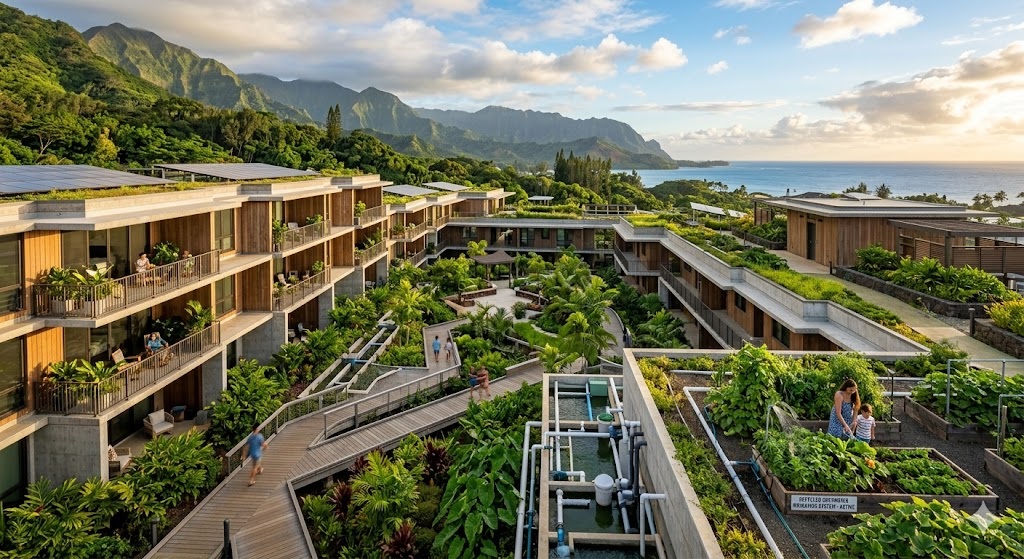
The project at the Pono Shim residence in Honolulu represents a fundamental shift in how we perceive “waste.” Instead of diverting greywater—water from sinks, showers, and laundry—into an overstrained centralized sewer system, this project captures and treats it on-site for landscape irrigation.
1.1 Breaking the Regulatory Ceiling
For decades, the hurdle wasn’t the technology; it was the red tape. Wastewater Compliance in many jurisdictions is built around 20th-century centralized logic. The Hawaii project succeeded because it brought regulators into the design process early. By working with the Department of Health to establish new safety benchmarks, the team at Roth Ecological Design turned a “prohibited” concept into a “permitted” blueprint.
1.2 The Role of “Cultural Intelligence” in Water Tech
An overlooked insight from this project is the integration of Aloha—the Hawaiian philosophy of connection to the land. In the B2B world, we often focus on the “hardware,” but this project reminds us that Sustainable Irrigation projects succeed when they align with local values. For developers, this means the marketing value of a “Net-Zero Water” building often far outweighs the initial CAPEX of the recycling system.
2. The Technical Infrastructure of Resource Recovery
To scale Greywater Reuse, we must understand the engineering that ensures safety and efficiency. This is where the industry’s most advanced Membrane Filtration and biological treatment systems come into play.
2.1 On-site Treatment vs. Centralized Facilities
Why move water miles away to treat it, only to pump it miles back for irrigation? Decentralized Water Systems eliminate the energy-intensive transport phase. By using compact, modular treatment units, high-density residential complexes can achieve Resource Recovery within their own footprint.
2.2 Achieving Wastewater Compliance through Innovation
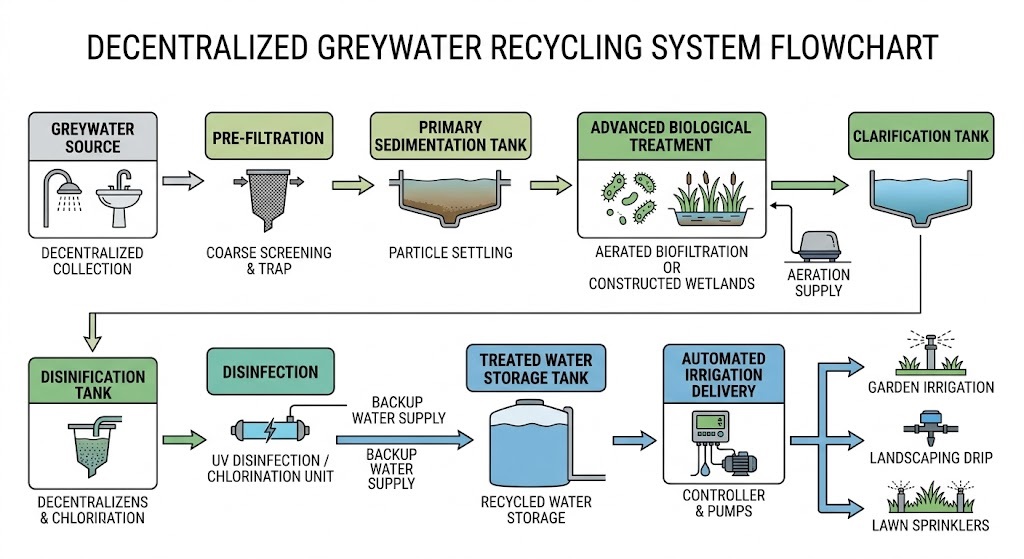
The technology used in Hawaii involves multi-stage filtration and disinfection to ensure that the water meets non-potable standards. For those of you following the trends at WATERTECH CHINA, you’ve seen the rise of “Smart MBR” (Membrane Bioreactor) systems. These units use IoT sensors to monitor water quality in real-time, providing the data transparency that regulators demand for Non-potable Water applications.
3. The Economic Logic: Why Developers Are Finally Listening
If you are a developer or a municipal planner, you know that “being green” is good, but “being profitable” is mandatory. Greywater Reuse is moving from a “nice-to-have” ESG feature to a core financial strategy.
3.1 Reducing Impact Fees and Utility Costs
In many cities, new developments are charged massive “sewer impact fees.” By reducing the volume of waste sent to the municipal grid, developers can negotiate lower fees. Furthermore, as water scarcity drives up the price of municipal tap water, the ROI on an on-site Resource Recovery system typically drops to under five years in drought-prone regions.
3.2 The “Resilience Premium”
In an era of climate uncertainty, a building that can irrigate its own landscape during a drought is more valuable. This “Resilience Premium” is reflected in higher property valuations and lower insurance premiums. By securing your own water supply, you are effectively achieving “Water Sovereignty.”
4. Scaling the Hawaii Model: From the Pacific to the World
The success in Honolulu provides a template that can be exported to any urban center, from Los Angeles to Shanghai. However, scaling requires more than just copying the plumbing diagrams; it requires a Circular Economy ecosystem.
4.1 The Importance of Cross-Sector Collaboration
The Hawaii project involved architects, engineers, health officials, and community leaders. This “Hexagon of Innovation” is exactly what we facilitate at WieTec. To scale decentralized tech, we need the equipment manufacturers (the hardware) to talk to the policy makers (the software).
4.2 Urban Resilience in High-Density Cities
In cities like Shanghai, the challenge is vertical. How do we implement Greywater Reuse in a 50-story skyscraper? The answer lies in “Vertical Water Grids,” where water is treated and reused every 10 floors, minimizing the energy required for pumping. This is the next frontier of Urban Resilience.
5. Unique Insight: Decentralization as a Security Strategy
Most industry commentary focuses on the environmental benefits of greywater. But as a strategist, I want you to consider the security aspect. Centralized water systems are “Single Points of Failure.” A main break or a contamination event can paralyze an entire city.
By distributing treatment across a network of decentralized sites, we create a “Mesh Grid” of water security. If one system goes down, the rest of the city remains resilient. This shift toward “distributed infrastructure” is perhaps the most significant trend in Industrial Decarbonization and resource management today.
6. How to Implement Greywater Reuse in Your Next Project
If you are looking to replicate the Hawaii success, your roadmap should look like this:
- Feasibility Audit: Quantify your greywater production vs. irrigation demand.
- Regulatory Engagement: Don’t wait for a permit; invite the Department of Health to co-create the solution.
- Technology Selection: Visit the Exhibitor List at WieTec CHINA to find modular MBR and UV disinfection providers.
- Data Integration: Ensure your system has remote monitoring to prove Wastewater Compliance 24/7.
7. Core Insights: The Quick Summary
- Regulatory Breakthrough: The Hawaii project proves that “outdated” laws can be updated through collaborative engineering.
- On-site Value: Greywater Reuse significantly reduces both OPEX (water bills) and CAPEX (sewer impact fees).
- Resilience First: Decentralized systems provide a hedge against drought and centralized infrastructure failure.
- Circular Economy: Water is a renewable asset, not a disposable commodity.
- Sourcing at WieTec: The hardware for these systems is now modular, affordable, and ready for global deployment.
8. Conclusion: Leading the Charge in Water Resource Recovery
The story of Hawaii’s first greywater project is a testament to the power of persistence and the maturity of modern water technology. We have moved past the era of “experimentation.” The tools for Greywater Reuse—from advanced membranes to AI-driven sensors—are now commercially available and financially viable.
As a leader in the B2B environmental space, your role is to move from observer to implementer. Whether you are designing a luxury resort or a municipal housing project, the integration of Decentralized Water Systems is your path to a resilient, high-value development. The “Hawaii Model” is no longer a dream; it is a proven strategy waiting for your next project.
We invite you to join us at WieTec 2027 in Shanghai, where the pioneers of these technologies will gather to shape the future of the Circular Economy.
9. Frequently Asked Questions (FAQ)
Q1: Is greywater reuse safe for public residential areas?
A: Yes, absolutely. Modern Resource Recovery systems use multi-stage treatment including UV disinfection and membrane filtration to ensure that the water is safe for all non-potable uses, such as irrigation and toilet flushing, meeting strict Wastewater Compliance standards.
Q2: What is the ROI on a decentralized greywater system?
A: While costs vary, most commercial and multi-family projects see a return on investment within 4 to 7 years. This is driven by lower water procurement costs, reduced sewage fees, and potential tax incentives for Sustainable Irrigation.
Q3: Can these systems be retrofitted into old buildings?
A: Retrogitting is more complex but entirely possible. The trend toward modular, “skid-mounted” treatment units makes it easier to install Decentralized Water Systems in existing basements or utility rooms.
Q4: How does greywater reuse impact LEED or ESG scoring?
A: It is one of the highest-impact strategies. Implementing Greywater Reuse can contribute significantly to “Water Efficiency” credits in LEED and GRESB, substantially improving your corporate ESG profile.
Q5: Where can I find the latest technology for these projects?
A: Global hubs like WATERTECH CHINA provide the best opportunity to see these systems in person and meet the engineers behind the Hawaii-style breakthroughs. You can find more info in our Industry News section.
10. Reader Interaction: Join the Conversation
Your Voice Matters
Do you think local governments are ready to embrace on-site water reuse? We‘re looking for real-world perspectives to feature in our upcoming WieTec Industry Trend Report.
Share your experience on LinkedIn, or send us a message. Let‘s keep the conversation going.
11. External References & Authoritative Sources
- Aquatech Trade: Hawaii Greywater Pioneer Project Analysis
- The Water Research Foundation: Decentralized Systems and Urban Resilience
- WATERTECH CHINA Official Site: Latest WATERTECH CHINA Exhibition Trends
- WieTec Official Site: Home – WieTec 2026 Shanghai | Environmental, Energy Efficiency & Healthy Living
- International Water Association (IWA): Circular Economy and the Future of Water
