


In the high-stakes arena of global water management, the transition from basic filtration to sophisticated disinfection marks the boundary between raw utility and public safety. As an overseas specialist for WATERTECH, I have observed a significant paradigm shift in how international stakeholders—from municipal engineers in the EU to industrial plant managers in Southeast Asia—approach the science of chlorination.
The following technical brief serves as a comprehensive resource for professionals seeking to bridge the gap between traditional chemical dosing and the future of smart, sustainable water treatment. As we look toward the WATERTECH 2027 exhibition in Shanghai, this article outlines the core pillars of modern chlorination technology that will be showcased at our event.
1. The Chemistry of Resilience: Why Chlorination Remains the Global Standard
While the “clean water” movement has introduced several alternative disinfection technologies—such as Ultraviolet (UV) irradiation and Ozonation—chlorination remains the unchallenged leader for one primary reason: Residual Efficacy.
A UV reactor or an Ozone generator provides a “point-of-contact” kill. The moment the water leaves the treatment chamber, it is vulnerable to re-contamination. In contrast, chlorination creates a lasting chemical shield that travels through kilometers of distribution piping, suppressing microbial regrowth and biofilm formation.
The HOCl vs. OCl- Equilibrium
To master chlorination, one must understand the molecular behavior of chlorine in water. When chlorine gas or liquid sodium hypochlorite is added to water, it forms Hypochlorous Acid (HOCl) and Hypochlorite Ion (OCl-).
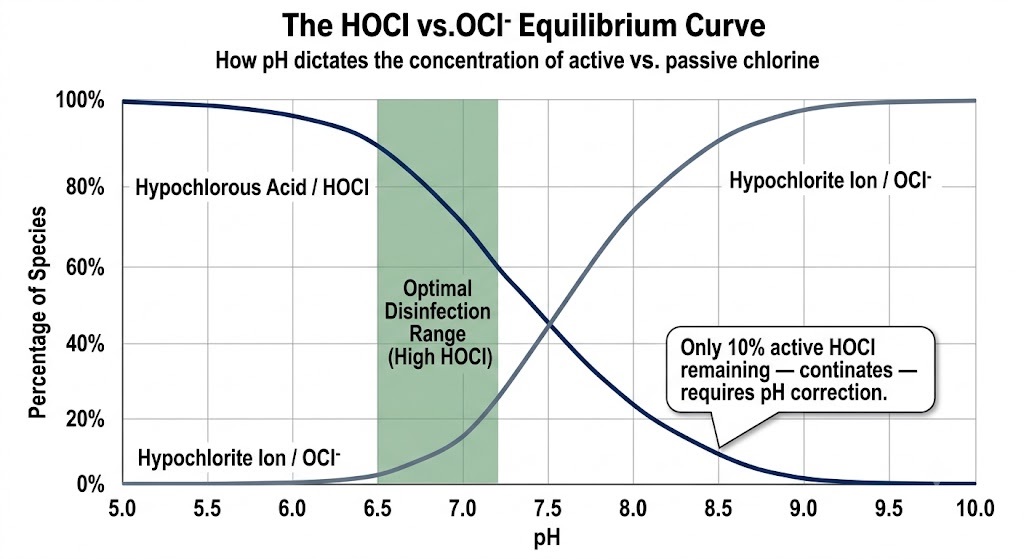
- HOCl (Hypochlorous Acid): This is the “active killer.” It is electrically neutral, allowing it to penetrate the negatively charged cell walls of bacteria and viruses with surgical precision.
- OCl- (Hypochlorite Ion): This is the “passive” form. It is negatively charged and is repelled by microbial cell walls, making it significantly less effective.
The secret to high-efficiency chlorination lies in pH Management. At a pH of 6.5, nearly 90% of the chlorine exists as HOCl. At a pH of 8.5, that number drops to 10%. For overseas specialists, the first step in optimizing a chlorination system is often the integration of an acid-injection pre-treatment stage to lower the pH, thereby maximizing the “kill power” of every gram of chlorine used.
2. Breakpoint Chlorination: The Science of Eliminating Nitrogenous Interference
A common frustration for industrial operators is the presence of “chlorine odors” and skin irritation, often incorrectly attributed to “too much chlorine.” In reality, these are signs of Combined Chlorine (chloramines), formed when chlorine reacts with ammonia or organic nitrogen.
The Four Stages of the Breakpoint Curve
- Oxidation of Reducing Agents: Chlorine is consumed by iron, manganese, and hydrogen sulfide. No disinfection occurs here.
- Chloramine Formation: Chlorine reacts with ammonia to form mono-, di-, and tri-chloramines. These are poor disinfectants.
- Chloramine Destruction: As more chlorine is added, it begins to break down the very chloramines it just created.
- The Breakpoint: This is the “Holy Grail” of water treatment. Once the breakpoint is crossed, all ammonia is oxidized, and any further chlorine added is Free Available Chlorine.
By engineering systems that reach and maintain the breakpoint, facilities can ensure 100% microbial inactivation while eliminating the unpleasant odors associated with inefficient treatment. At WATERTECH, our exhibitors specialize in the analytical sensors required to map this curve in real-time.
3. Engineering the Modern Dosing Skid: Architecture and Components
A chlorination system is only as reliable as its weakest component. For overseas projects where maintenance crews may be remote, “System Resilience” is the primary design requirement.
A. Digital Chemical Metering Pumps
The industry is moving away from traditional solenoid-driven pumps toward Stepper Motor Technology. Stepper motors provide a continuous, non-pulsating injection flow. This ensures that the chlorine is evenly distributed throughout the water stream, preventing “slugs” of high-concentration chemical that can damage sensitive downstream equipment like Reverse Osmosis (RO) membranes.
B. The Contact Tank: Redefining “Residence Time”
Disinfection is governed by the CT Value (Concentration × Time). If your contact tank allows for “short-circuiting”—where water takes a direct path from the inlet to the outlet—you are failing to meet safety standards. Modern engineers use serpentine baffled tanks or “plug-flow” reactors to ensure that every molecule of water spends the exact required time in contact with the disinfectant.into a PLC (Programmable Logic Controller), which uses a PID loop to adjust the pump speed. If the influent water suddenly becomes more contaminated, the system detects the drop in residual chlorine and automatically increases the dose.
C. Automated Residual Analyzers
Manual “drop tests” are no longer acceptable for high-tier industrial compliance. We now utilize Amperometric or Colorimetric online analyzers. These devices feed data directly Challenges: Tailoring Chlorination for Global Industry
Different industries require different chlorination philosophies. At WATERTECH, we categorize these solutions to help overseas visitors find their specific niche.
I. Municipal Drinking Water
The priority here is Distribution Network Safety. The challenge is maintaining a residual of 0.2–0.5 mg/L at the furthest tap without exceeding the regulatory limits for THMs (Trihalomethanes). This often requires “Booster Chlorination” stations located at various points in the city grid.
II. Industrial Cooling Towers
In the HVAC and Power Generation sectors, the enemy is Legionella. Chlorination must be aggressive but controlled to prevent corrosion of the galvanized steel in the tower. The use of ORP (Oxidation-Reduction Potential) controllers is the gold standard here, measuring the actual “work” being done by the chlorine rather than just its concentration.
III. Food and Beverage (F&B) Processing
For companies like Coca-Cola or Nestlé, water must be sterile for production but free of chlorine for the final product. These facilities use “High-Dose Chlorination” followed by De-chlorination via Granular Activated Carbon (GAC) or Sodium Metabisulfite. This “Kill-and-Remove” strategy ensures absolute safety without affecting the flavor profile.
5. The ESG Pivot: On-Site Hypochlorite Generation (OSHG)
One of the most significant trends we are seeing among our international visitors is the move toward On-Site Generation. Traditionally, plants had to buy high-concentration (12.5%) sodium hypochlorite, which is hazardous to store, degrades quickly in heat, and requires expensive specialized transport.
How OSHG Changes the Game
By using a process of electrolysis, OSHG systems create a low-concentration (<1%) bleach solution using only three ingredients: Salt, Water, and Electricity.
- Safety: The resulting solution is non-hazardous and does not require “Hazmat” storage permits.
- Sustainability: It eliminates the carbon footprint associated with trucking heavy chemicals across the country.
- Stability: Because the chlorine is generated on-demand, it never loses its strength, a common problem with bulk-purchased chemicals in tropical climates.
6. Managing Disinfection Byproducts (DBPs): A Regulatory Necessity
As environmental regulations tighten globally (EPA in the US, REACh in Europe, and GB standards in China), the management of DBPs like Trihalomethanes (THMs) and Haloacetic Acids (HAAs) has become a top priority. These compounds are formed when chlorine reacts with TOC (Total Organic Carbon) in the water.
The Multi-Barrier Approach
To attract overseas investment, water plants must prove they can manage DBPs. The strategy involves:
- Pre-Treatment: Using Coagulation, Flocculation, or Ultrafiltration to remove as much organic matter as possible before the chlorine is added.
- Alternative Oxidants: Using Chlorine Dioxide (ClO2) instead of standard chlorine, as ClO2 does not produce THMs.
- Post-Treatment: Using Catalytic Carbon to strip out DBPs before the water reaches the consumer.
7. Digital Transformation: The “Internet of Water” (IoT)
The final layer of modern chlorination is the Digital Twin. We are seeing a surge in demand for “Smart Skids” that can communicate with the cloud.
- Remote Diagnostics: An engineer in Germany can log into a chlorination system in a mining site in Chile to calibrate sensors or troubleshoot a pump failure.
- Predictive Maintenance: AI algorithms analyze the vibration and heat signatures of dosing pumps to predict a diaphragm failure before a leak occurs.
- Compliance Automation: Systems now generate “Electronic Data Reports” (EDRs) that are automatically sent to government regulators, ensuring that the facility never falls out of compliance.
