







In the current global industrial landscape, water is no longer viewed merely as a utility; it is a strategic asset and a significant operational risk. As we move toward 2027, the “fixed-asset” model of massive, centralized water treatment plants is being supplemented—and in some cases, replaced—by a more agile, decentralized, and modular approach.
For international project managers, municipal engineers, and industrial stakeholders, understanding the nuances of mobile water and wastewater treatment is no longer optional. It is the key to maintaining operational continuity in an era of climate volatility, shifting regulatory frameworks, and capital constraints. This comprehensive guide examines the technological, economic, and strategic dimensions of mobile water solutions, and explores why these innovations are becoming increasingly important for the future of sustainable water management.
The Macro-Economic Drivers: Why the World is Moving Toward Mobility
The global water treatment market is undergoing a seismic shift. Traditional infrastructure projects often require five to ten years from conception to commissioning. However, the modern global economy moves much faster. Several macro-factors are driving the surge in demand for mobile units:
The Volatility of Climate Change
Extreme weather events—prolonged droughts followed by flash flooding—are creating unpredictable feed-water quality for both cities and factories. When a traditional plant is overwhelmed by a sudden spike in turbidity or a drop in reservoir levels, mobile units provide the “elasticity” needed to bridge the gap without a total system failure.
The Decarbonization and ESG Mandate
Environmental, Social, and Governance (ESG) criteria are now central to corporate valuation. Companies are under immense pressure to reduce their “water footprint.” Mobile systems allow for the rapid implementation of water-reuse loops, enabling facilities to reclaim treated effluent for non-potable use, such as cooling towers or irrigation, without the need for extensive site re-permitting or major civil works.
Stringent Global Regulatory Evolution
From the tightening of PFAS “forever chemicals” regulations in North America and Europe to the “Zero Liquid Discharge” (ZLD) mandates in Asia, the legal landscape is changing. Many existing plants simply cannot be upgraded fast enough to meet new discharge limits. Mobile units offer a “plug-and-play” compliance solution that can be deployed while a permanent upgrade is being designed and built.
Technological Deep-Dive: The Mechanics of Modular Excellence
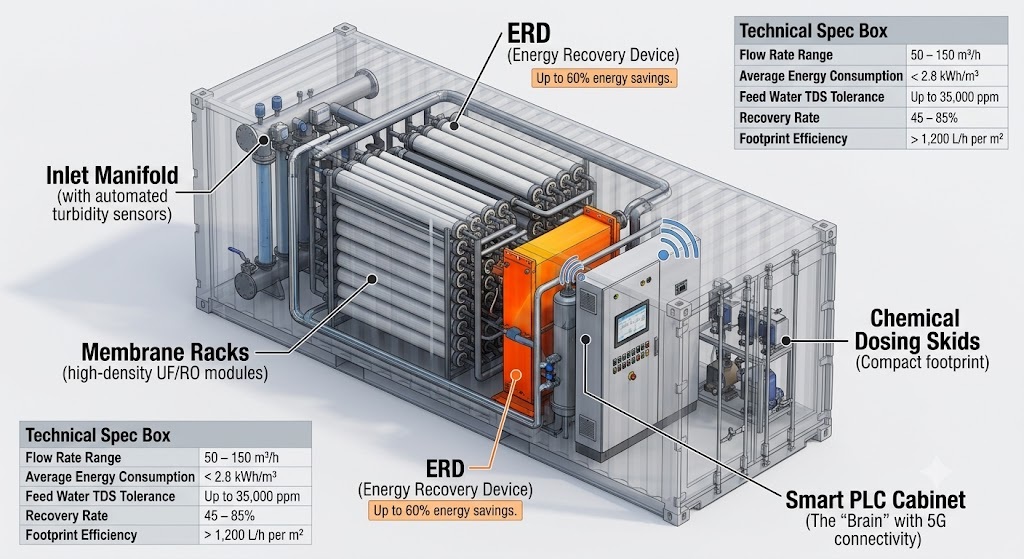
A common misconception is that mobile water treatment is a “stripped-down” version of permanent infrastructure. In reality, modern containerized systems often feature more sophisticated automation and higher-efficiency components than their stationary counterparts, due to the need to maximize throughput within a standard 20-foot or 40-foot shipping container.
Advanced Membrane Systems (UF, RO, and NF)
Ultrafiltration (UF) and Reverse Osmosis (RO) are the workhorses of the mobile sector. Contemporary mobile UF units utilize high-surface-area hollow fiber membranes that can handle high-solids loading while producing filtrate of exceptional quality. When paired with Reverse Osmosis, these systems can transform brackish water or industrial wastewater into high-purity process water.
The innovation lies in the Energy Recovery Devices (ERDs) now integrated into mobile RO units. These devices capture hydraulic energy from the high-pressure reject stream and transfer it to the feed stream, reducing power consumption by up to 60%—a critical factor for remote sites relying on diesel generators.
High-Rate Clarification and DAF
For high-turbidity applications or the removal of oils, greases, and suspended solids, Dissolved Air Flotation (DAF) and high-rate clarification units are now available in modular formats. By utilizing “inclined plate” or “lamella” technology, these units provide the settling area of a massive clarifier in a fraction of the footprint. This is particularly vital for the mining and oil & gas sectors, where site space is at a premium.
Biological Agility: MBR and MBBR
Perhaps the most significant leap has been in mobile biological treatment. Moving Bed Biofilm Reactors (MBBR) and Membrane Bioreactors (MBR) can now be housed in standard containers. These systems utilize specialized media or membranes to maintain high biomass concentrations, allowing for the effective treatment of high-strength organic wastewater (BOD/COD removal) and nutrient removal (Nitrogen and Phosphorus) in a fraction of the time required by traditional activated sludge processes.
Operational Strategies: Shifting from CAPEX to OPEX
One of the primary reasons overseas specialists are turning to mobile solutions is the financial flexibility they provide. The “Water-as-a-Service” (WaaS) model is revolutionizing how projects are funded.
Risk Mitigation through “Lease-to-Own”
For many industrial players, committing millions of dollars in Capital Expenditure (CAPEX) to a water plant is a high-risk move, especially in volatile emerging markets. Mobile solutions allow companies to utilize Operational Expenditure (OPEX) budgets. This model transfers the technical and maintenance risks to the service provider, ensuring that the facility only pays for the water it actually treats.
Rapid Deployment and Commissioning
A permanent water treatment plant can take 18–24 months to construct. A mobile unit can be shipped, installed, and commissioned in as little as 4–8 weeks. For a mining operation or a power plant, every day of delay represents millions in lost revenue. The speed of mobile deployment provides a “time-value” that far outweighs the slightly higher unit cost of treated water.
Pilot Testing and Scaling
Mobile units serve as the ultimate “Proof of Concept.” Before a multinational corporation invests in a $50 million wastewater facility, they can deploy a mobile pilot plant to treat the actual site water for six months. This generates “real-world” data on membrane fouling rates, chemical consumption, and sludge production, allowing the final permanent plant to be engineered with surgical precision.
Industry-Specific Applications: Real-World Impact
To truly appreciate the depth of mobile water treatment, one must look at how it is applied across diverse global sectors:
The Power Generation Sector
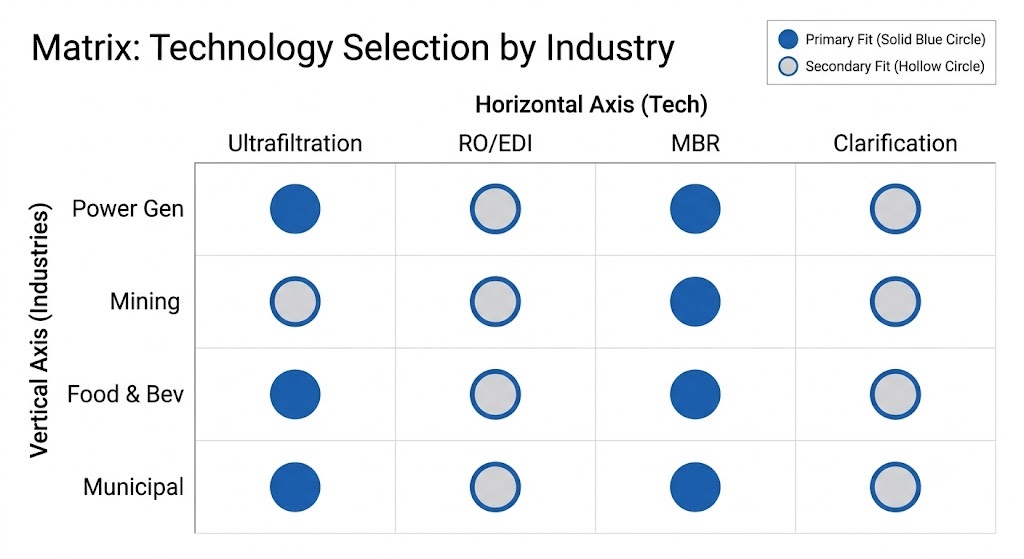
Power plants require massive volumes of high-purity demineralized water for boiler feed. During seasonal peaks or when a permanent demineralization plant undergoes maintenance, mobile ion-exchange or RO/EDI (Electrodeionization) trailers are essential to prevent a total grid shutdown.
Disaster Recovery and Humanitarian Aid
In the wake of natural disasters, the first priority is potable water. Mobile, solar-powered desalination units can be airlifted into disaster zones, providing thousands of liters of safe drinking water from seawater or contaminated wells, independent of the local power grid.
The Mining and Minerals Industry
Mining sites are often located in water-stressed, remote regions. Mobile units allow these operations to “follow the ore.” As a mine site moves, the water treatment infrastructure moves with it, ensuring that environmental discharge standards are met throughout the lifecycle of the mine.
Integrating Intelligence: IoT and Remote Monitoring
The “Specialist” of today knows that the value of a mobile unit is not just in the pipes and pumps, but in the data. Modern mobile fleets are integrated with Global Positioning Systems (GPS) and cloud-based SCADA (Supervisory Control and Data Acquisition) systems.
This allows a central engineering team in Shanghai or London to monitor the performance of a unit in the middle of a desert in real-time. Predictive maintenance algorithms can detect a drop in membrane pressure or a change in chemical dosage requirements before they lead to a system failure. This “Digital Twin” capability ensures that mobile units operate at peak efficiency with minimal on-site human intervention.
The Engineering Challenges: What to Look for in a Provider
When sourcing mobile solutions on a global scale, overseas specialists must look beyond the price tag. Several critical engineering factors determine the success of a mobile deployment:
- Materials of Construction: For coastal or high-salinity environments, the use of high-grade stainless steel (316L or Duplex) and UV-resistant coatings is non-negotiable to prevent corrosion.
- Logistics Compatibility: The units must be designed according to ISO shipping standards to ensure they can be transported via standard container ships, rail, and trucks without requiring “oversized load” permits.
- Climate Adaptation: A unit designed for a temperate climate will fail in the extreme heat of the Middle East or the freezing cold of Northern Canada. Specialized HVAC systems and insulation for the control cabinets are essential design features.
- Ease of Integration: The best mobile units feature “universal” connection points (flanges, cam-locks) and programmable logic controllers (PLCs) that can easily communicate with the existing plant’s distributed control system (DCS).
The Future of Global Water: Modular, Circular, and Connected
As we look toward the end of this decade, the distinction between “temporary” and “permanent” water treatment is blurring. We are entering the age of “Hybrid Infrastructure,” where a core permanent facility is supplemented by a fleet of mobile units that scale up or down based on demand.
This modularity is the cornerstone of the Circular Economy. By deploying mobile units, cities can begin to treat wastewater at the source—in neighborhoods or industrial parks—and reuse it immediately for local cooling or irrigation, rather than pumping it miles away to a massive central plant. This saves energy, reduces piping infrastructure costs, and creates a more resilient urban water cycle.

