







In the high-stakes arena of global water management, the narrative is shifting. For decades, expanding capacity meant building new infrastructure—large-scale, capital-intensive projects designed to serve growing urban populations. Today, however, aging assets, tighter budgets, and sustainability goals are reshaping investment priorities. Rather than replacing entire systems, utilities and industrial operators are increasingly embracing strategic retrofits to extend asset life, improve efficiency, and strengthen operational resilience.
This transition is driven by a convergence of global pressures: land scarcity in hyper-urbanized zones, the urgent mandate for carbon neutrality, and the tightening of environmental discharge regulations across the European Union, North America, and the Asia-Pacific region. For the forward-thinking water professional, the question is no longer how to build bigger, but how to engineer smarter within the existing structural framework.
At WATERTECH, we view retrofitting not as a temporary fix, but as a sophisticated discipline that combines mechanical precision with digital intelligence. By optimizing existing infrastructure, we can achieve performance levels that rival or exceed those of new facilities, but at a fraction of the environmental and economic cost. The following analysis explores the multifaceted benefits of this approach and why it has become the cornerstone of sustainable water governance worldwide.
The Evolution of Hydraulic Efficiency and Internal Optimization
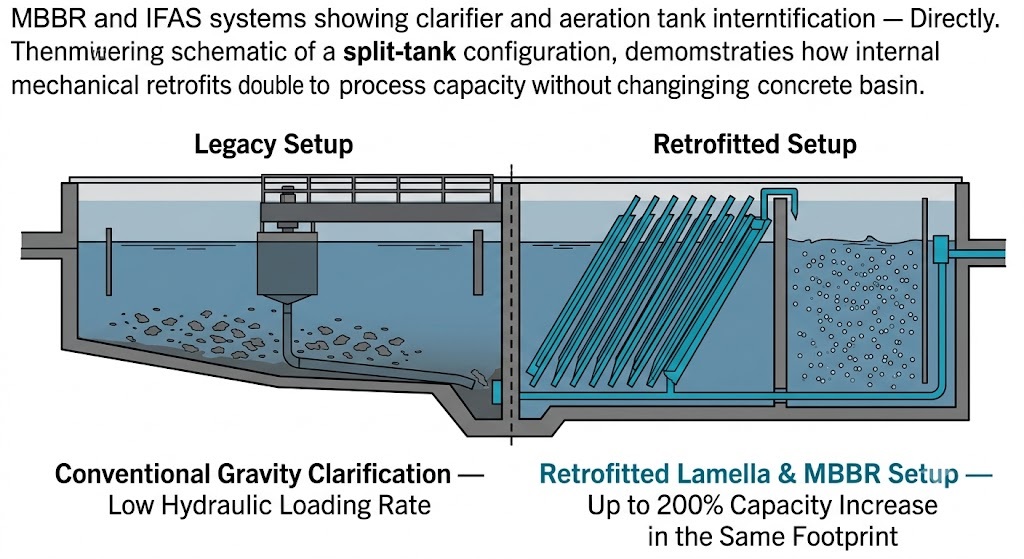
The most immediate challenge facing many legacy treatment plants is the mismatch between their original design capacity and current demand. Population growth and industrial intensification have pushed many facilities to their hydraulic limits. Traditionally, the solution was to construct additional basins—a process that is often prohibited by space constraints and bureaucratic hurdles.
Retrofitting offers a more elegant solution: the intensification of the treatment process itself. By focusing on the internal mechanics of clarifiers and settling tanks, engineers can dramatically increase throughput. The installation of advanced inclined plate settlers, or lamella technology, is a prime example. These systems increase the effective settling area within the same physical footprint, allowing for higher flow rates while simultaneously improving effluent clarity.
Beyond simple settling, we are seeing a massive global trend in the integration of specialized media and membrane systems into existing biological stages. By converting a standard activated sludge process into a Moving Bed Biofilm Reactor (MBBR) or an Integrated Fixed-film Activated Sludge (IFAS) system, plants can significantly increase their biomass concentration. This allows them to treat more high-strength waste or handle higher volumes without expanding the tankage. This “de-bottlenecking” strategy is essential for overseas operators who must meet the demands of growing urban centers while working within the confines of historical infrastructure.
Navigating the Energy-Water Nexus and Carbon Neutrality
Energy consumption remains the primary operational cost for water and wastewater treatment facilities. As global energy prices fluctuate and the “Net Zero” mandate becomes a legal requirement in many jurisdictions, the energy efficiency of water infrastructure has become a top-tier priority. A strategic retrofit is the most effective way to address the “Energy-Water Nexus.”
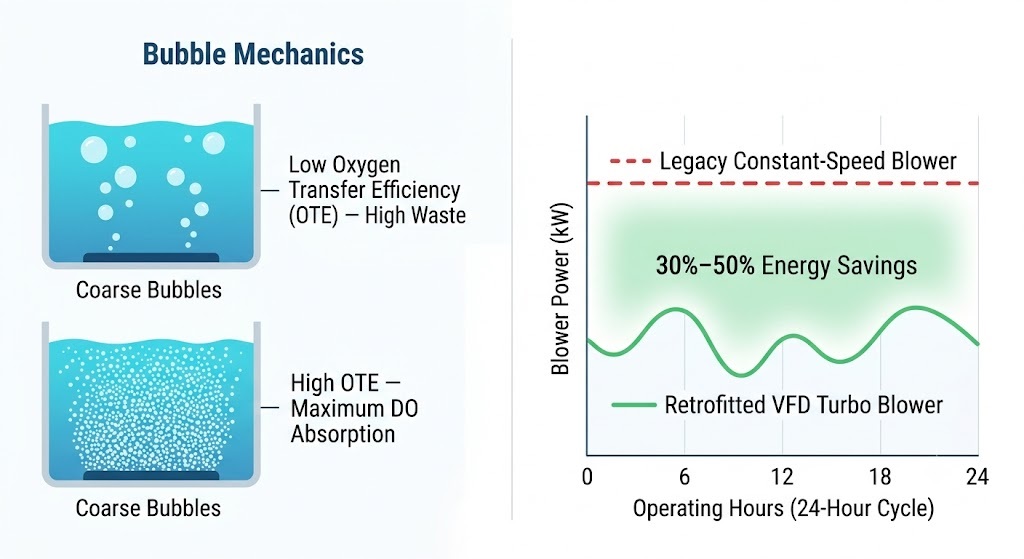
The vast majority of energy in a wastewater plant is consumed by aeration—the process of pumping air into tanks to support biological growth. Legacy systems often rely on coarse-bubble diffusers and outdated blowers that are inherently inefficient. A professional retrofit replaces these with ultra-fine-bubble aeration systems and high-efficiency turbo blowers. When these mechanical upgrades are paired with Variable Frequency Drives (VFDs), the results are transformative. We have seen international projects achieve energy reductions of 30% to 50% almost immediately upon commissioning.
Furthermore, the concept of the treatment plant is evolving from a “disposal site” to a “resource recovery center.” Retrofitting existing anaerobic digesters with advanced mixing systems and thermal hydrolysis can significantly boost biogas production. This biogas can then be harvested and converted into renewable heat and power, effectively turning a facility into a self-sustaining energy producer. For our global partners, this isn’t just about environmental stewardship; it is about shielding their operations from the volatility of global energy markets and creating a resilient, circular economy.
Material Science and the Prolongation of Structural Integrity
Infrastructure is a battle against the elements. Water treatment environments are inherently corrosive, characterized by high humidity, fluctuating pH levels, and the presence of aggressive gases like hydrogen sulfide. For many older plants, the mechanical components have reached the end of their design life, even if the concrete structures remain sound.
The modern approach to retrofitting leverages significant advancements in material science. We are no longer limited to standard carbon steel or basic coatings. Today’s retrofits utilize high-grade stainless steels, specialized duplex alloys, and increasingly, fiber-reinforced polymers (FRP). These materials offer superior resistance to corrosion and wear, ensuring that the “new” internals of an old plant can last for another quarter-century or more.
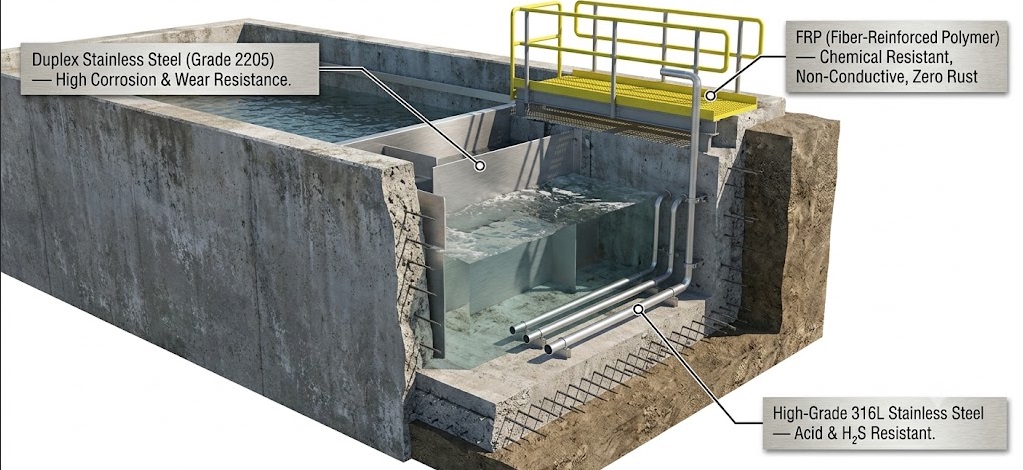
This focus on structural longevity is a key component of Life Cycle Cost Analysis (LCCA). By replacing high-wear parts with modern materials, operators can drastically reduce the frequency and cost of maintenance. This is particularly critical for overseas facilities located in remote areas or in regions where specialized labor is expensive. A plant that is “built to last” through a high-quality retrofit provides a level of operational peace of mind that is invaluable to stakeholders and investors alike.
Digital Integration and the Rise of the Intelligent Water Plant
Perhaps the most exciting frontier in retrofitting is the “Digital Layer.” We are moving beyond purely mechanical upgrades into the realm of the “Smart Water” plant. A digital retrofit involves the integration of sophisticated sensors, IoT (Internet of Things) connectivity, and AI-driven control systems into existing infrastructure.
Many legacy plants operate on a “static” model—processes are set to handle average conditions and are rarely adjusted in real-time. This leads to the over-dosing of chemicals and the wasting of energy. By retrofitting a plant with real-time monitors for dissolved oxygen, nutrient levels, and turbidity, we can create a dynamic control loop. Automation systems can then adjust aeration rates or chemical feeds in response to the actual characteristics of the incoming water, second by second.
The ultimate expression of this is the “Digital Twin”—a virtual model of the physical plant that uses real-time data to predict performance and simulate “what-if” scenarios. For the overseas specialist, this technology is a game-changer for remote management. A utility in Europe can monitor and optimize the performance of its assets in Southeast Asia or South America from a single dashboard. This level of oversight ensures consistent compliance with international standards and allows for predictive maintenance, catching potential failures before they lead to costly downtime or environmental incidents.
Regulatory Future-Proofing and the Challenge of Emerging Contaminants
The regulatory landscape for water treatment is not static; it is a tightening spiral. Standards that were considered “best practice” a decade ago are now the bare minimum. From the EU’s strict directives on nitrogen and phosphorus removal to the global concern over “forever chemicals” like PFAS and microplastics, water professionals are under constant pressure to improve effluent quality.
A complete plant replacement to meet a new regulation is rarely financially feasible. Retrofitting provides the surgical precision needed to target specific pollutants. We are seeing a surge in “bolt-on” retrofit technologies—modular units that can be integrated into existing process flows to provide advanced tertiary treatment. This might include Granular Activated Carbon (GAC) systems, Advanced Oxidation Processes (AOP), or high-flux membrane filtration.
By adopting a modular approach to retrofitting, utilities can “future-proof” their assets. Instead of a monolithic design that is difficult to change, a retrofitted plant can be adapted as new regulations emerge. This flexibility is a critical advantage in an era of environmental uncertainty. It allows for a “step-wise” investment strategy, where capital is deployed strategically over time to meet evolving standards without the shock of a single, massive construction project.
The Economic Logic: Maximizing ROI and Preserving Capital
In the final analysis, the shift toward retrofitting is driven by hard economics. For municipal governments and private industrial clients alike, capital is a finite resource. The Return on Investment (ROI) for a retrofit is almost always superior to that of a new build for several reasons.
First, the civil engineering costs—excavation, concrete work, and basic infrastructure—are already “sunk costs.” By reusing these assets, the majority of the new investment is directed toward high-value technology and equipment rather than labor and raw materials. Second, the timeline for a retrofit is significantly shorter. A new plant can take five to ten years from conception to commissioning, factoring in land acquisition, environmental impact studies, and construction. A retrofit can often be completed in months or a few years, and frequently in phases that do not require a total plant shutdown.
For overseas investors and development banks, this speed-to-market is vital. It means that environmental improvements and operational savings are realized much sooner. It also minimizes the risk associated with long-term construction projects, such as material price inflation or shifting political climates. Retrofitting is the most fiscally responsible path to modernization, allowing for the continuous evolution of infrastructure in a way that is both sustainable and profitable.
Strategic Resilience in a Volatile Global Climate
As we look toward the future, the resilience of our water infrastructure will be tested by more than just demand and regulation. Climate change is introducing new variables: more frequent and severe storm events, rising sea levels affecting coastal discharge, and prolonged droughts that necessitate water reuse.
Retrofitting is the primary tool for building this resilience. It allows us to harden existing plants against extreme weather, install better flood protection, and—most importantly—integrate water recycling technologies. The ability to treat wastewater to a standard where it can be reused for industrial or agricultural purposes is no longer a luxury; it is a survival strategy for many regions. Retrofitting existing facilities with the membranes and disinfection systems necessary for water reuse is the fastest way to bridge the gap between water supply and demand.
As an overseas specialist, I have seen that the most successful water utilities are those that treat their infrastructure as a living, evolving system. They do not wait for a plant to fail before acting. Instead, they engage in a program of continuous improvement, utilizing retrofitting to stay ahead of the curve. This proactive mindset is what separates the leaders in our industry from the laggards.

