







The global water industry is currently navigating one of its most complex challenges to date: the pervasive presence of per- and polyfluoroalkyl substances (PFAS). Often referred to as “forever chemicals,” these synthetic compounds are characterized by their extreme persistence in the environment and their ability to bioaccumulate in the human body.
As international regulatory bodies—from the US EPA to the European Chemicals Agency (ECHA)—drastically lower the maximum contaminant levels (MCLs) to the parts-per-trillion range, the pressure on municipal water authorities has reached a critical juncture. To meet these standards without compromising fiscal stability, we must shift from a reactive mindset to a proactive, holistic strategy.
The Regulatory Paradigm Shift: From Detection to Zero-Tolerance
For the past decade, the industry’s primary focus was on detection and monitoring. However, as medical research increasingly links PFAS exposure to adverse health outcomes, the regulatory landscape is shifting toward a “zero-tolerance” framework.
For overseas municipal directors, this shift introduces significant operational risks. Traditional wastewater treatment plants were not designed to break the carbon-fluorine bond—the strongest in organic chemistry. Consequently, standard treatment often results in PFAS simply being transferred from water to sludge, creating a secondary contamination loop. Achieving true compliance requires an integrated approach that addresses the chemical’s lifecycle from source to discharge.
Swimming Upstream: The Logic of Source Control
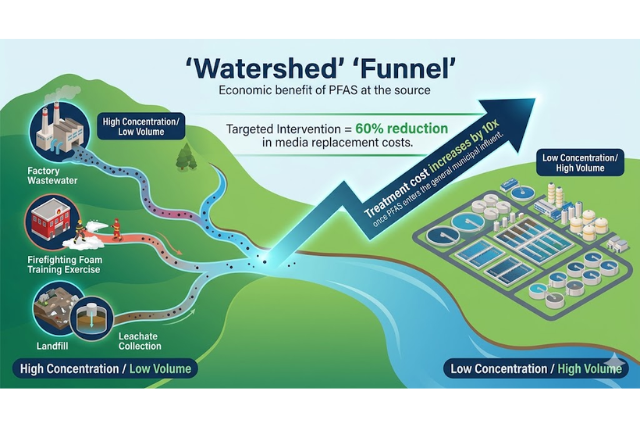
The most sustainable way to manage PFAS is to prevent its entry into the municipal stream. This is what we call “swimming upstream.” By the time PFAS reaches a large-scale municipal treatment facility, it is often diluted and mixed with other organic matter, making removal exponentially more expensive and energy-intensive.
A professional upstream strategy involves:
- Industrial Water Forensics: Utilizing advanced analytical chemistry to trace PFAS signatures back to specific industrial discharge points (such as textile mills, semiconductor fabs, or firefighting foam test sites).
- Pre-treatment Mandates: Implementing strict localized treatment requirements for industrial players before they discharge into the municipal sewer system.
- Watershed Collaboration: Partnering with regional environmental agencies to map the movement of PFAS through groundwater and surface water, allowing for targeted intervention at the highest concentrations.
By reducing the influent concentration, municipalities can significantly extend the life of their downstream filtration media, shifting the financial burden back to the producers rather than the taxpayers.
The Technological Stack: Deploying a Multi-Barrier Defense
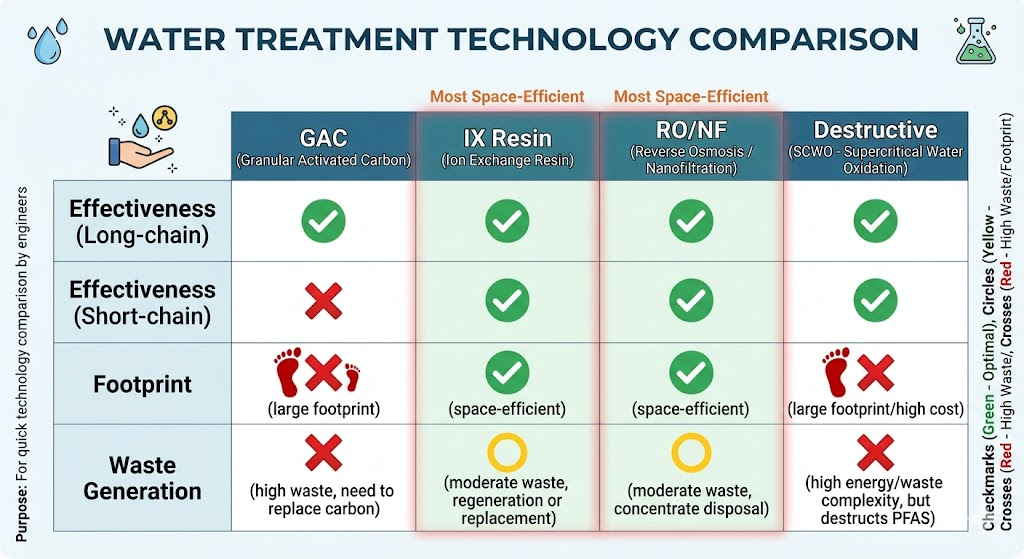
While upstream control is vital, downstream treatment remains the “last mile” of public safety. No single technology is a panacea for the wide variety of PFAS chain lengths found in modern water. Professional treatment now requires a tiered, multi-barrier approach:
1. Granular Activated Carbon (GAC): While excellent for long-chain PFAS, GAC requires large footprints and frequent thermal reactivation. It remains the baseline for many large-scale municipal operations.
2. Ion Exchange (IX) Resins: Specialized resins offer higher selectivity and faster kinetics than GAC, allowing for smaller vessel footprints—a critical factor for urban plants with limited space.
3. High-Flux Reverse Osmosis (RO) & Nanofiltration (NF): Membrane technology provides the most comprehensive physical barrier. The challenge lies in the management of the resulting brine concentrate, which contains highly concentrated PFAS levels.
4. Emerging Destruction Technologies: The industry is moving toward “mineralization.” Innovations such as Supercritical Water Oxidation (SCWO), plasma treatment, and electrochemical oxidation are showing promise in actually destroying the PFAS molecule, rather than just sequestering it.
Optimization through Digitalization and AI
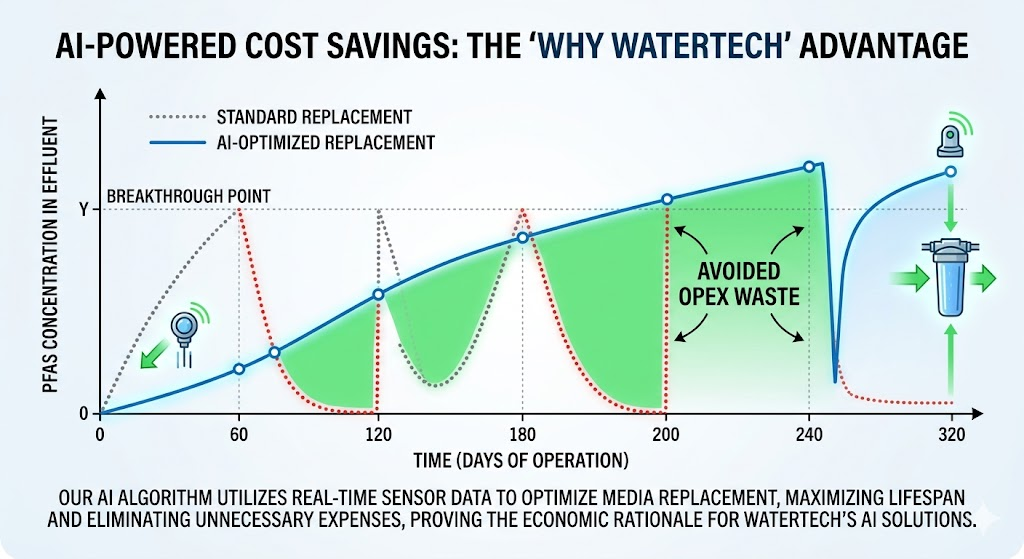
In an era of rising operational expenditure (OPEX), digital tools are becoming indispensable. Advanced sensors and AI-driven predictive modeling allow plant operators to monitor “breakthrough” points in carbon filters or resin beds in real-time. By optimizing the change-out cycles of filter media, municipalities can reduce waste and ensure they are only spending capital when strictly necessary. This “Smart Water” approach is the bridge between regulatory compliance and economic viability.
From PFAS Treatment to Long-Term Resilience
Managing PFAS is no longer a question of choosing a single treatment technology. As regulatory requirements become more stringent and the costs of remediation continue to rise, municipal water authorities need to approach PFAS as a complete lifecycle challenge—from preventing contamination at the source to optimizing treatment and managing concentrated waste responsibly.
The most resilient water systems will therefore combine upstream source control, multi-barrier treatment, continuous monitoring, and data-driven optimization. This integrated approach can help municipalities reduce treatment costs, extend the service life of treatment media, minimize secondary waste, and respond more effectively as contaminant profiles and regulatory requirements evolve.
Ultimately, the PFAS challenge is pushing municipal water management toward a more proactive and interconnected model. Future-ready utilities will not simply react when contaminants reach the treatment plant; they will use data, technology, and coordinated watershed management to identify risks earlier, intervene more strategically, and build water systems capable of adapting to an uncertain regulatory and environmental future.

