







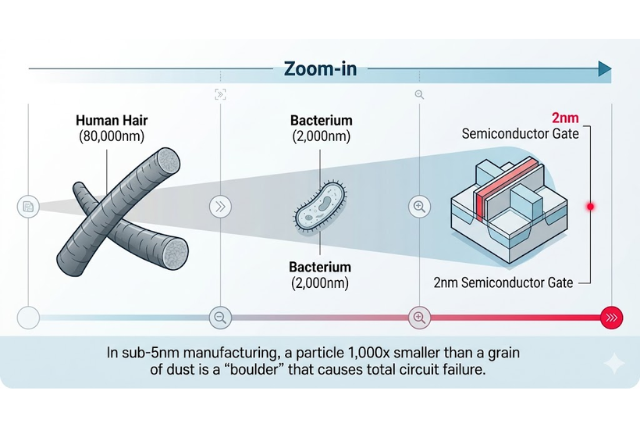
In the high-stakes arena of microelectronics, the difference between a market-leading processor and a wasted silicon wafer often comes down to a single molecule. As the global semiconductor industry pivots toward sub-5nm architectures and AI-driven hardware, Ultrapure Water (UPW) has transitioned from a basic utility to a critical strategic asset.
For international stakeholders in the water treatment sector, understanding the evolution of UPW is no longer just about chemistry—it is about ensuring the resilience of the global digital supply chain.
The Precision Paradox: When “Pure” is a Contaminant
In the world of advanced lithography, standard purified water is considered “dirty.” As circuit densities increase, the sensitivity of the manufacturing process reaches a molecular level.
To achieve high-yield production, UPW must be stripped of virtually all ions, silica, and organic carbons (TOC). Even a microscopic particle, invisible under standard magnification, can act as a catastrophic obstruction during the Chemical Mechanical Planarization (CMP) process. For overseas manufacturers and investors, the message is clear: Water quality is the ultimate gatekeeper of chip yield. Failure to maintain 18.2 MΩ·cm resistivity doesn’t just result in defects; it results in millions of dollars in lost throughput.
The Role of UPW in the 2nm Era: Immersion and Integration
We are entering the era of Extreme Ultraviolet (EUV) Lithography and advanced immersion techniques. Here, UPW serves a dual purpose. Beyond acting as the world’s most efficient cleaning solvent, it functions as a refractive medium. By replacing the air gap between the lens and the wafer with high-purity water, manufacturers can achieve a higher numerical aperture, allowing for finer resolution of circuits. This technical requirement has turned water treatment specialists into essential partners in the R&D process of the world’s leading foundries.
The Sustainability Frontier: Balancing Purity and ESG
The greatest challenge facing the industry today is the Water-Energy-Nexus. Producing UPW is inherently resource-intensive. As global ESG (Environmental, Social, and Governance) mandates tighten, the microelectronics industry faces a paradox: How do you increase water purity while decreasing environmental impact?
The focus has shifted toward Circular Water Economies. Leading-edge facilities are now integrating:
- High-Recovery RO Systems: To minimize brine waste.
- Advanced Reclaim Loops: Recycling up to 90% of process water back into the UPW makeup stream.
- Energy-Efficient Deionization: Utilizing next-generation Electrodeionization (EDI) to reduce the carbon footprint of the treatment plant.
Bridging the Gap: The Convergence of Technology and Scale
For the international water treatment community, the rapid expansion of semiconductor “Mega-fabs” represents a unique opportunity for cross-border collaboration. The complexity of these systems requires a synergy of membrane technology, ion exchange resins, and real-time analytical monitoring that can only be achieved through a globalized supply chain.
Beyond Purity: Building Resilient Water Systems for the Semiconductor Industry
The growing complexity of semiconductor manufacturing is making ultrapure water more than a process utility—it is becoming a strategic component of manufacturing resilience. As chip architectures become more advanced and fabrication facilities continue to scale, the ability to consistently produce, monitor, and recover UPW will increasingly influence both operational efficiency and production reliability.
At the same time, the future of UPW cannot be defined by purity alone. Semiconductor manufacturers must balance increasingly stringent water-quality requirements with rising pressure to reduce freshwater consumption, energy use, and wastewater generation. This is driving a shift toward high-recovery treatment systems, advanced water reclamation, intelligent monitoring, and more efficient deionization technologies.
Ultimately, the next generation of semiconductor water management will be defined by the ability to achieve both extreme purity and greater resource efficiency. By integrating advanced treatment technologies with real-time monitoring and circular water strategies, manufacturers can build water systems that are not only capable of meeting the demands of today’s most advanced chips, but are also resilient enough to support the semiconductor industry’s continued growth.

