







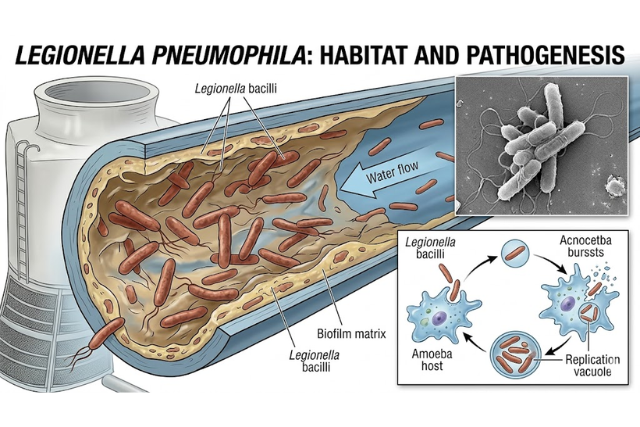
In the global water treatment sector, the focus has shifted from mere “supply” to “security.” As urban density increases and building systems grow in complexity, the risk of Legionella pneumophila has evolved from a maintenance concern into a high-stakes liability. For the international engineering community, the solution lies at the intersection of fluid dynamics, thermal precision, and digital intelligence.
The Bio-Dynamics of Risk: Beyond Simple Stagnation
Legionella is not merely a resident of stagnant water; it is a master of the biofilm ecosystem. Within complex piping networks, low-flow areas allow for the formation of biological matrices that protect bacteria from thermal shocks and chemical disinfectants.
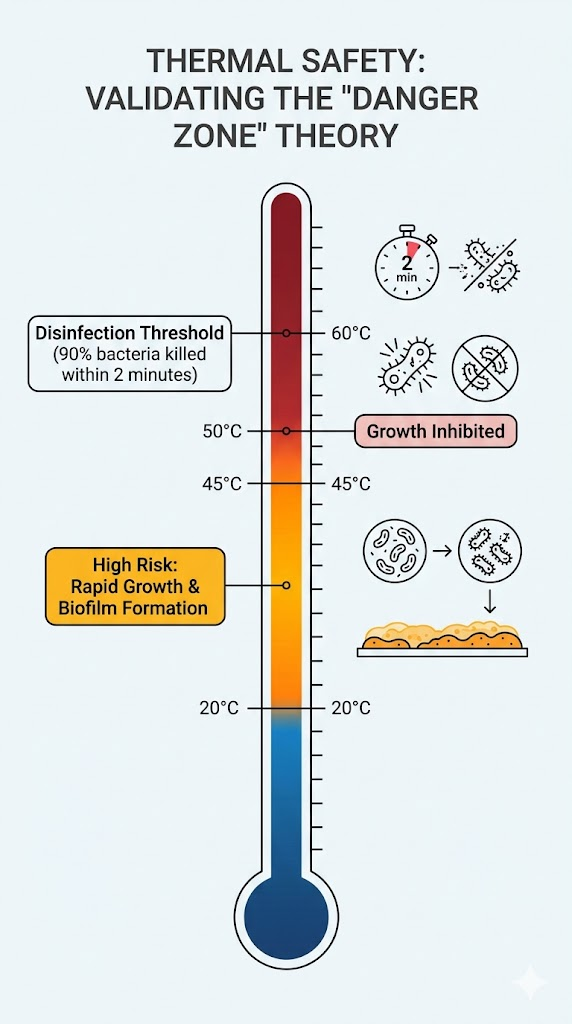
The primary catalyst for this risk is thermal stratification. Without aggressive and consistent circulation, water in large-scale facilities—such as hospitals, hotels, and high-rise residences—naturally separates into temperature layers. The “Danger Zone” (20°C–45°C) becomes a permanent fixture in the system’s periphery. To mitigate this, engineers must design for “Total Loop Integrity,” ensuring that no single branch of the system falls below the required biocidal temperature.
Precision Engineering: The Role of Hydraulic Balancing
One of the most overlooked aspects of Legionella prevention is Hydraulic Balancing. In large-scale domestic hot water (DHW) systems, water naturally takes the path of least resistance. This often results in the closest loops receiving high-velocity, high-temperature water, while the “remote” ends of the system suffer from sluggish flow and temperature drop.
Modern circulation solutions now incorporate automatic hydraulic balancing. By utilizing pressure-independent valves and smart-sensor pumps, the system can dynamically redistribute flow based on real-time temperature demands. This ensures that even the most distant outlet maintains the 50°C+ return temperature required to inhibit bacterial growth, all while reducing the mechanical stress on the pumping infrastructure.
The Energy-Safety Paradox: Navigating ESG Requirements
For the overseas specialist, the modern challenge is twofold: maintaining rigorous safety standards while adhering to increasingly strict ESG (Environmental, Social, and Governance) and energy-efficiency regulations.
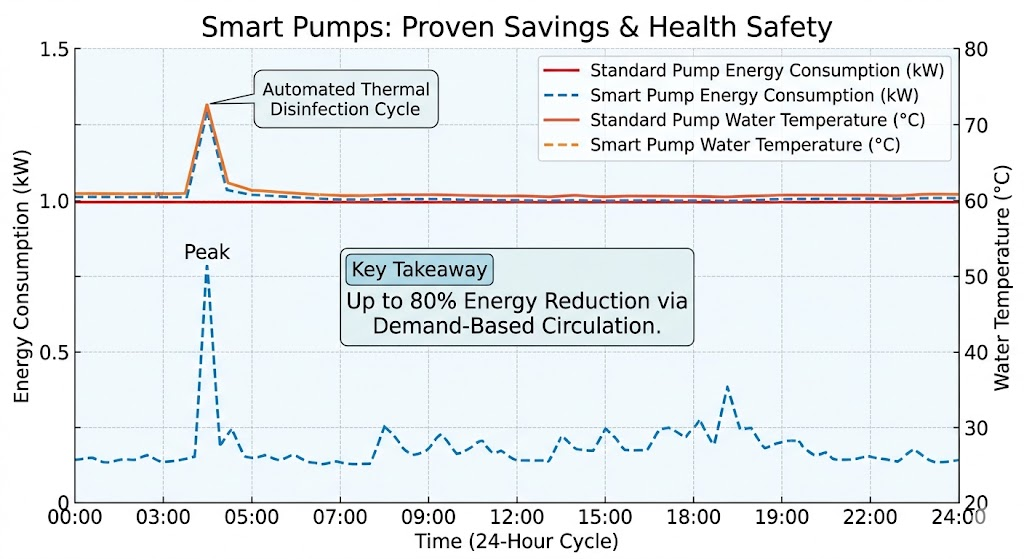
Traditional “constant speed” pumping is no longer viable in a high-cost energy market. The industry has pivoted toward Intelligent Control Modes. These systems utilize “Green-Button Technology” and ECC (Electronic Commutation) motors to reduce energy consumption by up to 80% compared to unregulated pumps. By using “Thermal Disinfection Recognition,” the pump only ramps up to maximum performance when it detects the boiler’s disinfection cycle, balancing peak safety with minimal carbon footprint.
Water 4.0: IoT and Predictive Pathogen Management
We are entering the era of Water 4.0, where the pump acts as a sophisticated data node. For international facility managers, the ability to monitor water health remotely is a game-changer.
- Real-time Telemetry: Pumps now feed data directly into Building Management Systems (BMS) via Modbus or BACnet, tracking temperature fluctuations and flow irregularities.
- Predictive Maintenance: AI-driven algorithms can identify a drop in circulation efficiency before it leads to a Legionella outbreak, allowing for preemptive flushing or system adjustment.
- Digital Documentation: Automated logging of thermal disinfection cycles provides the “Duty of Care” documentation required by international health regulators (such as CIBSE, ASHRAE, or VDI).
Global Standardization and the Future of Fluid Technology
As global standards continue to evolve, the demand for modular, high-compliance components is increasing. Whether it is WRAS approval in the UK, KTW requirements in Germany, or NSF standards in North America, material safety is becoming an increasingly important part of hygienic water system design. Components must not only withstand demanding operating conditions but also minimize the risk of supporting bacterial growth, with materials such as stainless steel and high-grade polymers playing an important role.
Ultimately, effective Legionella prevention requires more than maintaining a high water temperature. It depends on treating the entire hot water circulation system as an integrated safety network—combining hydraulic balance, thermal control, energy-efficient pumping, continuous monitoring, and predictive maintenance. As buildings become more complex and water safety requirements continue to evolve, intelligent circulation systems will play an increasingly important role in protecting public health while improving energy and operational efficiency.
The future of hygienic water management lies in making every part of the system work together: keeping water moving, maintaining the right conditions, identifying risks early, and responding before they become failures. This shift from reactive maintenance to proactive system management is set to redefine how large-scale hot water systems are designed, operated, and maintained.

